QQ vs AKs: Preflop Odds & Equity
Pocket queens are about a 53% favorite over AKs all-in preflop — the classic race, just a hair closer than versus offsuit AK. Here are the exact QQ-vs-AKs equities.
On this page · 7 sections
You get Q♠ Q♥ all-in against A♣ K♣. This is the premium version of the race: a big pair against two suited overcards. Queens are a slim favorite at about 53%, with suited AK winning around 47%. It’s a coinflip you’ll take gladly, but the suited AK makes it a touch closer than the offsuit version, and knowing the difference matters.
The headline equity
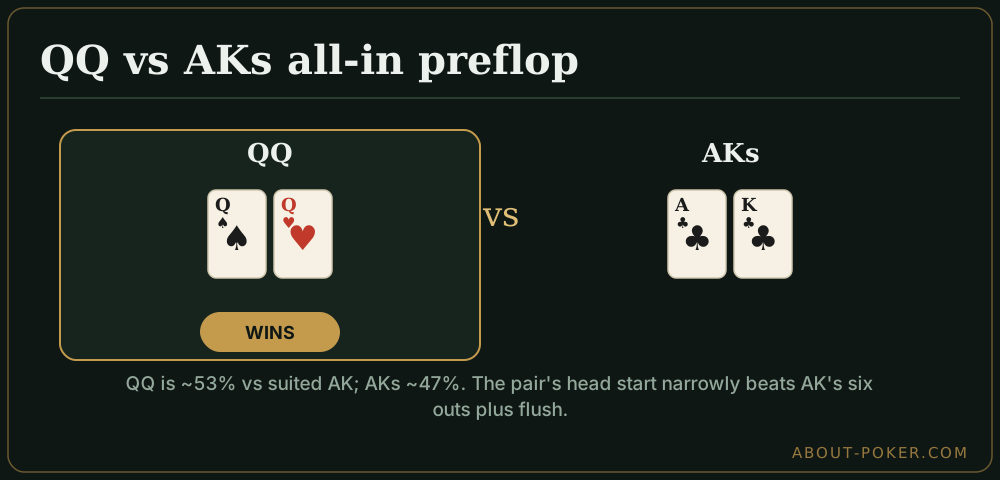
All-in preflop, pocket queens are about a 53% favorite over suited AK, with AKs winning around 47%. Against offsuit AK, queens edge up to roughly 54% because AK loses its flush outs.
| Matchup | QQ equity | AK equity |
|---|---|---|
| QQ vs AK suited | ~53% | ~47% |
| QQ vs AK offsuit | ~54% | ~46% |
The anchor: pair versus two overcards is a ~53/47 race when the overcards are suited — a real but tiny edge for the queens.
Where AKs’s 47% comes from
Suited AK has no pair yet, so it draws to catch up. It has more ways to do that than an offsuit AK:
- Pair the ace or king: three aces and three kings remain, giving AK six clean outs to top pair. This is the bulk of its equity.
- Flushes: because both cards share a suit, AKs can make a flush, adding the roughly one point of equity that separates it from offsuit AK.
- Straights: AK reaches for broadway and other straights, contributing a modest slice.
Add those up and suited AK lands at about 47% — just shy of a true coinflip. Being able to tally these overlapping outs quickly is the skill in the poker outs guide.
Why the queens stay ahead
Queens don’t need to improve — on a board like 9♦ 7♣ 2♠, they’re already the best hand and AK has missed. AK must catch one of its outs; the queens only have to survive. Starting as the made hand is worth a few percentage points, which is why even suited AK, with all its outs, can’t quite pull even. The suit just trims the gap from about 54/46 to 53/47. That trade-off — a made hand’s head start versus a drawing hand’s extra outs — is the essence of equity.
A worked example
Effective stacks are 35 big blinds. You open Q♠ Q♥, an opponent three-bet jams A♣ K♣, and you call. You’re a 53% favorite for the pot.
If the pot after the shove is 72 big blinds, your call is profitable: you win it 53% of the time, lose 47%. But the edge is razor-thin — this is essentially a coin toss, so expect to lose it almost half the time without having made any error. Treating a near-flip like a guaranteed win is a classic way to misread variance, and the preflop all-in odds framework exists to keep those expectations grounded.
Why calling can be right even when it’s close
A 53/47 spot barely wins the pot on average, so why is calling often correct — sometimes even when you’re getting it in behind? The answer is dead money and pot odds. When your opponent jams, the blinds, antes, and any prior bets are already in the middle, and you don’t have to be a favorite to profit — you only have to win often enough to cover the price of the call.
Work a quick version. Suppose you’ve posted and there’s 8 big blinds of dead money out there, and the opponent shoves 35 into it. You’re calling 34 to win a pot that will be about 78. Your break-even is call / (call + pot after your call), which is roughly 34 / 112, or about 30%. With 53% equity you clear that bar with enormous room to spare. This is the core reason big pairs love to get it in against AK-type ranges: even in a near-flip, the pre-existing money tilts the call strongly profitable. The closer the raw equity, the more the dead money is doing the work, which is exactly why folding QQ preflop here would be a large mistake despite the coinflip feel.
How stack depth reframes the matchup
The 53/47 equity never changes, but its importance does as stacks get deeper or shallower. Shallow — 20 big blinds and under — this is a trivial get-it-in. There’s no postflop to speak of, the pair’s raw edge plus dead money makes stacking off clearly correct, and both QQ and AK are thrilled to race.
Deep — 100 big blinds or more — the calculus shifts, and getting all-in preflop is often not the goal for either side. With QQ you’d frequently prefer to keep the pot smaller and avoid stacking off against the top of a tight range that also contains KK and AA, hands that crush you. AK deep, meanwhile, plays beautifully postflop precisely because it flops top pair with the best kicker and can realize its equity across streets rather than settling for its 47% share in one shot. So the same numbers push toward “jam it in” when short and “play poker” when deep. For the sister spot with unpaired big cards on both sides, see AJ vs KQ.
The takeaway
QQ versus AKs is the race in its most premium form: a big pair holding a slim edge over two live, suited overcards. The suit closes the gap slightly — from 54/46 to about 53/47 — but the queens stay ahead as the made hand. Lock in the anchor — QQ is ~53% over AKs — and treat it as a coinflip you’re happy to take. Build the surrounding skills through equity, counting outs, and the poker odds & math hub.
Frequently asked
What are the odds of QQ vs AKs preflop?
Pocket queens are about a 53% favorite over suited AK all-in preflop, with AKs winning around 47%. Against offsuit AK, queens are a touch better at about 54%. It's the classic coinflip, just fractionally closer when AK is suited.
Does AK being suited change QQ vs AK much?
Only slightly. Suited AK adds flush equity, moving from about 46% (offsuit) up to roughly 47%, so pocket queens fall from about 54% to about 53%. Both are coinflips.
Is QQ favored over AKs?
Yes, but barely. Queens are a small favorite at around 53%, because a made pair edges out two overcards even when those cards are suited. It's close enough that players call it a race.
How many outs does AKs have against QQ?
Six clean outs to pair — three aces and three kings — plus straight chances and the flush that comes from being suited. Together that's about 47% of equity, a near coinflip.