Balancing Your Own Range
How to build betting ranges an observant opponent can't exploit — correct value-to-bluff ratios by street, when balance matters, and when to abandon it.
On this page · 7 sections
Balancing your range is the flip side of hand reading: it’s making sure the person across the table can’t read you. If you only ever bet big with the nuts and only ever check your weak hands, an observant opponent folds every time you bet and value-bets you relentlessly when you check. A balanced range mixes value and bluffs in the right proportion so that whatever your opponent does — always call, always fold — they break even against you. This is the constructive side of the polarized range idea: not just betting a split of nuts and air, but getting the ratio right.
Why balance exists: making the caller indifferent
The whole point of a balanced betting range is to make your opponent’s call a break-even proposition. If your bet contains too many value hands, calling loses for them, so they should fold everything but the nuts — and you can’t get paid. If it contains too many bluffs, calling prints money for them. The balanced point is where their call exactly breaks even, which removes their edge no matter how they respond. That’s why balance is a defensive tool — it doesn’t maximize against a specific opponent, it protects you against a thinking one.
The ratio comes from your bet size
The correct bluff-to-value ratio is set entirely by how much you bet relative to the pot, because that determines the odds you lay the caller. Standard river numbers:
- Half-pot bet: roughly 25% bluffs (about 1 bluff to 3 value).
- Three-quarter-pot bet: roughly 30% bluffs.
- Pot-sized bet: roughly 33% bluffs (1 bluff to 2 value).
- Overbet (2x pot): roughly 40% bluffs.
The bigger you bet, the more bluffs you’re allowed, because a bigger bet lays the caller worse odds and they must fold more, so you can attack with more air. These are river figures where hands are final; earlier streets are looser because equity still shifts and your bluffs have outs.
A worked example
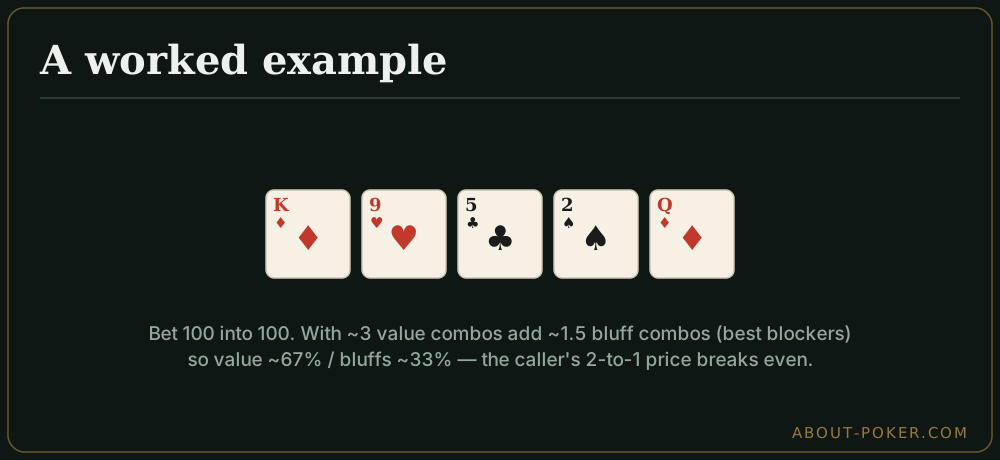
River pot is 100 chips and you bet 100 (pot-sized). For a balanced range you want about one bluff for every two value hands. Suppose your value hands here are two combos of a made straight and one set — three value combos. To balance, you want roughly 1.5 bluff combos, so you pick your best one or two bluff candidates — busted draws that block the opponent’s calls. Now the math from your opponent’s seat: they’re getting 2-to-1 to call (risking 100 to win 200), so they need to be right 33% of the time. Your range is 3 value to ~1.5 bluffs — value about 67%, bluffs about 33% — so their call breaks even exactly. They cannot exploit you by calling more or folding more. Pick bluffs by blocker quality, as in choosing which hands to fire; combo awareness from counting combos at the table is what lets you hit the ratio in real time.
Balance the check too
Balancing isn’t only about your bets — your checking range needs strength in it as well. If you check only weak hands, opponents bet into you every time and you can never punish them. Slow-play some strong hands into your check so that when you check-raise or check-call, your check has teeth. A checking range that’s all air is as exploitable as a betting range that’s all nuts.
When to throw balance away
Here’s the part most players get wrong: balance is the default against good opponents, not a law. Against players who don’t adjust, balancing leaves money on the table. If your opponent is a calling station, stop bluffing and pile on thin value — bet every decent hand and let them pay you, exactly as value betting in poker describes for exploitative spots. If your opponent over-folds, bluff far more than the “correct” ratio and stop bluff-catching. Balance protects you from being exploited; against someone not trying to exploit you, exploitation earns more.
Common mistakes
The recurring errors:
- Balancing against players who don’t watch you. You’re defending against an attack that isn’t coming. Exploit instead.
- Wrong ratio for the size. Betting pot with only 15% bluffs is under-bluffed — thinking opponents fold too much and you leave value uncollected on your value hands.
- No bluffs at all in big spots. A big bet with zero bluffs is the most exploitable range in poker; good players simply never pay you.
- All-air checking range. Protect your checks with a few traps.
The practical takeaway
Use balance as your baseline against strong, observant opponents — get the value-to-bluff ratio matched to your bet size, and hide strength in your checking range so you’re readable from neither line. Then, the moment you spot an opponent who isn’t adjusting, drop balance and exploit them directly. Knowing which mode you’re in on each hand — balanced or exploitative — is the real skill, and it’s what turns range construction from a textbook idea into money at the table.
Frequently asked
What does balancing your range mean?
Balancing means constructing your bets so they contain both value hands and bluffs in a ratio that makes your opponent indifferent to calling. A balanced range can't be exploited by always-calling or always-folding, because either response breaks even against you. It is the default when your opponent is paying attention to what you do.
What is the correct bluff-to-value ratio?
It depends on your bet size relative to the pot. For a pot-sized bet, roughly one bluff for every two value hands (about 33% bluffs) makes a calling opponent indifferent. Smaller bets allow fewer bluffs; larger bets allow more. The ratio comes from the pot odds you are laying the caller.
When should I not bother balancing?
Against opponents who don't adjust — calling stations, players who never fold, or anyone not tracking your tendencies — balance is wasted. Exploit them instead: bet thin for value against callers, bluff more against over-folders. Balance protects you from good, observant players; exploitation beats bad ones.
Does balancing matter more on the river?
Yes. On earlier streets equity keeps shifting and hands can improve, so ratios are approximate. On the river, hands are final and your betting range is either polarized value-and-bluffs or not, so the value-to-bluff ratio directly sets whether a thinking opponent can profitably call. River balance is where it matters most.