Barreling Blank Turns
How to barrel blank turns profitably: why a blank keeps your range advantage, which hands to fire and which to check, plus a worked double-barrel example.
On this page · 7 sections
The turn is where a lot of players freeze. They fire the flop confidently, then hesitate when a harmless card arrives and check away their advantage. But a blank turn is often the best card in the deck for the aggressor precisely because it changes nothing. Learning to barrel blank turns with the right hands, and to check the ones that prefer pot control, is one of the highest-leverage skills in postflop play.
What counts as a blank
A blank is a turn card that does not shift the balance of the hand. It does not complete a flush draw, it does not fill an obvious straight, it does not pair the board in a way that swaps who has the strong hands, and it does not bring an overcard that suddenly favors the caller’s range. A low, offsuit card such as the 3, 4, or 2 on a high, disconnected flop is the textbook blank. The defining feature is that neither player’s range improved, so whatever edge existed on the flop carries straight into the turn.
Contrast this with a scare card, which does shift ranges and requires a different plan; see barreling a scare card for that case. The whole point of a blank is that you do not have to re-solve the hand. Your flop advantage is intact.
Why the aggressor keeps betting
On many flops the preflop raiser holds both a range advantage and a nut advantage, meaning they have more strong hands and more of the very best hands than the caller. When the turn is a blank, that advantage is undisturbed, so the aggressor can keep betting to press it. The blank also does not give the caller any new reason to continue, so many of their marginal flop calls are now happy to fold to a second barrel.
That said, barreling every hand is a leak. Your turn betting range should be built, not sprayed. Bet the hands that want a bigger pot or that benefit from denying the caller’s equity, and check back the medium-strength hands that would rather get to showdown cheaply. This selection is the heart of good turn barreling.
Which hands to fire on a blank turn
- Value hands that want to grow the pot: top pair good kicker and better, sets, two pair.
- Strong draws that gain fold equity now and can improve later: flush draws, open-enders, and combo draws.
- A measured number of bluffs, ideally with backdoor equity or blockers, to keep your value bets from being obvious.
Check back the hands that do not fit those buckets: weak top pairs, second pairs, and ace-highs that would rather realize equity for free than bloat the pot. Those medium hands are why blanket second-barreling loses money; they turn into disasters when raised and gain little by betting.
A worked example
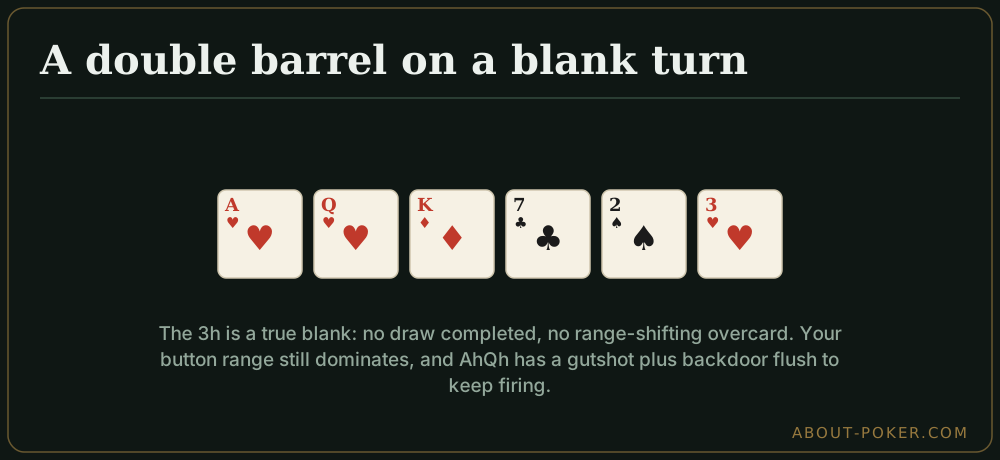
You open the button with Ah Qh and the big blind calls. The flop is Kd 7c 2s, a dry, high, disconnected board where your button raising range crushes the big blind’s calling range. You c-bet and get called. The turn is the 3h.
That three of hearts is a near-perfect blank: no draw completed, the board did not pair meaningfully, and no overcard to the king arrived. Your range still dominates. You should barrel again. With Ah Qh you actually have a gutshot to a jack plus a backdoor flush draw plus two overcards, so you have equity when called and fold equity against the big blind’s floats and weak pairs. Firing pressures their K-x-underneath, their 7-x, and their missed overcards. If the turn had instead been the Qh, that would help the caller’s range and you would slow down more; but on the blank three, keep the foot on the gas. This is the everyday version of double barreling.
Common mistakes
- Checking away your edge. Slowing down on a blank surrenders the advantage you earned on the flop.
- Barreling every hand. Firing your medium hands into a raise-prone caller bleeds chips; those hands want pot control.
- Ignoring the caller’s range. A blank preserves ranges, so if the caller was already strong, the blank does not fix that; read the flop action.
- Over-sizing. On a dry blank board you usually do not need a huge bet; a moderate size folds out the air and keeps worse pairs in.
Adjusting by opponent
Against a player who folds too much on the turn, widen your barreling bluffs, because fold equity is high and a blank gives them no reason to hero-call. Against a calling station, cut the bluffs and barrel mainly for value, since they will pay off your strong hands but never fold to pressure. Against a tricky aggressive regular, keep your betting range balanced so they cannot profitably check-raise you off your medium hands.
Quick checklist for blank turns
- Confirm the turn is a true blank: no draw completed, no range-shifting overcard, no meaningful pairing.
- If you had the flop advantage, a blank preserves it, so keep pressing.
- Fire value hands and strong draws; check back medium hands for pot control.
- Add bluffs with backdoor equity or blockers to stay balanced.
- Adjust bluff frequency to the opponent: more vs. folders, fewer vs. stations.
Frequently asked
What is a blank turn in poker?
A blank turn is a card that does not meaningfully change the board: it does not complete obvious draws, does not pair the board in a way that shifts ranges, and does not bring a scare card that swings the range advantage. A low, offsuit card that misses all draws is the classic blank.
Should you always barrel a blank turn?
No. A blank turn preserves whatever range or nut advantage you had on the flop, so it is a good spot to keep betting with value and strong draws, but you should not fire every hand. Continue with hands that want to build the pot or deny equity, and check back the medium hands that prefer pot control.
Why is a blank turn good for the preflop raiser?
Because the preflop raiser usually enters the turn with the range and nut advantage on many boards, and a blank does not change that. Since the card helps neither player's range, the aggressor keeps their edge and can keep applying pressure with a well-constructed betting range.