Counting Combos at the Table
A practical guide to counting combos live: the 16/12/9/6/4/3/1 shortcuts, how removal shrinks counts, and using combo math to make river calls.
On this page · 7 sections
Counting combos is how you turn a fuzzy read — “he probably has it” — into a number you can act on. Every hand type has a fixed number of two-card combinations, and once you know the base counts and how removal shrinks them, you can add up an opponent’s value hands and bluffs at the table and compare the totals to your pot odds. It’s the arithmetic underneath every good river decision, and it takes about an hour to internalize.
The base counts
Memorize these six numbers and you’re most of the way there. Any specific unpaired hand — say A-K — has 16 combos total: 12 offsuit and 4 suited. So a single suited hand like A♠K♠-style holdings is 4 combos, and a single offsuit hand is 12 combos. A pocket pair has 6 combos. That’s the full toolkit: 16, 12, 4, 6, and the two removal cases below (3 and 1). Everything else is subtraction. When you hear “there are more ways to hold a non-pair than a pair,” this is why — 16 versus 6.
How removal shrinks the counts
Cards you can see aren’t available to your opponent. If the flop is K-7-2, the number of AK combos drops from 16 to 12, because only three kings remain to pair with the four aces (4 × 3 = 12). For pocket pairs the shrinkage is sharper: normally 6 combos, but if one card of that rank is on the board, only three of that rank remain, so the pair drops to 3 and a set of that rank is also 3 combos (choose 2 of 3). This is the same card-removal principle behind blockers in poker — the difference is that here you’re counting the whole population, not just the effect of your two cards.
A worked river example
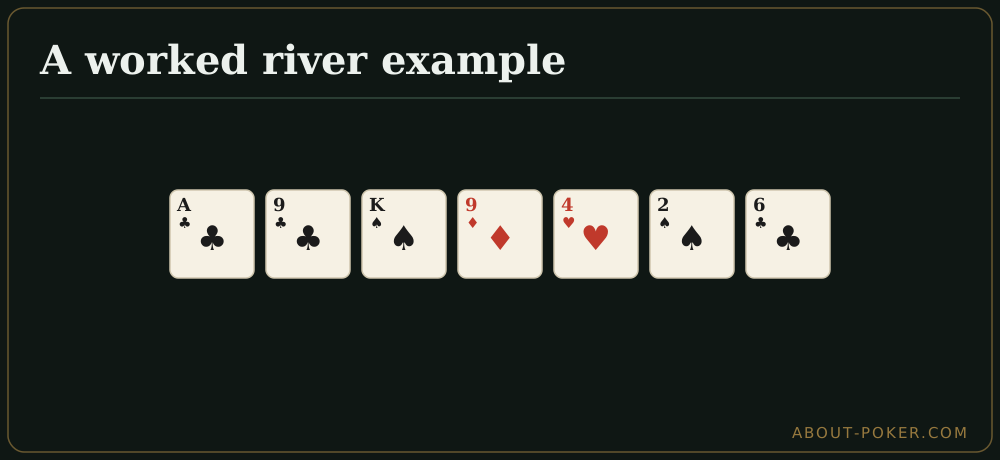
You call to the river with A♣ 9♣ on a final board of K♠ 9♦ 4♥ 2♠ 6♣. You have second pair, a classic bluff-catcher. Your opponent, a straightforward regular, jams the pot. Which hands can they be doing this with? Value: sets of kings (KK is 3 combos after removal? no — no king in your hand or elsewhere, so KK = 6, but they’d often 3-bet KK preflop, call it ~3 here), sets of 9s (you hold a nine, so 99 = 3 combos), two pair like K9 (you block a nine, so 4×1 patterns — roughly 3 combos), and the odd A4s/A2s. Round the value to about 9 combos. Bluffs: busted straight-draw hands like J♠10♠, Q♠J♠, and A-high spade busts — realistically 3 combos given how few he’d turn into a bluff. So you’re facing value 9 out of 12 times, or 75%. Against a pot-sized jam you need to be right 33% of the time to call; you’re only good ~25%, so you fold. The read didn’t decide it — the count did. This is exactly the kind of arithmetic that makes how to play the river a math exercise rather than a guess.
Values vs bluffs: the ratio that matters
Most river decisions reduce to one ratio: value combos versus bluff combos in the bettor’s range. If bluffs meet or beat the pot odds you’re getting, you call; if value dominates, you fold. A polarized bettor — all nuts and air, nothing in between — is the cleanest to count, which is why understanding a polarized range makes combo counting so powerful. When someone bets big, list their credible nut hands, count them, then list their credible bluffs, count those, and let the two numbers talk.
Speeding it up live
You won’t have time to enumerate every combo mid-hand, so use shortcuts. Round pairs to 6 (or 3 if the board pairs that rank). Round a single unpaired value hand to “about a dozen,” or a few if it’s suited-only. Group similar hands rather than counting each — “he has maybe three sets and three two-pairs, that’s six value” is close enough. The goal isn’t a perfect census; it’s a good-enough ratio to compare against your price. Practicing away from the table with a few flopped scenarios makes the rounding automatic within a couple of sessions.
Common mistakes
The first leak is forgetting removal — counting KK as 6 when a king is on the board (it’s 3), or ignoring that your own nine cuts his sets and two pair. The second is counting all of a hand type when the opponent wouldn’t play it that way; a nit doesn’t have every bluff, so don’t credit him with combos he’d never fire. The third is stopping at value and never counting the bluffs — you have to enumerate both sides to get a ratio. And the last is over-precision: a shaky read counted to the exact combo is still a shaky read. Combo counting sharpens a good read; it can’t rescue a bad one.
A quick checklist
At the table, run four steps. State the base count for each hand type in the opponent’s range. Subtract for every card removed by the board and your hand. Add up value combos and bluff combos separately. Compare the bluff share to your pot odds and act. Do this enough and the numbers appear on their own — you’ll “feel” that a jam is 3-to-1 value and fold your bluff-catcher before you’ve consciously done the math.
Frequently asked
How many combos does each hand type have?
An unpaired offsuit-or-suited hand has 16 combos total (12 offsuit, 4 suited). A single suited hand has 4 combos, a single offsuit hand has 12, and a pocket pair has 6 combos. These counts drop when cards are removed by the board or your own hand.
How many combos of a pocket pair are there?
Six, before removal. If one of that rank is on the board, a set becomes 3 combos and the pocket pair drops to 3 as well. Counting this removal correctly is the whole point of combo math on paired boards.
Why does counting combos matter?
It converts a vague read into a number. If your opponent's value hands add up to 9 combos and their bluffs to 3, you're facing value 75% of the time and can fold thin bluff-catchers. Combos turn hand-reading into arithmetic.
How do I count combos quickly at the table?
Memorize the base counts (16, 12, 4, 6, 3, 1), then subtract for removal from the board and your own cards. List the opponent's likely value hands and bluffs, add up each group, and compare the totals to the pot odds you're being offered.