Facing a Donk Bet
How to respond when the caller leads into you: what a donk bet means by player type and board, how to read the range, and when to raise, call, or fold.
On this page · 6 sections
A donk bet is a lead into the previous street’s aggressor — the player who called your raise bets into you before you get a chance to continuation bet. It flips the script, and it throws a lot of players off because it’s an unusual line. But a donk bet is also one of the most readable actions in poker, because the reason behind it is usually transparent. Respond well by figuring out what type of player is leading, what the board does to their range, and then choosing between raise, call, and fold with a clear plan.
What a donk bet is telling you
The meaning of a donk bet depends almost entirely on who’s making it. Recreational and low-stakes players donk bet with medium-strength made hands and weak draws they don’t trust to check — a pair they want to “protect,” a gutshot they’d rather bet than give up. That makes their leading range capped and often weak. Strong, thinking players use donk bets rarely and deliberately, leading polarized on boards that smash the caller’s range harder than the raiser’s — think a low, connected flop the big blind flatted with. Knowing the player type is 80 percent of the read. The full logic of building this line from the other seat is in donk betting in poker.
Board texture and range advantage
Ask who the board favors. If you raised from early position and the flop is A-K-4, that hits your range far harder than a caller’s, so a donk bet into you is either a rare trap or, far more often, a confused weak lead you can attack. If instead the big blind called and the flop is 6-5-4 two-tone, that texture favors the caller’s range of suited connectors and small pairs, and a donk bet there carries much more weight. The same-sized bet means different things depending on who the flop belongs to.
Sizing carries information too
Pay attention to how much they lead. A tiny lead — a min-bet or a third-pot poke — from a weak player almost always reads as “I have something small and I don’t want to face a big bet.” Reading those tiny stabs is covered in reading min-bets. A large, pot-sized donk from a straightforward player usually means a strong made hand or a big draw. The general principle: small often means weak-capped, big often means polarized, but always filter through the specific player.
A worked example
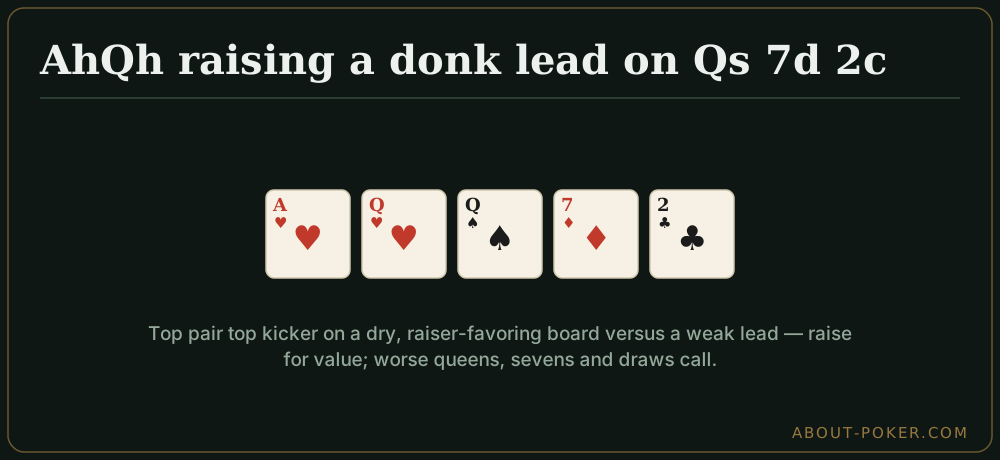
You open Ah Qh from the cutoff, the big blind calls, and the flop is Qs 7d 2c. Before you can c-bet, the big blind leads half pot into you. This is a dry board that favors your range, and a lead here from a typical opponent is usually a weak queen, a seven, or a naked draw like a gutshot with backdoors. Your top pair top kicker is well ahead. Raising for value makes sense: you get called by worse queens and sevens, and you deny equity to the draws. If instead you held a hand like 9-9 on that same lead, calling once and re-evaluating is cleaner, because raising folds out everything you beat and only gets action from better.
When to raise, call, or fold
Raise for value when your hand beats the bulk of a weak, capped leading range and worse hands can still call — top pair good kicker, two pair, sets. Raise as a bluff when you have real equity plus fold equity against someone who folds too much to aggression, using draws and blockers rather than pure air. Call with medium-strength hands that beat the bluffs but can’t get value from worse if you raise, and with draws that have the odds to continue. Fold the hands that only beat air when a credible, polarized donk represents genuine strength. The related probing line, when you’re the one leading later after the aggressor checks, is covered in probe betting in poker.
A quick checklist for facing a donk bet
Run through this every time: What type of player is leading, and are they capable of a balanced donk or just a weak stab? Whose range does this board favor? How big is the lead, and does that skew weak or polarized? Does my hand beat their bluffs and weak value, and can worse call a raise? If the answer to that last question is yes and you’re ahead, raise. If you beat the bluffs but not enough to get value, call. If you only beat air against a credible strong lead, fold and move on. Handled this way, a donk bet stops being an awkward surprise and becomes free information.
Frequently asked
What does a donk bet usually mean?
It varies hugely by player. Recreational players often donk bet with medium-strength made hands and weak draws they don't trust, so it reads as capped and weak. Strong players donk polarized on boards that hit the caller's range harder than the preflop raiser's.
Should I raise a donk bet?
Raise for value when your hand is clearly ahead of a weak, capped leading range, and raise as a bluff when you have equity plus fold equity against a player who folds too much to aggression. Against a strong, polarized donk, just calling with medium hands is safer.
Can I still continuation bet after a donk bet?
No — a donk bet takes the betting lead away from you. You can raise, call, or fold, but you can't c-bet because you're no longer the one opening the action on that street.
Why do weak players donk bet so often?
They're trying to find out where they stand or protect a hand they don't want to check, and they don't trust themselves to check-call. That makes their leads readable and exploitable, usually capped at one pair.