Reading Min-Bets
What a min-bet really means, why it usually isn't strength, and exactly how to attack it by street, position, and opponent — with a worked hand.
On this page · 6 sections
A min-bet — the smallest legal bet, typically one big blind — is one of the loudest signals at the table, and most players read it exactly backward. They see a bet and assume some strength; in reality a min-bet from a normal player almost never represents a hand that wants to build a pot. Learning to read min-bets is really learning to read why someone would risk almost nothing to bet, and the answers are nearly all weak. This sits opposite the logic of reading overbets, where the outsized size polarizes the range; the tiny size does the opposite.
What a min-bet actually represents
Ask what a min-bet accomplishes. It doesn’t charge draws — the odds are absurd, so every draw calls. It doesn’t get value from worse — worse hands call for one big blind regardless of the price. It doesn’t fold out better. So a strong hand min-betting is throwing away value on every street. That means the min-bet’s natural range is the set of hands that don’t want a big pot: weak made hands (bottom or middle pair) making a cheap “I have something” gesture, busted-ish hands taking a cheap stab, thin blocking bets to avoid facing a bigger bet, and pure uncertainty. From a typical, non-expert opponent, min-bets skew weak-to-medium almost every time.
The default response: raise
Because the range is capped and weak, your default against a min-bet with any continuing hand is to raise, not call. Two reasons. First, the min-bet lays you a gigantic price to see the next card, so if you only call you let the bettor realize equity and control the pot with their weak range. Second, raising punishes exactly the range they showed up with — weak pairs and air fold or pay off. Size the raise to the pot, not to the min-bet: a good rule is to make it about the size of the pot after their bet, so you charge the marginal hands a real price.
Call instead of raise only in two cases: you hold a marginal hand that genuinely wants a cheap card and gains little by raising, or raising would fold out everything you beat while getting called only by hands that beat you. Those cases are narrower than most players think.
A worked hand
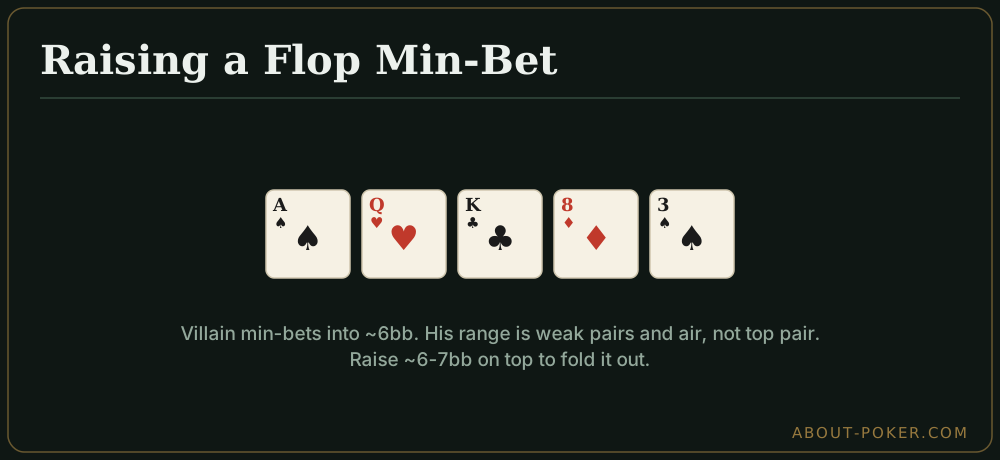
You are on the button with As Qh. It folds to you, you open, and only the big blind calls. Flop comes Kc 8d 3s. Villain leads out for a min-bet, one big blind into a pot of about six big blinds. What is going on?
His min-bet range here is not top pair — a King wants to bet bigger or check-raise. It is far more likely a weak pair (an 8 or a 3), a busted or backdoor hand taking a cheap stab, or an ace-high wanting to “see where he’s at” cheaply. You have two overcards to the 8 and 3, a gutshot to nothing useful, and a hand that is often ahead of his air but behind his pairs. Raising to about the size of the pot (roughly six to seven big blinds on top) folds out the weak-pair-and-air part of his range, which is most of it, and takes down the pot immediately with the best hand a good share of the time and decent equity when called. Flatting lets him keep barreling small or check the turn and realize equity for free. The raise is clearly better.
How it shifts by street
Min-bets read differently by street. On the flop, they are the cheapest probe and lean weakest — attack them hardest. On the turn, a min-bet after a bigger flop bet can signal a giving-up or pot-controlling hand — still usually weak. On the river, a min-bet is often a thin blocking bet or a weak value hand trying to get a cheap call while avoiding a bigger bet-or-check-then-face-a-bet spot; here you should frequently raise as a bluff with good blockers and value-raise your strong hands, because the min-bet screams “please let this be cheap.” This is the mirror of the donk-betting logic — a small out-of-position lead is rarely the sizing a monster wants.
Opponent adjustments
Read the player, not just the size:
- Recreational / passive — min-bets are weak almost always; raise relentlessly.
- Calling stations — they min-bet weak pairs and then can’t fold them; value-raise thinner, bluff-raise less.
- Tricky regs — a rare few min-bet monsters to induce; only give this interpretation to someone you’ve seen do it.
Common mistakes reading min-bets
The two big errors: treating the min-bet as strength and just calling, which surrenders the pot to a weak range; and raising to a small multiple of the min-bet, which keeps the pot tiny and lets weak hands continue cheaply — the opposite of the goal. Size to the pot and remember the core read: a min-bet is a hand that doesn’t want a big pot, so give it one. Manage the pot deliberately, as covered in pot control in poker, and the min-bet becomes one of the most profitable spots you face.
Frequently asked
What does a min-bet mean in poker?
A min-bet is the smallest legal bet, usually one big blind postflop. Against most non-expert players it is not a sizing chosen for strategic reasons — it signals uncertainty, a cheap probe, a weak made hand wanting a small show of value, or a blocking attempt. It rarely represents a big hand trying to build a pot.
Should I raise or call a min-bet?
Usually raise when you have a hand worth continuing, because the min-bet lays you enormous odds and caps the bettor's range at mostly weak holdings. Call only when you have a marginal hand that wants to see the next card cheaply, or when raising folds out everything you beat and only continues hands that beat you.
Is a min-bet ever a sign of strength?
Occasionally, from tricky players trying to induce a raise with a monster, but this is rare and read-dependent. Most min-bets from typical players are weak-to-medium. Give a strong-hand interpretation only to opponents you have specifically seen trap this way.
How much should I raise over a min-bet?
Size to the pot, not to the tiny bet. A common effective raise is to roughly the size of the pot after the min-bet, which charges draws and marginal hands properly. Raising to some small multiple of the min-bet leaves the pot small and lets weak hands continue too cheaply.