Flop C-Bet Sizing
How big should your flop c-bet be? Learn small vs large sizing by board texture, range advantage, and stack depth — with a worked example and checklist.
On this page · 6 sections
Your flop c-bet size is one of the highest-leverage decisions in a hand. Get it right and you win small pots uncontested, charge draws the correct price, and set up profitable turn and river barrels. Get it wrong and you either give draws a cheap look or bloat pots with hands that cannot stand heat. This guide gives you a clear framework for picking a flop c-bet size instead of defaulting to the same amount every time.
The two default sizes and when to use each
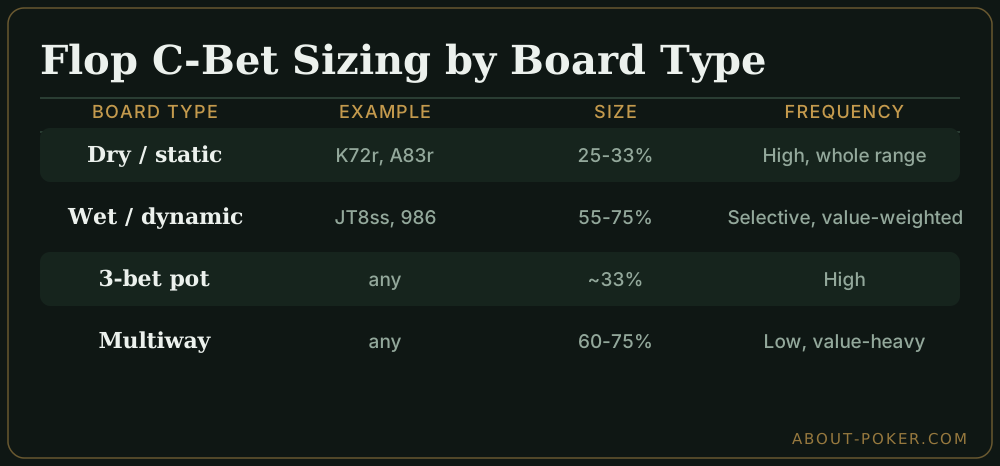
Most winning flop strategies revolve around two sizes: a small c-bet of roughly 25-33% of the pot and a large c-bet of roughly 55-75%. The choice is driven mainly by board texture and how the flop connects with each player’s range.
Use the small size on dry, static boards — think K72 rainbow or A83 rainbow — where the turn rarely changes who is ahead. Here the preflop raiser holds most of the strong hands, equities are close across the range, and a cheap bet denies the opponent’s overcards their equity while risking little. Use the large size on wet, dynamic boards — like JT8 two-tone or 986 with a flush draw — where many turn cards shift equity. A bigger bet charges flush and straight draws, grows the pot for your sets and two pair, and stops opponents from realizing equity on the cheap.
For the underlying logic on why texture drives everything, see our guide on c-bet sizing by board texture.
Range advantage sets the ceiling for your size
Before you bet, ask who has the range advantage — the player whose range contains more of the strongest possible hands on this board. As the preflop raiser on an ace-high or king-high dry board, you have a large range and nut advantage, which justifies betting your whole range small and often.
When the board favors the caller — for example a low, connected flop like 654 that hits their calling range harder than your raising range — you should c-bet far less often, and when you do bet, a larger polarized size makes more sense than an automatic small stab. On these boards, checking a big chunk of your range and playing carefully is usually higher EV than blasting a small c-bet into a range that connects well.
A worked example
You open A♣K♦ from the button and the big blind calls. The flop is K♠7♥2♣, a dry, static, king-high board.
You hold top pair top kicker, and your entire button range crushes this flop: you have all the sets, all the top pairs, and every overpair, while the big blind’s flatting range is capped and full of misses. The pot is 6 big blinds. A c-bet of 2 big blinds (33%) accomplishes everything you need — it gets called by worse kings, gets folds from ace-high and small pairs that still had two overcards or backdoor equity, and keeps the pot manageable so you can barrel most turns. Betting 4.5 big blinds (75%) here would be an overpay: you fold out the exact hands you beat and only get action from hands that have you crushed or drawing thin.
Contrast that with A♣K♦ on J♠T♠9♥. Now the board favors the caller’s range and is soaked in draws. You would check a large share of your range, and when you bet you would use a bigger size to charge the flush and straight draws that are live against you.
How stack depth and pot type change things
In single-raised pots at 100 big blinds deep, the two-size framework above holds well. In 3-bet pots the stack-to-pot ratio is lower, so a small c-bet of around 33% is standard on most boards — you do not need a large bet to get stacks in, and a small size lets your overpairs and strong aces bet cheaply while keeping bluffs inexpensive.
Multiway changes the math the most. With three or more players, someone connects with the flop far more often, so you should c-bet less frequently and lean toward larger, more value-heavy sizes when you do fire. A thin small c-bet that works heads-up gets raised and floated too often multiway. Our multiway pot strategy guide covers this in depth.
Common mistakes to avoid
The biggest leak is sizing by hand strength — betting big with your strong hands and small with your weak ones. Observant opponents read this instantly and play perfectly against you. Instead, let board texture and range advantage pick the size, then put your value hands and bluffs into that same size so your range stays balanced.
Two more frequent errors: c-betting too large on dry boards, which turns a cheap, high-frequency small bet into an unnecessary risk, and c-betting too small on wet boards, which lets draws call profitably and realize equity. Match the size to the surface. For the wider decision of whether to fire at all, revisit our continuation bet strategy guide.
Quick flop c-bet sizing checklist
Run through this before you slide chips forward:
- Who has the range advantage on this exact flop?
- Is the board static (dry) or dynamic (wet)?
- Small size (25-33%) on dry, high-card boards you dominate; large size (55-75%) on wet boards full of draws.
- Are you in a 3-bet pot? Default smaller.
- Is the pot multiway? Bet less often and larger, more value-weighted.
- Are you using one size for your whole range, or leaking information by sizing to hand strength?
Nail these six questions and your flop c-bet sizing will already be ahead of most opponents you face.
Frequently asked
What is the best c-bet size on the flop?
There is no single best size. On dry, static boards where you hold a big range advantage, a small c-bet of 25-33% of the pot is efficient. On wet, dynamic boards you usually want 55-75% to charge draws and build the pot with your value hands.
Should I c-bet the same size with my whole range?
On very dry boards you can bet one small size with a wide, merged range because equities run close together. On wetter boards a mixed strategy — some checks and a larger size when you do bet — protects your value and reduces how much you can be exploited.
Does a smaller c-bet mean I have a weak hand?
Not if you size correctly. Good players use small c-bets with their entire range on the right boards, so a small size reveals nothing. It becomes readable only when you use size purely by hand strength, which is exactly what to avoid.