Range vs Range on Dry Boards
How to think in ranges on dry boards like K-7-2: who has the nut advantage, why small c-bets work, and how to defend when you're capped.
On this page · 7 sections
A dry board is a flop with no flush draw and few or no straight draws, and ranks that don’t connect — something like K♦ 7♠ 2♣. Nothing much can change from flop to river, so hand values are close to locked in the moment the flop lands. That stability is exactly why dry boards are the cleanest place to practice thinking in ranges instead of thinking about your two cards. The whole decision is: whose range does this board favor, and by how much?
Who owns the board
On a K-high dry flop, the preflop raiser owns it. Their opening range is stuffed with big broadway cards and overpairs — AK, KQ, KJ, AA, QQ, JJ — that either made top pair or beat top pair. The caller, meanwhile, defended with a lot of suited connectors, small pairs, and offsuit broadways that mostly missed. When you overlay the two ranges, the raiser has both the nut advantage (more of the very best hands) and the equity advantage (more total combos that are ahead). This is the textbook setup described in board texture and range advantage, and it’s what licenses aggressive, cheap betting.
Why the bet is small
Because the raiser’s advantage covers their entire range, the correct tool is a small bet — 25% to 33% of the pot — fired at a very high frequency. A small size accomplishes three things at once. It denies equity to the caller’s overcards and backdoor stuff for a cheap price. It keeps dominated hands (worse kings, pocket pairs below the king) in the pot as callers. And it lets the raiser bet nearly every hand, so they never have to reveal strength by choosing when to fire. This is the core logic behind c-betting dry flops: the flop is so lopsided that a token bet does the work of a big one.
A worked example
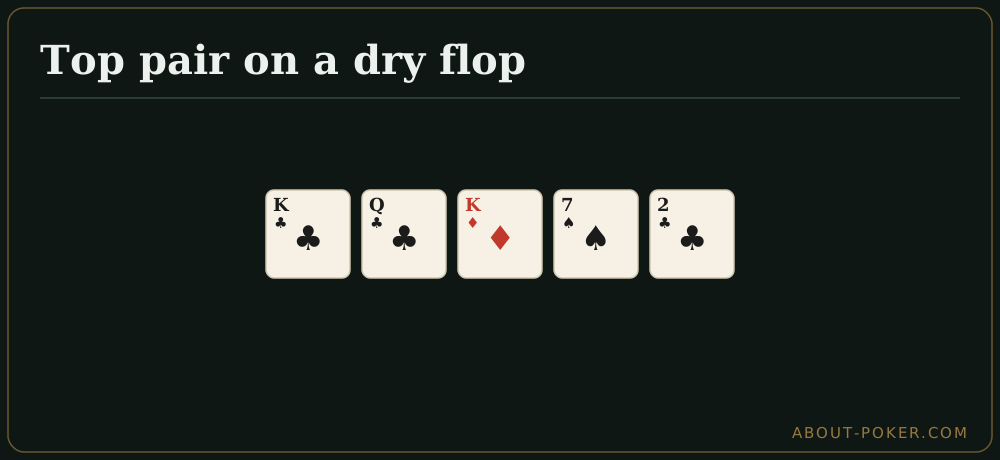
You open K♣ Q♣ from the cutoff to 2.5bb, the big blind calls, and the flop is K♦ 7♠ 2♣ in a roughly 5.5bb pot. You’ve flopped top pair, second-best kicker, in position. You bet 2bb — about 33% pot. Here’s the reasoning by range, not by hand: the big blind’s continuing range is capped at one pair of kings with a worse kicker, plus pocket pairs like 88-QQ and the occasional 72 or set of deuces. You beat almost all of the pairs and lose only to a slim set count and the rare KA/K2 combos. A small bet gets called by KJ, KT, K9, 88-QQ, and floats from ace-high — all hands you’re crushing or freezing out. You’d bet this same size with A♠ 5♠ as a pure bluff too, because the range wants to bet, and your specific hand barely matters.
Defending when you’re capped
The flip side is being the caller on the same board. Your range is capped — you can’t have AA, KK, or AK because you’d usually have 3-bet them preflop. When the raiser bets small, folding your whole air range is a leak; you’re being offered a great price (calling 2 to win ~7.5). Continue with any pair, ace-high with a backdoor, and the gutshots that exist. Against a small bet, the minimum defense frequency is high — MDF = pot ÷ (pot + bet), so against a 33% bet you should defend about 75% of your range to stop auto-profitable bluffs. On dry boards you rarely check-raise as the caller because you have so few nutted hands to protect the raise with.
Blockers still matter
Even on a board where the whole range bets, your exact cards decide which bluffs to prefer and which thin values to fire. Holding the A♠ or an offsuit ace slightly blocks the caller’s ace-x floats; holding a king reduces the number of KX hands that can call you down. Use blockers in poker to break ties: when you’re picking which air hands to turn into barrels on later streets, favor the ones that remove the opponent’s strongest continues, and give up with the ones that block their folds.
Common mistakes
The biggest error is over-betting dry boards. Firing 75% pot with your KQ on K-7-2 folds out exactly the worse hands you wanted to keep and only gets called by the sets and better kings that beat you. A second leak is checking too much as the raiser out of fear — you surrender the equity your range earned preflop. On the caller’s side, the mistakes are over-folding to the small bet (you’re priced in) and inventing a check-raise range that has no nuts behind it. Dry boards reward discipline: bet small and often when you have the range edge, defend wide and passively when you don’t, and let your specific two cards only fine-tune the plan.
A quick checklist
Before you act on a dry board, run three questions. First, whose range does the top card favor — that tells you who’s betting. Second, is my range capped or uncapped — that tells me whether I’m attacking or defending. Third, what does my exact hand block — that breaks ties between bluffing and giving up. Answer those in order and you’ll play K-7-2, A-8-3, and Q-6-2 correctly without memorizing a chart.
Frequently asked
What is a dry board in poker?
A dry board is a flop with few draws and disconnected ranks, like K-7-2 rainbow. There are no flush draws and almost no straight draws, so hand values are mostly fixed on the flop and rarely change on later streets.
Why do you bet small on dry flops?
The preflop raiser usually has a big range advantage on high-card dry boards, and the opponent can't have many strong hands. A small bet (25-33% pot) pressures the whole range cheaply, keeps worse hands in, and denies equity without risking much.
Who has the range advantage on K-7-2?
The preflop raiser. A K-high dry board smashes their range of big broadway cards and overpairs, while the caller rarely raised preflop with hands that connect hard. This nut and equity advantage is why the raiser can bet a high frequency.
Should you ever check on a dry board as the raiser?
Sometimes, especially on boards that hit the caller's range better than yours or when you hold hands that want to keep the pot small. But on classic dry high-card flops, betting a large chunk of your range at a small size is usually the highest-EV plan.