Range vs Range on Wet Boards
How ranges collide on wet boards like 9-8-7 two-tone: why equities run close, when to size up, and how to defend and check-raise draws.
On this page · 7 sections
A wet board is a coordinated flop: connected ranks, two of a suit, plenty of live draws. Think 9♥ 8♥ 7♠. On a board like this, almost nothing is settled — flushes, straights, and two-pair-plus-draw hands are all in play, and equities can swing 30 points on the turn. Because so much can change, the range-versus-range battle on wet boards is fought over equity denial and pot geometry, not over who has one more combo of top pair. This is the opposite pole from a dry flop, and the contrast is the whole story of wet vs dry board texture.
Equities run close
On a low, connected board the preflop raiser’s usual edge shrinks or disappears. A hand like 9-8-7 crushes the caller’s defending range of suited connectors, one-gappers, and small-to-mid pairs — they flop straights, two pair, sets, and monster combo draws far more often than they do on K-7-2. The raiser’s overcards (AK, AQ) are now just two-card nothing hands with backdoor equity. When two ranges have similar equity and the caller holds a healthy share of the nuts, the raiser can no longer bet their whole range. They must check more, and they must size up when they do bet.
Why the bet gets big
The reason to bet large — two-thirds pot up to full pot — is that draws are worth money. Give a flush draw a cheap look and it realizes close to its ~35% equity for free; charge it properly and you tax that equity every street. A big bet on a wet board does three jobs: it denies equity to the many draws, it builds a pot so your sets and straights get paid, and it polarizes your betting range into strong made hands and strong draws. This is the engine behind c-betting wet flops: you fire fewer hands than on a dry board, but each bet is larger and carries a clear threat.
A worked example
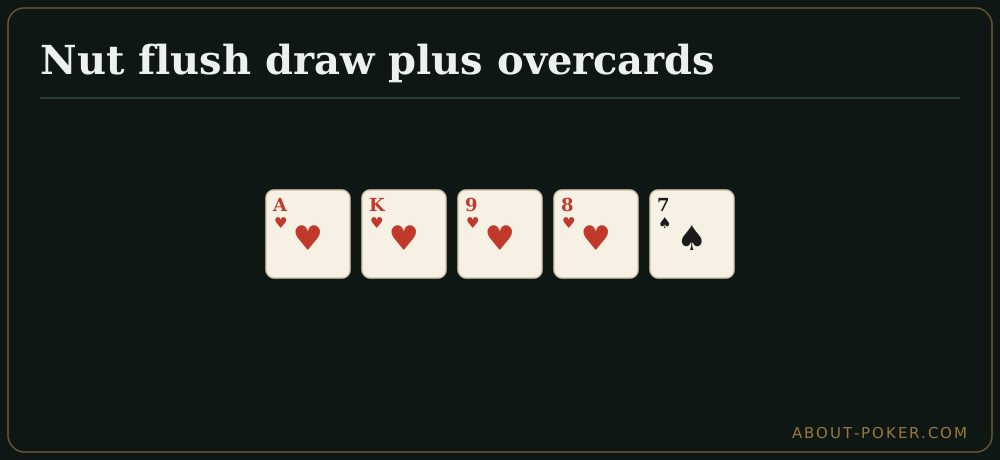
You open A♥ K♥ from the button, the big blind calls, and the flop comes 9♥ 8♥ 7♠ in a 5.5bb pot. You have the nut flush draw plus two overcards — a premium semi-bluff, not a made hand. The big blind’s range is loaded with straights (JT, T6s, 65s), sets, and two pair here, so a small bet accomplishes nothing. You bet 4bb, roughly 75% pot. If called, you have ~15 outs twice (nine hearts, three aces, three kings, discounting some overlap) and can barrel most turns credibly. If check-raised, you have the equity to continue. The point: your specific draw wants a big bet for the same reason your range’s value hands do, so the sizes line up — that’s balance falling out of the board naturally. Compare this to how you’d handle the same holding as a pure draw in playing draws postflop.
Defending and check-raising
As the caller on a wet board, you finally have the material to fight back. Your range contains real nuts — straights, sets, two pair — plus strong combo draws, so a check-raise is well-supported. A good flop check-raise on 9-8-7 pairs made hands like 65s and sets with draws like Th9h or the naked flush draw, keeping your raise balanced so it can’t be exploited. Facing a large bet, your minimum defense frequency is lower than against a small one — MDF = pot ÷ (pot + bet), so against a 75% pot bet you only need to continue about 57% of the time. That means you can fold your weakest air and still not get run over, and you should call or raise with your equity-rich hands rather than bluff-catch with pure trash.
Turn geometry matters most
Wet boards are really about the turn. Because a big flop bet builds the pot, the turn bet is what commits stacks, so plan two streets ahead. If you fire 75% flop and 75% turn, you’ll be nearly all-in by the river with 100bb stacks — that’s fine with the nuts and with the draws you intend to jam. Trouble comes from firing big on the flop with a marginal made hand like top pair and then facing a raise you can’t answer. On wet boards, decide on the flop whether your hand wants a three-street war or wants to pot-control, and don’t start a war you can’t finish.
Common mistakes
The recurring error is betting small on wet boards “to c-bet.” A small bet on 9-8-7 charges nothing, folds out nothing that matters, and lets every draw peel — it’s the worst of both worlds. The mirror mistake as the caller is over-folding to a big bet because it “looks scary”; your MDF is only ~57%, and folding all your draws and gutshots hands the raiser free money. Finally, don’t slowplay your sets and straights on wet textures — the board is too dangerous, cards that kill your action or beat you come constantly, so charge the draws while you’re ahead.
A quick checklist
On a wet board, ask: has the nut advantage shifted toward the caller? If yes, check more as the raiser and bet big when you do. Do I have a draw or a made hand that wants a three-street pot? If yes, size up and plan the turn. As the caller, do I have the nuts to support a check-raise, or should I call and let draws come in cheaper? Answer those and coordinated boards stop being scary and start being profitable.
Frequently asked
What is a wet board in poker?
A wet board is a coordinated flop with many draws — connected ranks and two of a suit, like 9-8-7 with a flush draw. Lots of straight and flush draws are live, so hand values shift dramatically from flop to river.
Why bet bigger on wet boards?
Draws have real equity, so a small bet lets them continue cheaply. Betting large (66-100% pot) charges draws the correct price, builds a pot for your strong made hands, and denies the free cards that would let opponents realize their equity.
Does the preflop raiser still have range advantage on wet boards?
Often much less, and sometimes none. Low and middling connected boards hit the caller's suited connectors and small pairs hard, which flattens equities and can shift the nut advantage toward the defender, so the raiser must check more.
When should you check-raise a wet board?
When you have a mix of strong made hands and strong draws to balance. Wet boards give the caller natural check-raising material — sets, two pair, and combo draws — so check-raising is far more common here than on dry boards.