Turning Made Hands into Bluffs
Sometimes your pair is worth more as a bluff than a bluff-catcher. Learn when to turn a made hand into a bluff, and when to just check it down.
On this page · 6 sections
Turning a made hand into a bluff sounds like a contradiction — why bluff with a hand that can win at showdown? The answer is that some made hands have so little showdown value on a given runout that they win more money as bluffs than as bluff-catchers. If your weak pair is going to lose almost every time you check and can’t call a bet profitably, then its best use is to fire and fold out the hands that beat it. This is an advanced concept, but the logic is simple once you separate “hands with a pair” from “hands that actually win at showdown.”
When showdown value collapses to near zero
A hand has real showdown value when checking wins a meaningful share of the time. But value is relative to the runout. Bottom pair might be a fine bluff-catcher on the flop and completely worthless by the river if scare cards have arrived and the opponent’s range has firmed up. If, by the river, your pair beats basically nothing in villain’s range that would bet or continue, then checking is worth close to zero. That’s the trigger. When a made hand’s showdown value approaches zero, giving it up by checking costs you nothing — so you might as well look for the hand’s other use.
The best bluff candidates block the caller’s range
Not every worthless made hand is a good bluff. The ones you want to turn into bluffs are those that also block the hands that would call you. If you hold a pair that removes combos of the opponent’s likely calling range, your bluff succeeds more often. This is the same blocker logic that governs a good polarized range — your bets should be strong value hands plus bluffs that make it less likely the opponent holds a call. A made hand that both can’t win at showdown and blocks calls is a prime candidate to bet.
A worked example
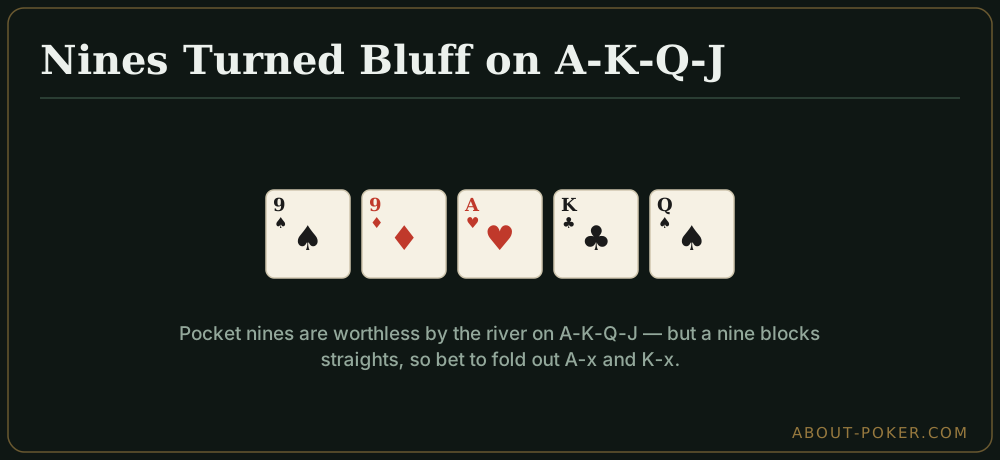
You hold 9-9 in the big blind and call a button raise. Flop comes A-K-4 rainbow. You check, villain c-bets small, you call — your nines have some equity and beat a lot of villain’s air. Turn is the Q of spades. Now the board reads A-K-Q, and your pocket nines have collapsed: you beat almost nothing that continues, and worse, the board smashes villain’s range of broadway cards.
You check, villain bets again. River is the J of hearts, completing every straight draw and putting A-K-Q-J on the board. Your nines are now nearly worthless — you lose to any ten, any ace, any king. Checking will win essentially never. But you hold a nine, which is a card in the T-9 and 9-8 straight combos and blocks a slice of villain’s range. If you lead or raise as a bluff on this scary, straight-completing river, you fold out one-pair hands like A-x and K-x that can’t call a big bet. Your hand couldn’t win at showdown — so you used it to win by betting instead. This is the same engine behind triple barreling: repeated pressure on a range that can’t continue.
When NOT to turn it into a bluff
The mistake is bluffing with made hands that still have showdown value. If checking wins a fair share of the time — say your middle pair still beats a chunk of villain’s bluffs — then checking to realize that equity is more profitable than betting. Turning a hand into a bluff throws away its showdown value, so it’s only correct when that value is already gone. Ask yourself honestly: if I check, do I ever win? If the answer is “almost never,” bluffing is on the table. If the answer is “sometimes,” check and take the free showdown.
How opponent type changes the call
- Against tight, honest opponents who fold correctly, turning a hand into a bluff works well — they lay down the medium hands you’re targeting.
- Against calling stations, never do it. They call with the exact hands you’re trying to fold out, so your bluff only donates chips. Check and give up.
- Against thinking opponents who read scare cards, a well-chosen blocker bluff on a range-shifting runout is highly effective, because they know their own range is capped.
For the flip side — knowing when a hand is genuinely a value bet instead of a bluff — see value betting.
Quick checklist
Two conditions must both be true. First, checking almost never wins — your showdown value is near zero on this runout. Second, betting can actually fold out better hands, ideally helped by blockers. If either fails — you still win sometimes by checking, or the opponent never folds — don’t do it. When both hold, turning a dead made hand into a bluff recovers value from a hand that would otherwise be a pure loss.
Frequently asked
What does turning a made hand into a bluff mean?
It means betting or raising with a hand that has some showdown value — like a weak pair — as a bluff, because that hand can't win at showdown against a strong range but can fold out better hands. You give up the small showdown equity to attack the pot.
When should you turn a made hand into a bluff?
When your hand is too weak to win a showdown but blocks the opponent's calling range, and when checking would almost never win. If a better line is to check and realize equity, don't bluff. Turn it into a bluff only when showdown value is near zero and the bluff has fold equity.
Doesn't a made hand have showdown value?
Some, but not always enough. A hand like bottom pair on a scary river might lose to almost everything that calls a bet and win almost nothing if checked. When its showdown value is that low, betting as a bluff can be more profitable than checking.