Value Bet Sizing
Size your value bets to the hands you beat, not to the hands that beat you. Learn how to pick value-bet sizes by opponent, board, and hand strength.
On this page · 6 sections
The single most important principle in value betting is deceptively simple: size to the hands you beat, not the hands that beat you. Every value bet is a question — “what’s the biggest amount a worse hand will still call?” — and your job is to find that number. Get it right and you extract maximum chips from second-best hands; get it wrong and you either scare off your customers or leave money on the table.
The Core Question Behind Every Value Bet
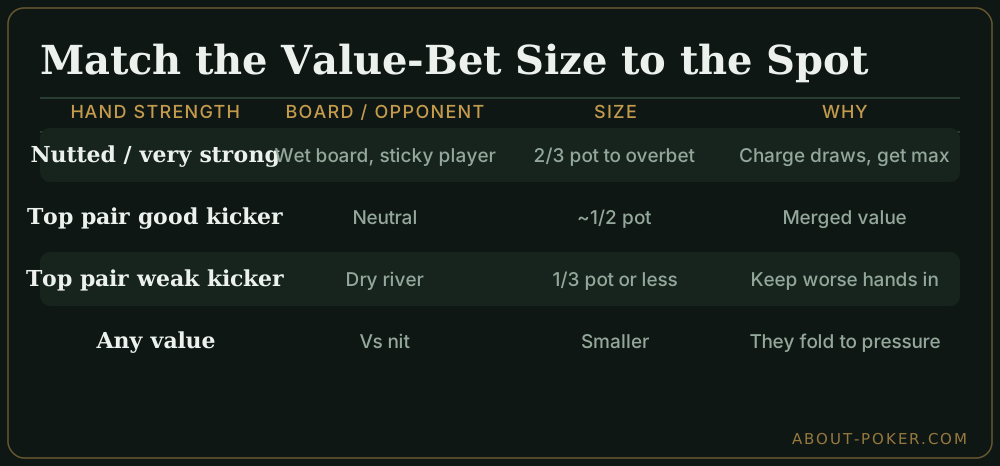
A value bet only makes money when a worse hand calls. That reframes sizing entirely. You’re not asking “how strong am I?” but “how strong is the range that calls me, and how much will it pay?” If your opponent’s calling range is full of medium-strength hands that hate folding, you can bet big. If it’s thin and nervous, you bet small to keep them in. The strength of your own hand only matters insofar as it beats what calls. This is the foundation laid out in value betting in poker.
Sizing Up: Strong Hands on Wet Boards
When you hold a genuinely strong hand and worse hands will still pay, size up. Two situations demand it. First, wet boards: if the texture is loaded with draws, a large bet — two-thirds pot to pot — both charges those draws and gets called by the made hands that can’t fold. Second, sticky opponents: some players simply call too much, and against them a big value bet with a strong hand prints money because they pay off with hands they should fold.
The mistake to avoid is betting big into a range that only continues when it beats you. If a tight player will only call your river bet with a better hand, sizing up just gets you stacked. Big value sizing requires a caller who shows up with worse.
Sizing Down: Thin Value
At the other end sits thin value — betting a hand that’s only marginally ahead of the calling range. Top pair with a weak kicker on the river, or an overpair on a scary runout, are classic thin-value spots. Here a large bet is self-defeating: it folds out exactly the worse hands you wanted to tax and only gets called by better ones. The fix is a small bet, often one-third pot or less, that keeps second pairs, weak top pairs, and ace-highs in the pot. The art of extracting from these marginal spots is covered in thin value on the river.
A Worked Example
You’re on the river with A-K on a board of A-9-4-6-2, all rainbow. The pot is $80. Your opponent, a straightforward player, called flop and turn bets and now checks to you.
His calling range is mostly weaker aces (A-Q, A-J, A-T), some nines, and a few busted draws. Against that range, a small bet folds out the busted draws for no reason and leaves value uncollected from the weaker aces. But a pot-sized bet risks getting called only by A-K or better, or by a nine that got there. The sweet spot is a medium bet — around $50, roughly 60% pot. The weaker aces still can’t find a fold at that price, and you extract two-thirds of a pot from a range you dominate. Betting $80 might win the same call from a station but risks folding out A-J from a thinking player; betting $20 simply leaves half your value behind.
Match the Size to the Opponent
Sizing is opponent-dependent as much as board-dependent. Calling stations reward larger value bets across the board — they don’t fold, so bet more. Nits and thinking regulars require more restraint, especially for thin value, because they fold marginal hands to pressure. The half-pot bet is often the reliable middle for merged value hands where you’re not sure how wide the call is; see half-pot bet strategy for when that compromise is exactly right.
A Value-Sizing Checklist
- Ask first: what worse hands call, and how much will they pay?
- Strong hand + wet board or sticky opponent: size up (two-thirds pot to overbet).
- Thin value (marginal edge): size down (one-third pot or less) to keep worse hands in.
- Never size to fold out the hands you beat — that’s the cardinal sin of value betting.
- Adjust for the player: more against stations, less against nits.
- Reassess each street: the worse hands that call the flop may not be there by the river.
Value betting isn’t about maximizing the bet — it’s about maximizing the call. Keep asking what a worse hand will pay, and let that number set your size.
Frequently asked
How big should a value bet be?
Size to the strength of the worse hands that will call. Strong made hands on wet boards want large bets (two-thirds pot to overbet) to charge draws and get paid; thinner value hands want smaller bets so marginal holdings still call.
What is thin value betting?
Thin value is betting a hand that's only slightly better than the hands your opponent calls with — like top pair weak kicker on the river. It requires a smaller size because a big bet would fold out the exact hands you're trying to get value from.
Should I bet bigger with a stronger hand?
Not automatically. You bet bigger when worse hands will still call bigger — usually on wet boards or against sticky opponents. With a monster on a dry board versus a tight player, a smaller size that keeps their bluff-catchers in can earn more.