Defending the Big Blind vs a Under the Gun Open
UTG opens the tightest range at the table, so your big blind defense has to shrink hard. Learn the correct BB calling and 3-bet ranges vs a UTG open.
On this page · 6 sections
When the player under the gun (UTG) raises and the action folds around to you in the big blind, you’re facing the strongest opening range at the table. That single fact changes everything. You still get the same pot-odds discount you always get in the big blind, but the range you’re up against is so much tighter that you have to defend far fewer hands than you would against a late-position raiser. This page gives you the correct calling and 3-betting ranges, the logic behind them, and a worked example.
Why UTG changes your defense
The big blind is a special seat: you already have one big blind invested, and when you call you close the action, so nobody can raise behind you. That’s why the big blind defends very wide against buttons and cutoffs — sometimes 40% or more of all hands.
But defense width is a function of two things: the price you’re getting and the strength of the opener’s range. Against UTG only the first factor is friendly. A solid UTG opening range in a 9-max game is roughly the top 15% of hands — big pairs, strong broadways, suited aces, and a handful of suited connectors. That range crushes marginal holdings. So even with a discount, hands like K7o or Q9o are simply dominated too often to continue profitably.
The result: against a 2.5bb UTG open you defend roughly the top 25-30% of hands, versus 40%+ against a button. You are cutting your defense almost in half purely because of range quality.
What to call and what to 3-bet
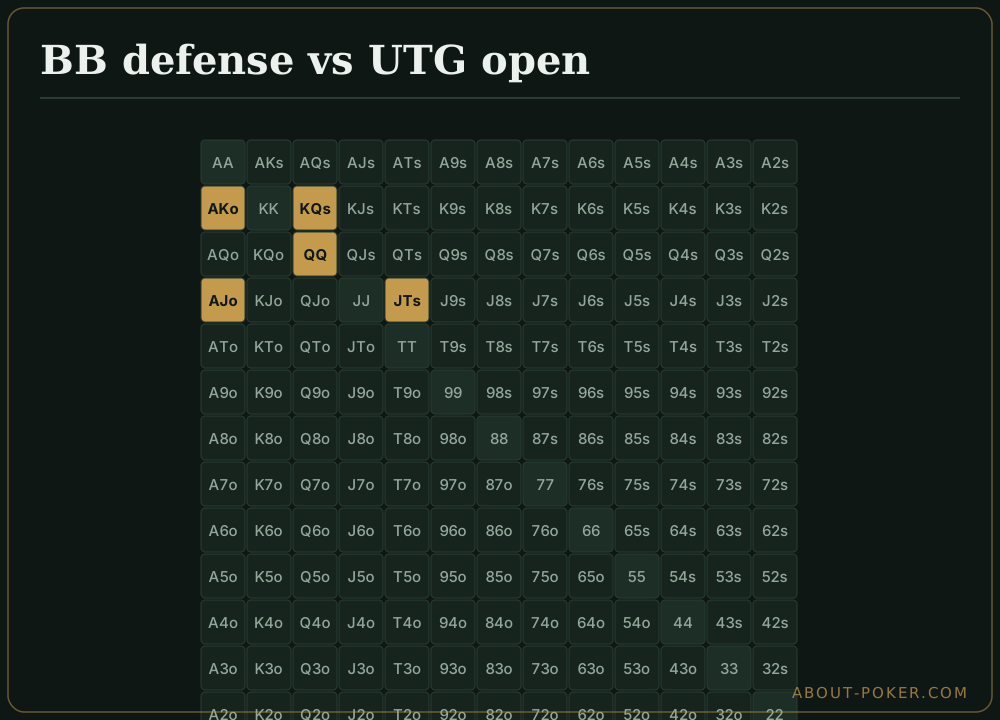
Split your continuing range into two buckets.
Call (flat) with the bulk of your range. Because UTG is so strong, you keep your 3-bets tight and just call with most playable hands: pocket pairs 22-JJ, suited aces down to about A5s, suited broadways (KQs, KJs, QJs, JTs), suited connectors down to about 65s, and the better offsuit broadways like KQo, AJo, KJo.
3-bet a small, mostly value-heavy range. Your value 3-bets are QQ+ and AK. Add a thin layer of bluffs — hands like A5s, A4s, and KJs/QJs that block the top of UTG’s continuing range and play well when called. Keep this range narrow. Because UTG rarely folds a strong opening range to a 3-bet, wide light 3-bets bleed money.
Everything else folds. That includes hands that look tempting but are dominated: KTo, QTo, ATo, most offsuit connectors, and small offsuit aces like A7o.
A worked example
You’re in the big blind with K9o. UTG opens to 2.5bb, everyone folds, and it’s on you. Should you defend?
Fold. K9o is exactly the kind of hand the discount tempts you into and the range quality vetoes. When UTG holds a hand like AK, AQ, KQ, or KJ, your kicker is dominated — you’ll flop a king and lose a big pot. Against a button open, K9o is a fine call because the button raises so wide that your K9 is often ahead. Against UTG’s top-15% range, K9o is roughly a fold: you don’t have the equity or the playability to overcome domination out of position.
Now swap it for K9s. The suitedness adds flush potential and enough extra equity that it becomes a marginal call — the flush and backdoor equity make up for the domination risk. That razor-thin line between K9o (fold) and K9s (call) is exactly the kind of distinction that separates disciplined defense from spew.
Adjusting for size and opponent
Everything above assumes a standard 2.5bb open. If UTG uses a larger 3bb+ sizing, tighten further — your discount shrinks and the price gets worse. If you’re playing against a weak live UTG who opens far too wide (say 25%+), you can widen back toward your button-defense range and even add exploitative 3-bets, because now the range quality assumption no longer holds.
The core discipline is simple: respect the position of the raiser. The same K9o is a call against a button and a fold against UTG, and understanding why is worth more than memorizing either chart.
Playing the flop after you defend
Defending correctly preflop is only half the battle; the trap with UTG opens is misplaying the flop against a strong range. Two guiding principles keep you out of trouble.
First, UTG’s range is condensed and strong, so it connects hard with high boards. On A-K-x or K-Q-x flops, UTG has an enormous share of the strong made hands, so your check-raises and floats should be far more selective than they’d be against a button. Do not bluff-raise into the exact texture the opener’s range loves.
Second, you have the range advantage on low, disconnected boards. When the flop comes something like 7-5-2 or 8-4-3, UTG has few sets and no big pairs improved, while your wide flatting range is full of pairs and pieces. These are the textures to lead into or to check-raise as a bluff, because the opener’s range is mostly two overcards that must fold. Sorting flops into “their board” and “your board” is the single biggest postflop skill in these spots.
A quick decision checklist
Before you defend against a UTG open, run through this:
- Is my hand dominated by UTG’s value range? Offsuit Broadways with weak kickers (KTo, QTo, ATo) usually are — fold them.
- Does suitedness or connectedness give me a way to make a strong hand? Suited aces, suited Broadways, and suited connectors realize equity far better than their offsuit versions. This is why K9s calls and K9o folds.
- Am I planning to call or 3-bet? If it’s a 3-bet, is it in the value bucket (QQ+, AK) or a disciplined blocker bluff (A5s, A4s)? If it’s neither, it’s a call or a fold, not a light 3-bet.
- Has the sizing or opponent changed the math? Bigger opens tighten you further; a loose live UTG lets you widen back out.
Nail those four questions and you’ll defend the big blind against early-position opens the way a solver does — tight, suited-weighted, and value-heavy on the 3-bets. Tie it back to the broader framework in defending the blinds and preflop opening ranges.
Frequently asked
How wide should the big blind defend against a UTG open?
Much tighter than against a late-position open. In a full-ring or 9-max game you defend roughly the top 25-30% of hands versus a 2.5bb UTG raise, because UTG opens a strong, condensed range. Against a button open you'd defend 40%+.
Should I 3-bet or call from the BB versus UTG?
Mostly call. Your 3-bet range against a UTG open is small and value-heavy — think QQ+, AK, and a few suited-broadway or suited-ace bluffs. Because UTG's range is so strong, light 3-bets get called or 4-bet more often, so you flat wide and 3-bet tight.
Why can't I defend as wide against UTG as against the button?
UTG's opening range is far stronger and more condensed, so your equity when called is lower and you're dominated more often. The pot discount is the same, but the quality of the opponent's range is what forces you to fold more hands.