How to Play Ace-Five Suited (A5s)
A5s is the premier wheel ace: a wide open and the go-to suited-ace 3-bet bluff. Learn why A5 suited blocks so well and how to play it preflop and postflop.
On this page · 8 sections
Ace-five suited (A5s) is the best of the wheel aces and the poster child for a good 3-bet bluff. It stacks three sources of value on top of each other: the nut-flush draw, the wheel straight (A-2-3-4-5), and the ace blocker. That combination makes A5s far more useful than its weak kicker suggests — it’s a wide open and, more importantly, the suited ace you reach for first when you want to bluff-3-bet.
Where A5s belongs preflop
- Early position: usually a fold at a full table, though it’s closer than the higher-kicker weak aces because of its straight potential.
- Middle position: a marginal open, more clearly open at 6-max.
- Cutoff and button: standard opens.
- Small blind: open by raising; the wheel potential makes it a comfortable raise-first hand.
- Big blind: defend widely against single raises.
But A5s’ signature spot isn’t opening — it’s the 3-bet. See how it fits a polarized range in 3-bet range.
Why A5s is the go-to 3-bet bluff
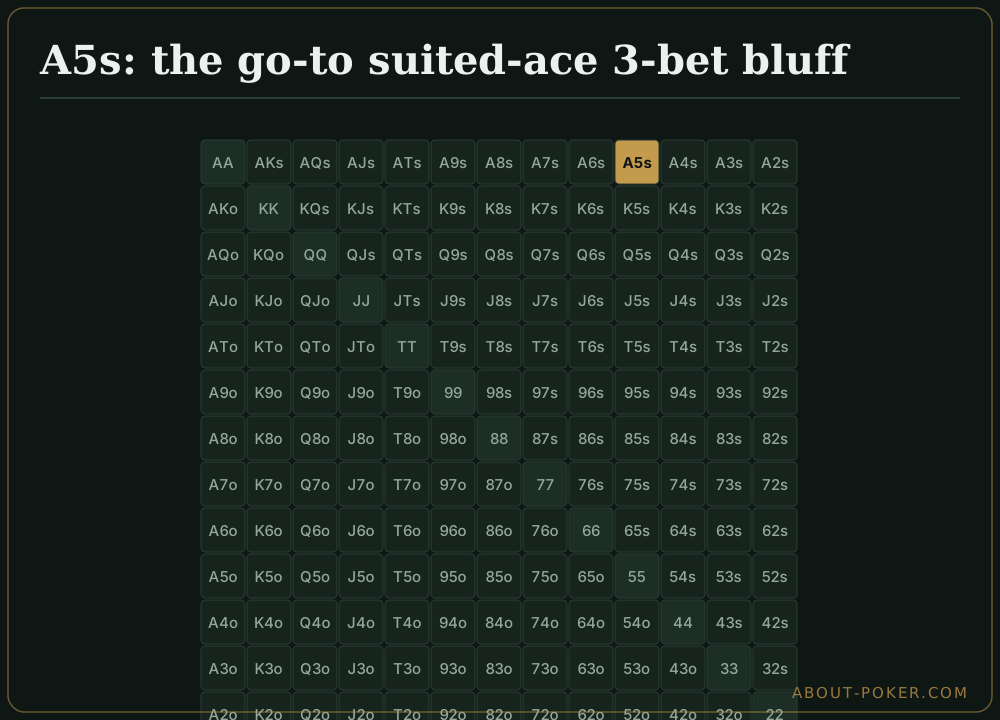
A good bluff does two jobs: it blocks the hands that would beat you, and it has a plan when called. A5s does both:
- Blocker: holding the ace cuts your opponent’s A-A from 6 combos to 3 and removes many A-K, A-Q, A-J combos from their continuing range. They simply have fewer nutted hands, so your 3-bet gets through more often.
- Fallback plan: when called, A5s flops the nut flush draw, wheel draws, and pairs. Unlike an offsuit junk hand, it can keep barreling with real equity.
This is exactly the “pick bluffs with blockers, keep a fallback plan” principle from preflop range construction. A5s is the clean example of that theory in a single hand.
A worked example
You’re on the button. The cutoff opens, and you 3-bet A♣5♣ as a bluff. The blinds fold. The cutoff calls.
Flop: K♣ 8♣ 3♦. You’ve flopped the nut flush draw — nine outs, roughly 35% equity as a bare draw, more with backdoor and ace-high outs. This is an easy continuation bet: you have a strong draw, fold equity against the cutoff’s many king-less calls, and a nutted payoff when a club arrives.
Turn is the 2♥, a brick. You barrel again — you still hold the nut draw and represent a strong king convincingly. If the river is a club, you have the nut flush and bet for maximum value; if it bricks, your ace-high sometimes wins at showdown, and you can fire a final bluff on scary run-outs. Every branch of this hand works because A5s blocks the cutoff’s premiums and flops real equity. That’s the difference between a principled 3-bet bluff and a spew.
When not to 3-bet it
A5s is a bluff, so it needs fold equity to be profitable. Against a calling station who never folds to 3-bets, drop the bluff and simply call in position — turning a hand that wants folds into a raise against someone who won’t fold is a leak. And against a tight early-position open, prefer flatting or folding rather than bluffing into a range full of the exact hands your ace blocks least.
Postflop shorthand
- Nut flush draw: semi-bluff aggressively; you can’t be drawing dead to a bigger flush.
- Wheel or wheel draw: strong, disguised equity — barrel and get paid when it completes.
- Top pair (ace): weak kicker; value bet in position, pot-control out of position.
- Air with the ace: a credible barreling and blocker-bluff hand.
A5s versus the value 3-bets it partners with
A polarized 3-bet range is built from two buckets: the strong hands you 3-bet for value (AA, KK, QQ, AK) and the bluffs you 3-bet to balance them (led by A5s and the other wheel aces). A5s only works as a bluff because it sits alongside those value hands — the whole point is that your opponent can’t tell them apart. When they face your 3-bet, they don’t know if you have aces or A5s, so they can’t profitably call wide or fold everything.
This is why A5s is a bluff and not a thin value bet. If you 3-bet it for value, you’d get called by better hands and fold out worse ones — the definition of a bad value bet. As a bluff, the logic inverts: you want folds, and when you don’t get them, your blockers and flush potential give you a hand that can still win. The 3-bet range page shows how many bluffs to pair with each value hand to stay balanced. As a rough anchor, solver ranges 3-bet roughly one to one-and-a-half bluff combos for every value combo at 100bb, and A5s is almost always in that bluff bucket.
How A5s compares to the offsuit weak aces
The suited quality of A5s is doing enormous work, and the contrast with offsuit weak aces makes it obvious. Take A5o versus A5s:
- A5s carries nut-flush potential, cleaner straight coverage, and better playability when called — a real 3-bet bluff and a fine open from late position.
- A5o keeps the ace blocker and the wheel straight but loses every flush, so its post-call equity collapses. It is mostly a blind-vs-blind hand and a marginal button steal, not a 3-bet bluff you’d fire into a raiser.
That gap — the flush and the extra playability — is exactly why the suited wheel aces are prized bluff candidates while their offsuit versions are near-junk. The blocker is identical between them; everything else that makes A5s good comes from the suit. Contrast that dynamic with a weak offsuit hand that leans purely on its blocker, like K4o’s blind-vs-blind role, and the value of suitedness in a low-kicker ace becomes clear.
Where to go next
A5s is where preflop theory becomes tangible: a low kicker that plays like a premium because of blockers and straight potential. Put it to work in your 3-bet range, understand the logic behind it in preflop range construction, see where it fits your opening spots in preflop opening ranges, and connect it all through the preflop strategy hub.
Frequently asked
Is A5 suited a good hand?
A5s is one of the most valuable low suited aces because it combines nut-flush potential, the wheel straight, and a powerful ace blocker. It opens from a wide range of positions and is the textbook suited-ace 3-bet bluff.
Why is A5 suited a good 3-bet bluff?
The ace blocks your opponent's A-A and many strong A-x combos, so they're less likely to hold a hand that continues. A5s also flops the wheel straight and straight draws, giving it a real fallback plan when called — the hallmark of a good bluff.
Is A5s better than A4s or A3s?
Marginally, yes. All three are wheel aces with similar profiles, but A5s makes slightly more straights (it uses the five as a connector to 6-7-8 as well as the 2-3-4 wheel), so it's usually the first wheel ace picked as a bluff.