How to Play Ace-Four Offsuit (A4o)
A4o is a weak offsuit ace whose value lives in the ace blocker and the wheel. Learn where A4 offsuit opens, when to 3-bet it as a bluff, and how to dodge.
On this page · 8 sections
Ace-four offsuit (A4o) is a weak offsuit ace that earns its keep with two small assets: the ace blocker and the wheel (A-2-3-4-5). Holding an ace makes it less likely your opponent has A-A or a strong A-x, which quietly lifts A4o’s value as a light 3-bet bluff and a heads-up hand. Take away the blocker, though, and you’re left with a poor kicker and no flush help. A4o is a discipline hand: apply the blocker where it counts, and fold before the weak kicker drags you into a big pot.
Where A4o belongs preflop
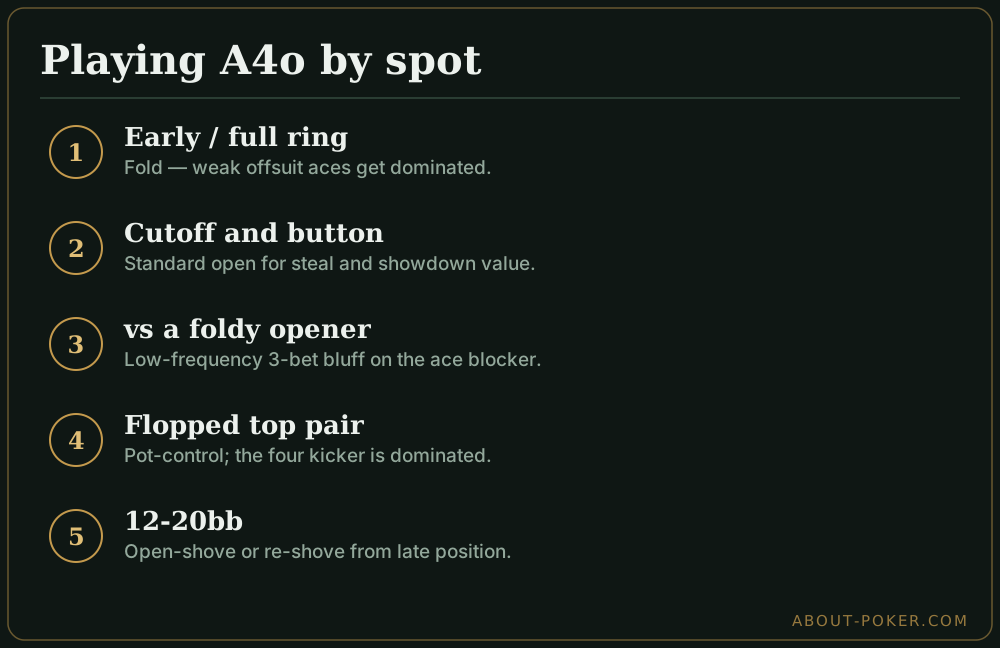
- Early position: fold at a full table. Weak offsuit aces invite domination from every better ace behind you.
- Middle position: a marginal open at 6-max, still a fold at full ring.
- Cutoff and button: standard opens. Position lets you realize the ace’s showdown value and steer the weak kicker carefully.
- Small blind: open by raising in blind-vs-blind spots, where the ace blocker shines heads-up. See blind vs blind play.
- Big blind: defend against opens, but play cautiously postflop — top pair with a four kicker is a trap.
The blocker and the wheel, not the kicker
A4o’s kicker is bad, so its value comes from what it removes and what it can make. Holding the ace cuts your opponent’s A-A from 6 combos to 3 and strips many A-K, A-Q, and A-J combos out of their continuing range. That’s why A4o shows up as a light 3-bet bluff — the same blocker logic that makes A4 suited a premier suited-ace bluff. The difference: A4o has no flush to fall back on when called, so it bluffs at a lower frequency and relies on fold equity. Deploy it inside a polarized 3-bet range, mostly against opponents who over-fold. The wheel adds a second layer: A4o can flop or turn a straight or a strong draw, giving it disguised equity when it does connect.
A worked example
You’re in the small blind, the button opens, and you 3-bet A♠4♦ as a bluff. The button folds to 3-bets often, so the ace blocker plus fold equity makes the re-raise profitable on its own.
Say the button calls instead. Flop: A♥ 9♣ 4♠. You’ve flopped top pair, weak kicker — showdown value, but your four kicker is dominated by every A-9 through A-5 that called. The right plan is usually pot control: bet small or check to keep the pot manageable, and be ready to fold to serious aggression. Now suppose the flop is 5♦ 3♣ 2♠ instead. You’ve flopped an open-ended wheel draw — an ace or a six completes the straight, and you also hold a pair-and-gutshot mix. That’s a hand to barrel with, because your equity is real and disguised. A4o wins by reaching a cheap showdown or by hitting the wheel, not by bloating a pot with a dominated top pair.
Postflop shorthand
- Top pair (ace), weak kicker: pot-control it; don’t stack off. Value bet thin only in position.
- Wheel or wheel draw: disguised equity — barrel and get paid when it lands.
- Pair of fours / gutshot: a peel-one-card hand, not a raising hand.
- Ace-high, no pair: a credible blocker bluff that occasionally wins unimproved.
How stack depth changes A4o
The blocker bluff lives and dies on fold equity, and fold equity is a function of stack depth. At 100 big blinds, a 3-bet with A4o commits a meaningful chunk of your stack, and if the opener 4-bets you have an easy fold — you’ve simply lost the 3-bet size. That’s a fine risk against a foldy opponent, but it means A4o is a low-frequency bluff at deep stacks, not a hand you jam in every orbit.
At short stacks the picture flips in A4o’s favor. Around 12 to 20 big blinds, A4o becomes a comfortable open-shove or re-shove hand from late position and the blinds. Now the wheel and kicker barely matter — you’re playing an ace with fold equity, and any ace has enough raw equity to shove profitably when the alternative is blinding out. The classic push-fold charts include A4o as a jam from the cutoff, button, and small blind at these depths. In short: deep, A4o is a careful blocker bluff; shallow, it’s a standard shove.
Reading the board texture
Because A4o’s value is so lopsided — great when it makes the wheel, poor when it makes a weak top pair — board texture should steer almost every postflop decision.
- Ace-high boards: you have showdown value but a dominated kicker. Keep the pot small. A single thin value bet in position is fine; stacking off is a leak because the hands that call are mostly better aces.
- Low, connected boards (fives and below): these are your barreling boards. A 5-4-3 or 6-3-2 flop gives you pairs, gutshots, or open-enders with disguised strength, and your opponent’s overcards missed.
- High, disconnected boards (K-Q-7 type): you’ve whiffed and hold only ace-high. This is a give-up or a single small stab, not a spot to fire multiple barrels.
When not to play it
Fold A4o from early position and against tight opens — you’d be 3-betting into the exact strong aces your blocker least neutralizes, and calling means playing a dominated kicker out of position. Against a calling station who never folds to 3-bets, drop the bluff entirely; turning a fold-equity hand into a raise against someone who won’t fold is a clear leak.
Where to go next
A4o is a blocker-and-wheel hand: open it late, jam it as a light 3-bet against foldy players, and keep the pot small when your weak kicker connects. Sharpen the theory in 3-bet range, see the stronger version in A4 suited, and master its best home in blind vs blind play.
Frequently asked
Is A4 offsuit a good hand?
A4o is a marginal hand that leans almost entirely on its ace blocker and wheel potential. It is too weak to open from early position, but it opens from late position, plays well blind-vs-blind, and works as a light 3-bet bluff because the ace blocks premium aces.
Should you 3-bet A4 offsuit?
Sometimes, purely as a bluff. The ace blocks your opponent's AA and strong A-x, so your 3-bet gets through more often. Because A4o has no flush backup when called, it is a lower-frequency bluff used mainly against players who over-fold to 3-bets.
How does A4o compare to A4 suited?
A4 suited is clearly stronger because it adds nut-flush potential and smoother playability, making it a top-tier 3-bet bluff. A4o keeps the ace blocker and the wheel straight but loses the flush, so it is played more cautiously and folded more often preflop.