How to Play Ace-Four Suited (A4s)
A4s is a wheel ace and a premium suited-ace bluff. Learn where A4 suited opens, why it makes an ideal 3-bet bluff, and how to play it after the flop.
On this page · 10 sections
Ace-four suited (A4s) is a wheel ace and one of the best suited-ace bluffs in the game, sitting a hair behind A5s. It carries the same three-layered value that makes low suited aces punch above their kicker: the nut-flush draw, the wheel straight (A-2-3-4-5), and the ace blocker. The four in your hand barely matters — what matters is that A4s blocks your opponent’s best hands and flops real equity when called.
Where A4s belongs preflop
- Early position: typically a fold at a full table.
- Middle position: marginal; more clearly an open at 6-max.
- Cutoff and button: standard opens.
- Small blind: open by raising rather than limping.
- Big blind: defend widely against single raises with a price — see defending the blinds.
As with A5s, A4s’ headline use is the 3-bet bluff. It’s a core piece of a well-built polarized 3-bet range.
Why A4s makes a premium bluff
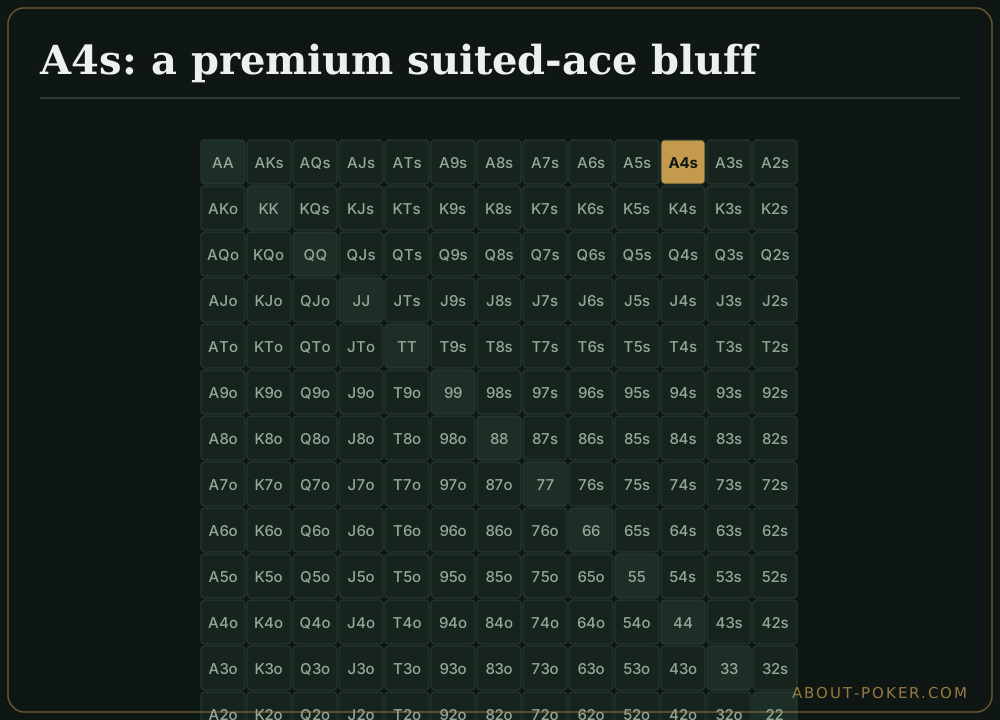
The two qualities of a good bluff — blocking and a fallback plan — both live in A4s:
- Blocker: the ace removes combos of A-A, A-K, A-Q, and A-J from your opponent’s continuing range, so they fold to your 3-bet more often than a random hand would earn.
- Fallback: when called, A4s flops nut-flush draws, wheel draws, and pairs, so it can keep applying pressure with equity rather than pure air.
This is the textbook application of the “blockers plus a plan” idea from preflop range construction. A4s and A5s are essentially interchangeable as bluffs; you use them together to give your 3-betting range enough believable pressure.
A worked example
The hijack opens and you 3-bet A♥4♥ from the button as a bluff. Everyone folds to the hijack, who calls.
Flop: Q♥ 7♥ 2♣. You’ve flopped the nut flush draw — nine outs, about 35% equity as a bare draw, more counting your ace overcard and backdoor straight outs. You continuation-bet: strong draw, fold equity against the hijack’s air, and a nutted payoff when a heart lands.
Turn is the 9♠, a brick for you but a scary card for the hijack’s medium hands. You barrel again — you still hold the nut draw and credibly represent a big queen or an overpair. A river heart gives you the nut flush and a max-value bet; a brick still leaves your ace-high as an occasional winner and a further bluff on the right run-outs. Every line profits because A4s blocks the hijack’s strong hands and flops genuine equity — the same reason A5s works, played the same way.
When to skip the bluff
A4s needs fold equity. Against a station who calls 3-bets too wide, stop bluffing and flat call in position instead — you don’t want to inflate the pot with a weak made hand against someone who won’t fold. And against a tight, early-position open, the value hands you’d normally block are less prevalent in a way that favors just folding or calling rather than firing.
Postflop shorthand
- Nut flush draw: semi-bluff hard; never drawing dead to a bigger flush.
- Wheel / wheel draw: disguised strength — barrel and extract when it hits.
- Top pair (ace): weak kicker; value bet in position, pot-control out of position.
- Air with the ace: a legitimate blocker bluff.
Where to go next
A4s proves that in modern poker, blockers and draws matter more than kickers. Deploy it in your 3-bet range, understand why it works via preflop range construction, and tie it into the rest of your game at the preflop strategy hub.
How stack depth changes A4s
The 3-bet-bluff plan assumes you have room to apply pressure across multiple streets, which means stack depth matters. At 100 big blinds and deeper, A4s is a premium bluff precisely because the nut-flush draw and the wheel give it a real fallback when the 3-bet gets called — you can barrel with equity and stack someone when your draw fills. As stacks get shorter, the calculus changes. Around 20 to 30 big blinds, a low suited ace is often better used as a 3-bet shove or a fold than a small 3-bet, because the postflop game where the draws pay off has been compressed. And at very short stacks the ace-high itself gains value as a shoving hand, so you lean on the raw blocker and give up on the multi-street bluff plan entirely.
Position works the same way it does for every speculative hand. In position you get to see how your opponent reacts, control the pot, and realize your draw equity fully; out of position — for example if you flat and then face a squeeze — A4s is much harder to play and you should fold more readily rather than putting in chips with a hand that wants initiative.
Multiway versus heads-up
A4s is built for heads-up pots, where its blockers and fold equity do the heavy lifting. The moment a pot goes multiway, the bluff value collapses: you cannot fold out three players with one 3-bet, and someone will usually have a piece of any given flop. In multiway pots, treat A4s as a pure drawing hand — continue only when you actually flop the nut-flush draw or the wheel draw, and give up the pure-blocker bluffs. This is why A4s is a 3-bet bluff to isolate the original raiser heads-up, not a hand you want to see five ways to a flop with.
A4s versus A5s and the other wheel aces
A4s and A5s are near-identical, but the small differences are worth knowing. A5s makes the wheel with 2-3-4 on board and also plays the A-2-3-4-5 straight one card lower, giving it a hair more straight equity, so solvers usually reach for A5s first when they only want one wheel-ace bluff. A4s is the natural second, and A3s and A2s fill out the group when a range needs more blocker bluffs. The practical point: you do not need to memorize each one separately. Learn the archetype — low suited ace, nut-flush draw, wheel potential, ace blocker — and you know how to play the whole family. Just avoid over-loading your range with all of them at once, which turns your 3-betting range too bluff-heavy and lets observant opponents 4-bet you off your air.
A quick decision checklist
- Late position, facing a wide open? 3-bet as a bluff.
- Facing a tight early open? Fold or flat, do not bluff into premiums.
- Called and flopped a nut-flush or wheel draw? Barrel as a semi-bluff.
- Pot went multiway? Play it as a pure draw, drop the bluffs.
- Opponent never folds? Stop bluffing; flat in position for set-and-draw value.
Frequently asked
Is A4 suited playable?
Yes. A4s is a wheel ace with nut-flush potential, straight potential, and a strong ace blocker. It opens from late position and the blinds and is one of the preferred suited-ace 3-bet bluffs, right alongside A5s.
Should I 3-bet A4 suited?
Often, as a bluff. The ace blocks premium ace-x and pocket aces so your 3-bet gets through more, and the hand flops the wheel and flush draws as a fallback. Against calling stations, flat call in position instead of bluffing.
Is A4s the same as A5s?
Almost. Both are wheel aces with near-identical profiles. A5s makes slightly more straights, so it's usually chosen first, but A4s is an excellent second wheel-ace bluff and is played essentially the same way.