How to Play Ace-Three Suited (A3s)
A3s is a wheel ace that opens late and works as a suited-ace 3-bet bluff. Learn where A3 suited plays, its blocker and straight value, and postflop lines.
On this page · 9 sections
Ace-three suited (A3s) is a wheel ace, the third of the low suited aces that behave like premiums despite a tiny kicker. Like A5s and A4s, it draws its value from three overlapping sources: the nut-flush draw, the wheel straight (A-2-3-4-5), and the ace blocker. The three in your hand is nearly irrelevant at showdown; what earns money is the way A3s blocks your opponent’s strong hands and keeps equity when the money goes in.
Where A3s belongs preflop
- Early position: usually a fold at a full table.
- Middle position: marginal; a cleaner open at 6-max.
- Cutoff and button: standard opens.
- Small blind: open by raising, not limping.
- Big blind: defend widely against single raises with a discount.
For the seat-by-seat borders, anchor on preflop opening ranges. A3s’ most distinctive use, like its wheel-ace siblings, is as a 3-bet bluff inside a polarized 3-bet range.
Why the wheel aces bluff so well
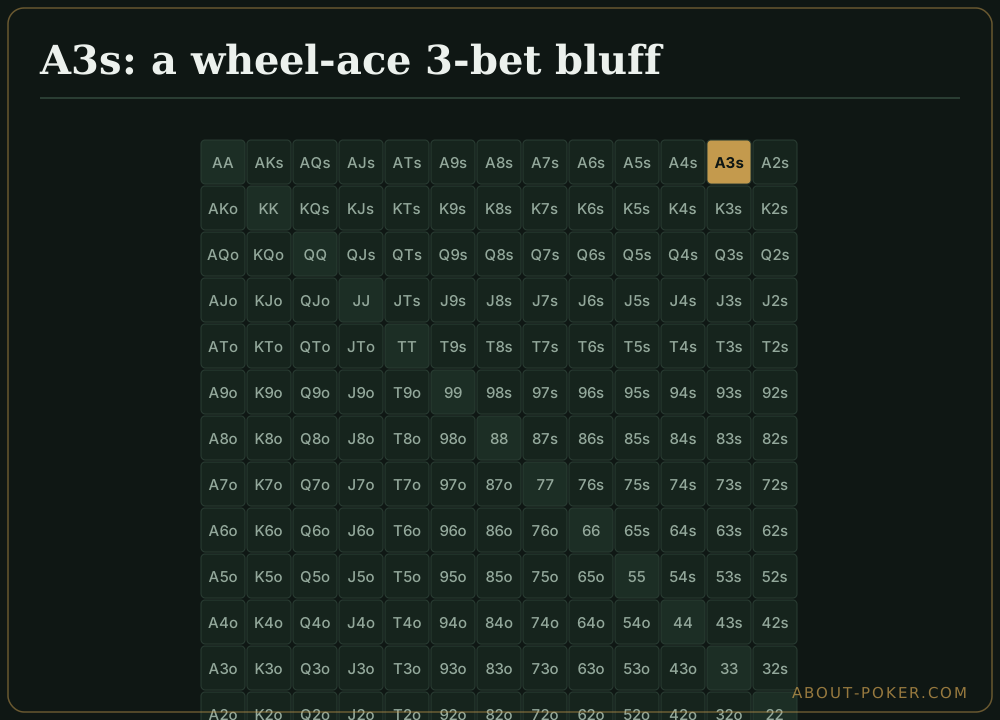
A3s checks both boxes of a good bluff — it blocks your opponent’s continuing hands and has a fallback plan when called:
- Blocker: holding an ace cuts opponent A-A from 6 combos to 3 and strips many A-K, A-Q, A-J combos out of their range. Fewer nutted hands means your 3-bet gets through more often.
- Fallback: when called, A3s flops nut-flush draws, wheel draws, and pairs — real equity to keep barreling, not dead air.
That’s the “blockers plus a plan” logic from preflop range construction. A3s ranks just behind A5s and A4s because it makes slightly fewer straights, but it’s played the same way and rounds out a believable bluffing range.
A worked example
The cutoff opens and you 3-bet A♠3♠ from the small blind as a bluff. The big blind folds; the cutoff calls.
Flop: J♠ 6♠ 4♦. You’ve flopped the nut flush draw plus a backdoor wheel draw — nine clean flush outs, about 35% equity as a bare draw, more with ace-high and backdoor outs. Out of position, you continuation-bet: you have a strong draw, you deny equity, and you can stack the cutoff when a spade completes.
Turn is the 9♥, a brick. You barrel again — you still hold the nut draw and represent an overpair or a strong jack. A river spade gives you the nut flush for a big value bet; a brick leaves your ace-high as an occasional winner and a spot to fire one more bluff on the right cards. The hand profits because A3s blocks the cutoff’s premiums and flops genuine equity — even played out of position, the blocker-plus-draw structure carries it.
When to hold back
A3s only bluffs profitably when opponents fold enough. Against a calling station, drop the 3-bet and call in position instead — bluffing a weak hand at someone who never folds just builds pots you’ll lose. And from out of position against a tight raiser, folding is often better than either flatting or bluffing, since you’ll struggle to realize equity.
How stack depth changes A3s
The value of A3s shifts sharply with the effective stack. At 100bb, the nut-flush draw is the star: when the money goes in deep, the hand that makes the nut flush stacks the second-best flush, so A3s’ implied odds are enormous. This is why deep-stacked play tolerates a wider suited-ace 3-bet range — the payoff on the rare stack-off is worth the frequent small losses.
Shorten to 40bb and the picture flattens. Implied odds shrink because there’s less behind to win, and the blocker becomes the main reason to 3-bet — you’re mostly trying to fold out the top of your opponent’s range and pick up the pot preflop or with one continuation bet. Below 20bb in a tournament, A3s stops being a 3-bet-bluff hand and becomes a 3-bet shove: the ace plus wheel and flush equity means it flips fine against a caller and folds out plenty, so you jam rather than raise-fold.
The rule of thumb: the deeper you are, the more A3s wants to see flops and realize its draws; the shorter you are, the more it wants to get the money in preflop while its blocker and raw equity still matter.
Multiway and position adjustments
A3s is a heads-up hand, not a multiway one. Its equity comes from blockers and the nut-flush draw, and both degrade when several players see the flop — the blocker matters less against a wider field, and a bare flush draw wins a smaller share of a three- or four-way pot. If your 3-bet is likely to get called in two spots, or you’d be flatting into a family pot, A3s’ bluff value collapses; prefer folding or, from the button, a simple open that keeps the initiative.
Position also decides whether the flatting line exists at all. In position against a late-position open, calling with A3s is fine because you realize equity well and can take a free card with your draw. Out of position, the flat is much weaker — you’ll check-fold too many flops — so out of position the hand is better as a 3-bet or a fold, not a call. That’s the practical reading of the “raise or fold out of position” idea in preflop range construction.
Quick decision checklist
- Late position, folded to you: open. Standard.
- Facing a single raise, in position: 3-bet as a bluff against a foldy raiser; flat against a loose caller who lets you realize equity.
- Facing a raise, out of position: 3-bet or fold — avoid the dominated flat.
- Short (under 20bb), facing an open: 3-bet shove rather than raise-call.
- Multiway pot likely: downgrade sharply; the blocker and lone flush draw lose value.
- Postflop with the flush draw: semi-bluff; you’re never drawing dead to a bigger flush and you hold the nut redraw.
Postflop shorthand
- Nut flush draw: semi-bluff aggressively; never drawing dead to a bigger flush.
- Wheel / wheel draw: disguised strength worth barreling and stacking off with when it hits.
- Top pair (ace): weak kicker; value bet in position, pot-control out of position.
- Air with the ace: a credible blocker bluff.
Where to go next
A3s completes the wheel-ace trio — proof that blockers and straight potential outrank a big kicker in a well-built range. Slot it into your 3-bet range, understand the reasoning in preflop range construction, and tie it back to the rest through the preflop strategy hub.
Frequently asked
Is A3 suited a good hand?
A3s is a solid wheel ace. It opens from late position and the blinds and serves as a suited-ace 3-bet bluff thanks to its ace blocker, nut-flush potential, and wheel straight. Its weak kicker means most of its value comes from draws and blocking, not showdown.
Should I 3-bet with A3 suited?
Yes, as a bluff in the right spots. The ace blocks premium hands so your 3-bet folds them out more often, and the hand flops flush and wheel draws as a fallback. It's slightly behind A5s and A4s in bluff priority but is used the same way.
Why play A3s over an offsuit ace?
The suited version adds nut-flush potential and much better equity realization. A3s can open late and 3-bet as a bluff, while A3 offsuit is far more marginal and usually only playable from the button or blinds.