How to Play Eight-Four Suited (84s)
Eight-four suited is a weak three-gapper that is a fold from almost everywhere except the button and blind defense. Learn exactly when 84s is playable.
On this page · 6 sections
Eight-four suited (84s) is a three-gapper — the eight and four straddle a missing seven, six, and five — which lands it near the bottom of the playable suited hands. With that many gaps, its straight potential is almost gone: the only straight it can make requires the board to supply the entire 5-6-7 middle, so in practice 84s is a flush-draw-and-nothing-else hand. It sits clearly below the eight-five suited two-gapper, and it should be a fold from nearly every seat. When it is playable at all, it is a button steal or a discounted big-blind defend that survives on its flush and its position.
Where 84s belongs preflop
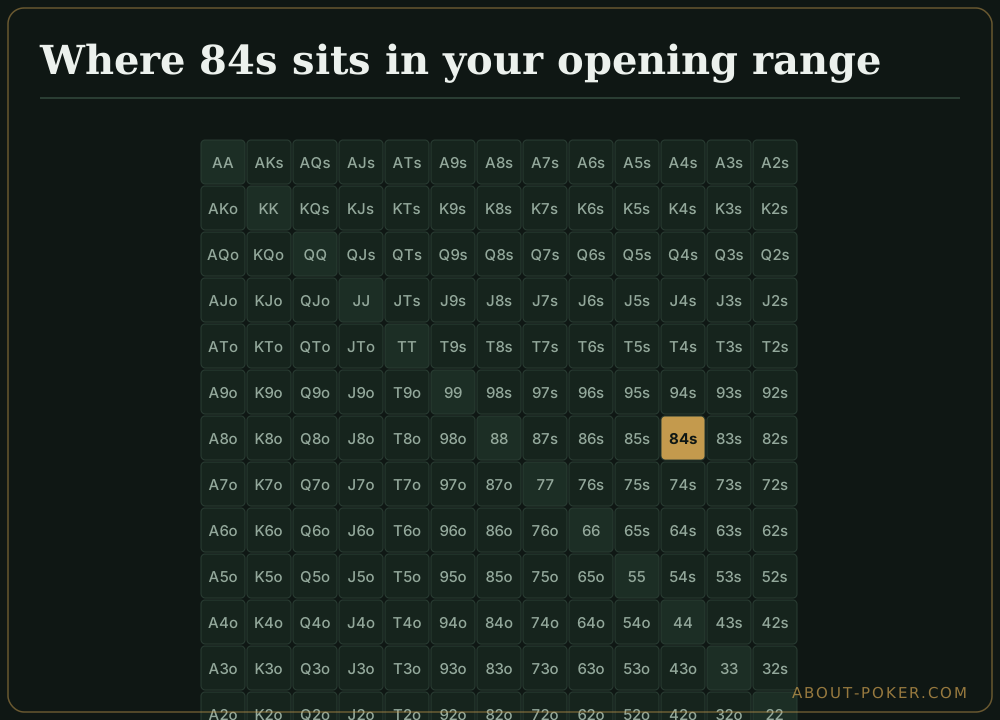
By seat, 84s is a fold almost everywhere:
- Early and middle position: fold, without exception.
- Cutoff: fold in nearly all games.
- Button: a marginal open at the very bottom of your range, and only when it folds to you.
- Small blind: generally a fold; open only against unusually tight blinds.
- Big blind: an occasional discounted defend against a late open.
Anchor the borders in the preflop opening ranges. 84s sits below the eight-five suited two-gapper and belongs in your range only when position and price are both in your favor.
Why the third gap matters so much
Each gap you add strips out straight combinations, and by the third gap there is almost nothing left. A connector makes straights from both ends; a three-gapper like 84s needs the board to build the entire missing stretch, which is rare. That leaves the flush draw as its only reliable source of equity, plus a sliver of disguise value on the odd made hand. Because its straight equity is essentially zero and its pairs are weak and easily dominated, 84s must have position and a flush draw to be worth a chip. Out of position or without a flush, it should not be in the pot.
Facing a raise
Against an opener, 84s is a fold in the overwhelming majority of spots. It is a poor 3-bet bluff — the equity when called is weak and there is no straight potential to fall back on — so leave that job to the connectors. The only reasonable continue is a discounted big-blind defend against a wide late raiser, where the price lets you flop the occasional flush draw cheaply. Everywhere else, fold. Keep those marginal defends disciplined through defending the blinds.
A worked example
You open 8♥4♥ on the button and the big blind calls. The flop comes 8♣ 5♥ 2♥ — you have flopped top pair plus a flush draw. That is the dream flop for a hand like this: your pair has showdown value and your nine flush outs give you roughly 35% equity to hit the flush alone by the river with two cards to come, on top of the pair. You bet for value and protection. The big blind calls, the turn is the Q♥, and you complete the flush and bet again. This flush-plus-pair scenario is essentially the only way 84s wins a big pot.
Now suppose the flop had come 8♠ 9♦ 2♣ — top pair, eight-high, with a four kicker and no flush draw. That is a weak, easily dominated one-pair hand: check it down or fold to pressure. Without the flush draw, 84s has nothing to lean on.
Postflop in one paragraph
When 84s flops a flush draw, that is its only real reason to keep playing — semi-bluff it and continue. When it flops a combo draw or a completed flush, play it hard for value. When it flops top pair without a draw, keep the pot tiny and give up to any real aggression. When it whiffs, fold. Because a three-gapper has essentially no straight potential, treat 84s as a flush-or-fold hand and do not get attached to its pairs.
Where to go next
84s is a weak three-gapper that is a fold almost everywhere and a flush-dependent button steal at best. Sharpen your opens with the preflop opening ranges, compare it to the slightly stronger eight-five suited, and tie the framework together at the preflop strategy hub.
Frequently asked
Is eight-four suited a good hand?
No, it is a weak hand. 84s is a three-gapper with almost no straight potential, so it relies entirely on its flush draw and position. It is a fold from every seat except an occasional button open or a discounted big-blind defend.
Can you open eight-four suited?
Only as a marginal button open, and even then it sits at the very bottom of your opening range. From every other seat 84s should be folded. Without position and a suited flush draw to lean on, it has too little going for it.
Should you 3-bet bluff eight-four suited?
Rarely. 84s makes a poor 3-bet bluff because it has weak equity when called and little straight potential. Prefer suited connectors and one-gappers for connector bluffs and leave 84s in the fold pile most of the time.