How to Play Five-Three Suited (53s)
Five-three suited is a small one-gap suited connector that plays through its draws. Here is how to open, defend, and play 53s the right way.
On this page · 6 sections
Five-three suited (53s) is a small one-gap suited connector. That single gap between the five and the three matters: it removes some of the straight combinations that a fully connected hand like five-four suited enjoys, so 53s is a clear step weaker. Still, it is far from trash. It is suited, so it makes flushes, and it can make straights on both sides — including the wheel (A-2-3-4-5) with an ace. Heads-up against a random hand it wins only about 42%, but as with all small suited hands, raw equity is not the point. You play 53s for its playability — the disguised draws and straights it flops in cheap, in-position spots.
One gap, and why it costs you
Every gap in a connector removes straight outs. A hand like 54s can flop open-ended draws and use both of its cards in more straight runs; 53s makes fewer of those and more often flops a gutshot instead of an open-ender. That difference is small but real, and it pushes 53s below 54s in every range. In practice it means you play 53s a little tighter: mostly from late position and the big blind, and you lean even harder on its flush potential and disguised value.
Opening and defending
As an open, 53s is a late-position-only hand. It is a marginal raise from the button, and sometimes from the cutoff or small blind in six-max, where suited one-gappers can just qualify. From early and middle position it folds. Your preflop opening ranges should treat 53s as a fringe late-position holding and drop it entirely up front.
The big blind is 53s’s most comfortable home. When you face a raise, get a price, and close the action, 53s is a fine defend against wide late-position opens. It is exactly the kind of cheap, suited, semi-connected hand that thrives in wide defending ranges where its flush and straight draws can flop with position and a discount.
A worked example
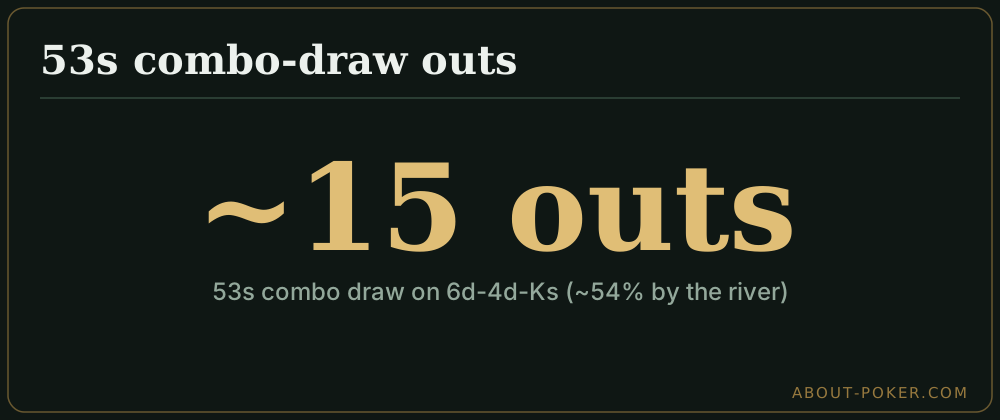
You defend the big blind with 5♦3♦ against a button open and the flop comes 6♦-4♦-K♠.
This is a monster draw for 53s. You have a flush draw — any diamond makes your flush, nine outs — plus an open-ended straight draw, since any seven or two completes a straight using your 5-3 with the 6-4 board. Together that is a combo draw with roughly fifteen clean outs and about 54% equity to improve by the river with two cards to come — you are actually a favorite against a single made pair. This is a textbook semi-bluff: bet or check-raise aggressively, because you have both fold equity and huge equity when called.
Compare that to a flop of Q♠-9♥-3♣, where you hold bottom pair with no draw. That is a weak, low-equity spot — check and give up cheaply rather than committing chips.
Common mistakes with 53s
Small suited gappers reward discipline and punish wishful thinking. The usual leaks:
- Playing it from early or middle position. 53s has no business opening up front. Its equity is too low to survive a 3-bet, and you gain nothing from a hand that folds to any real pressure.
- Calling 3-bets with it. When you open 53s from the button and face a re-raise, fold most of the time. You are out of implied-odds territory once the pot bloats and stacks shorten relative to the pot, and bottom-of-range speculative hands do not want to play big pots.
- Overvaluing a bare pair. Flopping a pair of fives or threes is almost worthless — it is regularly outkicked and rarely improves. If the pair does not come with a draw, treat it as a check-and-give-up, not a hand to fire bets with.
- Chasing a naked gutshot to the wheel. A single four-out gutshot is usually not enough equity to keep firing against a bet. Fold your weak draws and save your aggression for the strong combo draws where the math backs you.
How the spot changes with conditions
53s is condition-sensitive because it lives on implied odds. Deeper stacks help it a lot: at 150-200bb, the payoff when you flop a well-disguised straight or flush is large, which is exactly the situation that justifies a speculative late-position open. Short stacks hurt it: at 40bb or less, you cannot get paid enough on your big flops, so drop it from your opening range. Opponent type matters too: 53s prefers a loose, passive field that lets you see cheap flops and pays you off when you hit, and it does poorly against tight, aggressive players who apply pressure before you can realize your draw-heavy equity. Against those opponents, tighten up and defend it only at genuine bargain prices. Compare its narrow requirements to the fully connected five-four suited, which qualifies from slightly more seats thanks to its extra straight combinations.
The right mindset
Treat 53s as a late-position and big-blind hand that lives on its draws. Open it only from the back, defend it in the big blind at a good price, and postflop press hard with strong draws while folding bare weak pairs. Respect the one gap by playing it a touch tighter than fully connected hands. Its profit is all playability — the disguised straights and flushes it hits cheaply and in position, and the discipline to fold the many flops where it makes nothing.
Frequently asked
Is five-three suited playable?
In the right spots, yes. 53s is a small one-gap suited connector that makes straights and flushes, including the wheel with an ace. Its raw equity is low, but its playability makes it a reasonable speculative hand in late position and a fine big-blind defend at a good price.
Should you open five-three suited?
Only from late position, and even then it is close. 53s is a marginal open from the button and sometimes the cutoff or small blind in six-max. From early and middle position it folds. Its one gap makes it noticeably weaker than the fully connected 54s.
How do you play 53s postflop?
Play it for draws. Continue with straight draws, flush draws, combo draws, and made straights or flushes, and semi-bluff your strong draws in position. Fold when you flop a bare weak pair with no draw, which is the most common outcome.