How to Play Five-Four Suited (54s)
Five-four suited is a small suited connector with strong straight and flush potential. Here is how to open, call, and play 54s across positions.
On this page · 6 sections
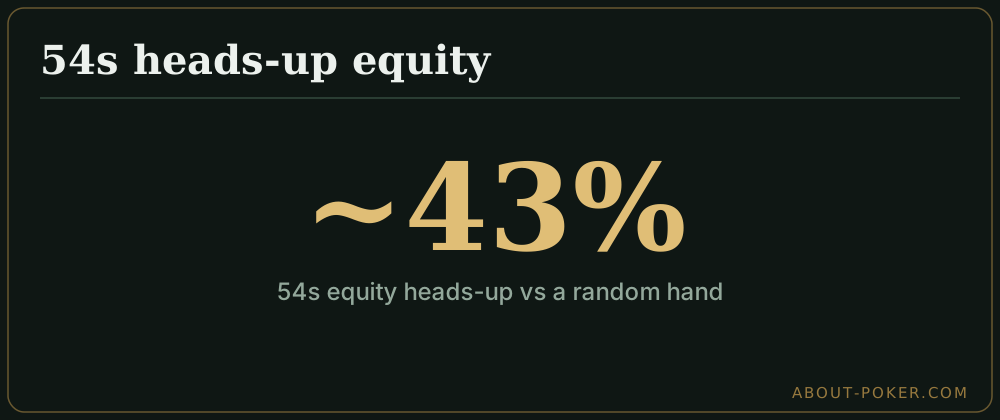
Five-four suited (54s) is a small suited connector, and it is one of the better speculative hands in the deck for its price. Unlike disconnected trash, 54s is fully connected — it can make straights in multiple directions, including the wheel (A-2-3-4-5) — and being suited it also makes flushes. Its raw high-card strength is low; heads-up against a random hand it wins only about 43%. But raw equity is not why you play it. You play 54s for its playability: the frequent, disguised draws it flops, and the big pots it wins when those draws come in. It belongs in the same family of hands as seven-six suited, just a rung lower.
Why 54s is playable despite low equity
A hand’s value has two parts: how often it is ahead right now, and how well it plays across future streets. 54s is rarely ahead preflop, but it flops strong draws and disguised straights at a high rate, and those hands are easy to play profitably in position. When you flop a straight with 54s, it is almost never on your opponent’s radar — they put you on big cards, not a well-hidden 6-7-8 run — so you get paid.
Position amplifies all of this. In position you control the pot, realize your equity on later streets, and choose your spots to semi-bluff. Out of position, a speculative hand like 54s realizes far less of its potential.
Opening and defending with 54s
As an open, 54s is a standard raise from the cutoff and button, and often from the small blind in six-max, where its suitedness and connectedness earn a spot. From early position it is more marginal and folds in tighter, full-ring setups. Your preflop opening ranges should include 54s in late position and drop it as you move toward the front of the table.
The big blind is one of 54s’s best homes. Facing a raise you are getting a price and closing the action, so 54s is a comfortable defend against most opens, especially from late position. It is exactly the kind of suited, connected hand that thrives in wide, cheap defending ranges.
A worked example
You call a button open from the big blind with 5♥4♥ and the flop comes 7♠-6♦-2♣.
You have flopped an open-ended straight draw: with 5-4 on the 7-6-2 board you hold the 4-5-6-7 run, so any three or any eight completes a straight. Counting your clean straight outs, you have roughly eight outs — about 32% equity to hit by the river with two cards to come. This is a perfect semi-bluff: you can bet or check-raise, applying pressure while holding real equity, and when you complete the straight it is well disguised on this low board.
Contrast that with a flop of K♠-9♦-5♣, where you hold bottom pair with no draw. That is a weak, low-equity spot — check and give up cheaply rather than committing chips with a fragile pair.
How position changes the plan
The same 54s plays like two different hands depending on where you sit, and getting this right is most of the profit.
In position (you called a raise on the button, or the preflop raiser is to your right), 54s is a dream. You see your opponent act first, you can take a free card with your draws, you can bloat the pot only when you connect, and your disguised straights get paid because the board looks harmless to a big-card range. This is where you should be most willing to peel flops with backdoor equity — a hand like 5-4 on a 7-3-K board has a backdoor straight and backdoor flush that add up to a real float.
Out of position — most often after defending the big blind — you realize far less of that equity. You cannot control the pot as cleanly, you get barreled off backdoor draws, and your check-raise semi-bluffs are your main way to fight back. Against a competent opener, tighten your continues: keep the strong draws and made hands, and fold the marginal bottom-pair and gutshot-only flops rather than bleeding chips out of position. A useful rule of thumb is that 54s realizes roughly its full equity in position but only about 70-80% of it out of position, which is exactly why you defend it happily but never open it into players who have position on you.
When to fold 54s preflop
Speculative hands earn their keep on price and playability, so the fold button matters as much as the raise button:
- Facing a 3-bet out of position. 54s does not have the equity to call a big reraise from the blinds, and it is a poor 4-bet bluff. Muck it.
- Deep in a multiway raised-and-called pot with a bad price. The implied odds help, but only if you can get in cheaply; do not overpay to speculate.
- Short-stacked (say under 30bb). With no room to realize your draws over multiple streets, the implied odds that justify 54s evaporate. Its value is a deep-stack, big-pot value, so shrink its range as stacks shrink.
- Early position in a tight full-ring game. Too many players left to act, too little fold equity, too often dominated postflop dynamics — fold and wait for a later seat.
For a rung up in the same family, compare how seven-six suited opens a little wider thanks to its higher straight potential.
The right mindset
Treat 54s as a position-and-price hand. Open it from late seats, defend it liberally in the big blind, and lean into its draws postflop — semi-bluff your strong draws and stack opponents when your disguised straights and flushes get there. Give up cheaply when you flop a bare weak pair. Its profit comes from playability, not raw strength, so realize that potential in position and release it when the flop offers nothing.
Frequently asked
Is five-four suited a good hand?
It is a strong small suited connector for its class. 54s makes straights and flushes and can even make the wheel with an ace. It has low raw equity but excellent playability, making it a good speculative hand in the right spots, especially in position and in the big blind.
Should you open five-four suited?
Yes, from late position. 54s is a standard open from the cutoff, button, and often the small blind in six-max games. From early position it is more marginal and folds in tighter setups. Its value comes from position and deep stacks where its draws can win big pots.
How do you play 54s after the flop?
Play it for its draws. 54s continues with straight draws, flush draws, combo draws, and made straights or flushes. It should give up cheaply when it flops a bare weak pair with no draw. Its power is in semi-bluffing strong draws and hitting disguised straights.