How to Play Jack-Ten Offsuit (JTo)
JTo is a connected offsuit broadway that opens from late position and defends the blinds. Learn where JTo plays, when to fold it, and how to play it postflop.
On this page · 6 sections
Jack-ten offsuit (JTo) is the most connected of the offsuit broadways, and connectivity is exactly what a broadway hand wants. Because the jack and ten sit next to each other, JTo makes more straights — and more open-ended draws — than QTo, KJo, or any gapped broadway. That straight potential does the heavy lifting: it partly cancels the offsuit-broadway curse of domination and makes JTo worth opening in more seats and defending more widely than its rank alone would suggest.
Where JTo belongs preflop
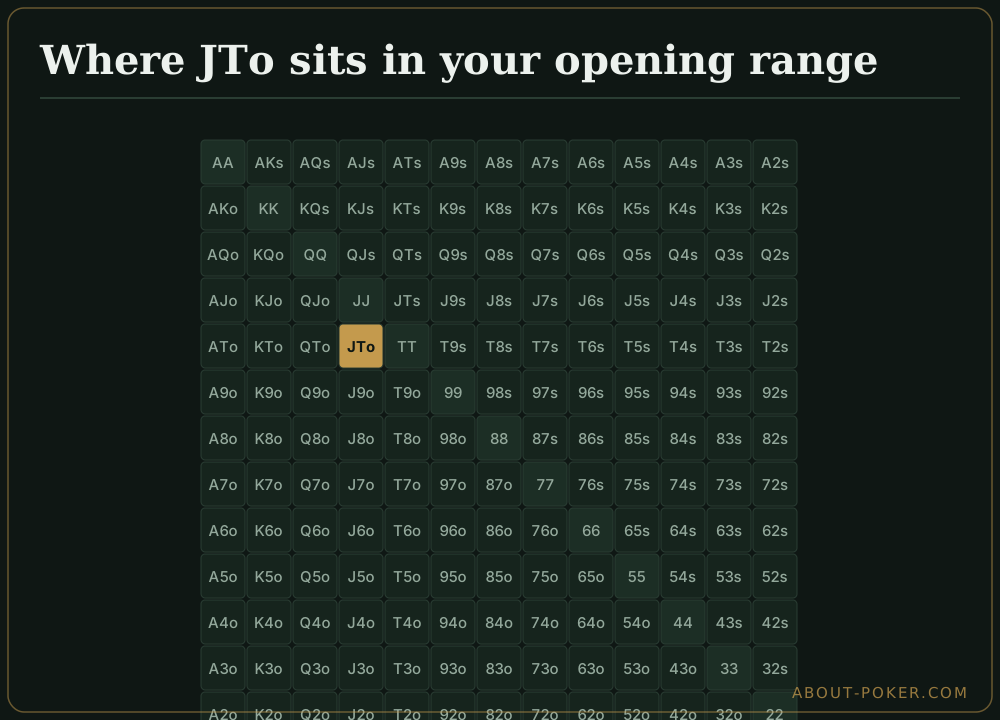
By seat, JTo is a late-position and blind hand that leans a touch wider than the other offsuit broadways:
- Early position: fold in tight games; a borderline open in loose 6-max pools only.
- Middle position: a marginal open — playable but not automatic.
- Cutoff: a standard open in most games.
- Button: an easy open every time; position plus straight equity is a strong combination.
- Small blind: open (raise) when it folds to you.
- Big blind: defend widely against opens — this is one of JTo’s best spots.
Anchor the borders in the preflop opening ranges, and note how JTo defends more freely than the gapped queen-ten offsuit because of its extra straight combinations.
Connectivity is the whole point
Like every offsuit broadway, JTo suffers domination: your jack loses to AJ and KJ, your ten loses to AT and KT, and big pairs beat both. What sets it apart is that the fully connected structure makes the most straights of the group. On boards like KQ-x, Q9-x, or 98-x, JTo can flop or turn open-enders and completed straights — including some to the nuts. That is why JTo out-earns QTo and KJo despite being lower-ranked, and why it is such a comfortable big-blind defend. Study those wide defends in defending the blinds.
Even with that upside, JTo still wants to play heads-up and in position. Its pairs are fragile and often out-kicked, so the money is in the straights, not the top pairs.
Facing a raise
When there is a raise in front, JTo is mostly a call-or-fold hand. Against a tight opener, 3-betting isolates you against AJ, KJ, AT, and big pairs — the hands that dominate you. Against a wide late opener or in blind-versus-blind, JTo makes a fine 3-bet bluff: it has good equity when called and blocks jack-x and ten-x hands. In position at a good price, calling a single raise is standard because you flop so many draws. Out of position against a tight raiser, fold unless the price is very good.
A worked example
You open J♦T♣ from the cutoff and the big blind calls. The flop comes K♥ Q♠ 4♣ — you have flopped an open-ended straight draw to the nuts (any ace or nine completes Broadway or the jack-high straight, giving you eight clean outs). The big blind checks. You continuation-bet as a semi-bluff: with eight outs you have roughly 31% equity to reach the river with two cards to come, plus fold equity when a weak hand folds now. The big blind calls. The turn is the A♠ — you make the nut straight and bet for value, targeting a king, a queen, a two-pair hand, or a slowplayed set. That flop-to-turn sequence is JTo’s signature payoff.
Contrast a top-pair flop like J♠ 7♥ 2♦: you hold a jack with a ten kicker that is out-kicked by AJ, KJ, and QJ. Bet once for thin value at most and fold to pressure — the pair is not where JTo makes its money.
Postflop in one paragraph
When JTo flops a straight draw, especially an open-ender on a broadway board, semi-bluff it hard because both the equity and the payoff are large. When it flops top pair, take thin value against wide ranges but pot-control against ranges full of bigger kickers and sets. When it flops middle pair or worse, it is usually a give-up or a single barrel. The recurring theme: JTo lives on straights, so lean into the draws and stay disciplined with the pairs.
Where to go next
JTo is the best offsuit broadway because it is fully connected, but it still rewards positional discipline. Sharpen your opens with preflop opening ranges, compare it to the weaker gapped queen-ten offsuit, and connect the whole framework at the preflop strategy hub.
Frequently asked
Is jack-ten offsuit a good hand?
JTo is a connected offsuit broadway that plays better than most because it makes plenty of straights. It opens from late position and defends the big blind well, but it is a fold from early position because it is easily dominated by AJ, KJ, AT, and KT. Its straight potential is what keeps it worth playing.
Should you 3-bet jack-ten offsuit?
Rarely as value, occasionally as a bluff. JTo is dominated by most hands that continue to a 3-bet, so against a tight opener it plays as a call or fold. Against a wide late opener or in blind versus blind you can 3-bet it as a bluff, since it has decent equity and blocks jack-x and ten-x hands.
Can you call a raise with jack-ten offsuit?
Yes, in position at a good price. JTo flops top pairs and the most open-ended straight draws of any offsuit broadway, so it realizes equity well heads-up and in position. Out of position against a tight raiser it is usually a fold because you will be dominated and hard-pressed to play back.