How to Play Jack-Three Offsuit (J3o)
J3o is a weak offsuit jack that is almost always a fold and opens only from the button. Learn where J3 offsuit plays, when to muck it, and how to handle it postflop.
On this page · 6 sections
Jack-three offsuit (J3o) is a bottom-tier offsuit jack. It carries the jack blocker and can flop top pair, but the trey kicker is dead weight and, unlike J3 suited, there is no flush draw to lean on. For most of your table time, J3o is simply a fold — you play it only in the widest, most positionally favorable spots.
Where J3o belongs preflop
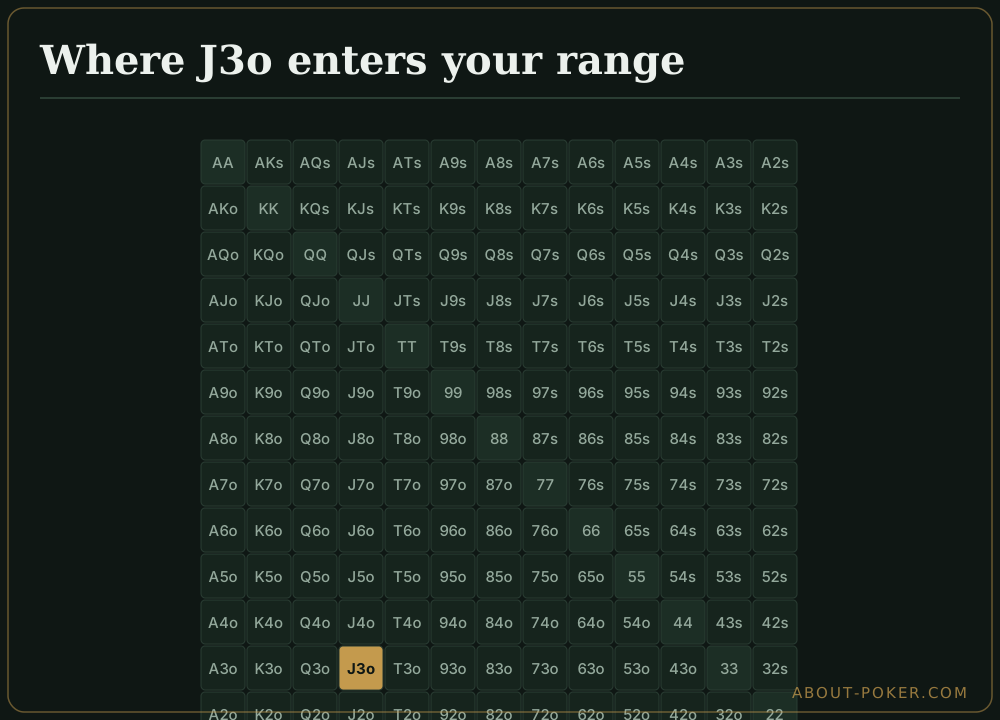
In a standard 6-max game, J3o is not a default open until you reach the button, and even there it sits on the fringe of your steal range. From the button you are attacking just two blinds with a very wide range, so a jack with a live blocker can occasionally earn a raise. From the cutoff and everywhere earlier, fold it — the offsuit gap and dead kicker make it a losing open against the tighter ranges you face in those seats.
The other place J3o appears is blind defense. In the big blind against a late-position raise at a good price, you can flat-call a few J3o combos because you are closing the action cheaply. Against earlier-position opens, the caller’s range is too strong and you should fold. The preflop opening ranges chart lays out exactly where hands like this enter and exit the mix.
J3o is not a 3-bet hand. It is too weak to raise for value and a poor bluff because it unblocks most of the hands that continue against a 3-bet. Reach for a suited jack or a suited connector when you want a light 3-bet.
Why the offsuit gap matters
The trey kicker is the whole issue. Flop top pair with your jack and you are routinely out-kicked by better jacks, while against aggression you are often drawing thin. A suited version would add flush equity and a flush blocker; J3o has neither. Its value is tied almost entirely to flopping a pair of jacks and getting to showdown cheaply.
That makes J3o a “fold or top-pair” hand postflop. You are not chasing draws, and you are not firing multiple bluffs — the trey offers no meaningful backdoor straight potential.
A worked example
You open J♣3♦ on the button to 2.5bb. The big blind calls, and the flop comes J♥ 7♠ 4♣. You have top pair, trey kicker.
C-bet small — around one-third pot. You hold a made hand that wants calls from worse (weak jacks, sevens, gutshots) while keeping the pot manageable, because your weak kicker means you do not want a big pot against a range that may dominate you. If the big blind check-raises, you are rarely ahead and folding is usually correct against better jacks, two pair, and sets.
If the flop instead came Q♥ 9♠ 4♣, you have jack-high and nothing. Give up — there is no draw to continue with and no reason to bluff a dead hand into a range that has connected.
How stack depth and opponent type change things
The narrow window where J3o is playable shrinks or disappears depending on the table. Two variables matter most: how deep the stacks are, and who is sitting in the blinds.
At short stacks — say 15 to 25 big blinds in a tournament — the button steal is actually a little more forgiving, because you are often open-shoving or opening to fold out the blinds rather than playing a deep postflop pot where your dead kicker gets punished. When most of the value comes from taking down the blinds and antes uncontested, a jack-high hand with a live blocker does its job. At 100bb and deeper, the opposite is true: postflop mistakes compound, reverse-implied odds bite harder when you flop that dominated top pair, and J3o slides toward a fold even on the button.
Opponent type is the other lever. Against a tight big blind who folds too much preflop and plays straightforwardly after the flop, J3o’s fold equity goes up and it becomes a fine steal. Against a big blind who defends wide and check-raises or floats aggressively, you are opening a hand that cannot stand heat and cannot make a strong second pair — drop it. The same logic applies to the small blind behind you when you are considering a button open: a loose, sticky small blind who cold-calls or 3-bets light turns your marginal steal into a chip leak.
A quick decision checklist
Before you put J3o in the pot, run through this:
- Am I on the button in an unopened pot? If not, it is almost always a fold.
- Are both blinds tight or straightforward? Good — the steal has fold equity. If either is a wide, aggressive defender, muck it.
- Are stacks shallow enough that stealing the blinds is the main goal? That favors the open. Very deep? Lean toward folding.
- Facing any raise or 3-bet? Fold. J3o never continues against strength.
- In the big blind getting a great price against a late open? A rare, cautious flat is allowed — nothing more.
If the answer to the first question is no, you have your answer without needing the rest.
How J3o compares to its neighbors
Among offsuit jacks, J3o is near the bottom, roughly level with J2o and slightly behind J4o, since the trey rarely completes a straight. It plays clearly worse than J3 suited, which at least offers backdoor flush equity. In blind-versus-blind pots, where ranges are widest, J3o becomes genuinely playable; for a deeper look at those dynamics see blind vs blind play.
The practical takeaway: open it only from the button as a marginal steal, defend it selectively at a great price, and treat it as a fold-or-top-pair hand once you see a flop. Folding weak offsuit jacks is one of the easiest edges to bank.
Frequently asked
Is J3 offsuit a good hand?
No. J3o is one of the weakest offsuit jacks and a clear fold from almost every seat. It can open only from the button as part of a wide steal and shows up in a few big-blind defenses; everywhere else it should be mucked.
Should I 3-bet with J3 offsuit?
No. J3o is far too weak to 3-bet for value and a bad bluff because the trey blocks almost none of your opponent's calling range. Choose a suited jack or a suited connector for a light 3-bet instead.
Can I defend J3 offsuit in the big blind?
Rarely, and only against a late-position open at a very good price. The jack blocker helps a little, but you flop dominated pairs often. Continue cautiously and fold to any real pressure.