How to Play Jack-Ten Suited (JTs)
Jack-ten suited is the best suited connector in poker — it makes more straights and flushes than any other. Here is how to open, 3-bet, and play JTs.
On this page · 7 sections
Jack-ten suited (JTs) is the best suited connector in Texas Hold’em, and one of the most fun hands to play well. It makes more straights than any other starting hand — it completes four separate straights (7-8-9-T-J, 8-9-T-J-Q, 9-T-J-Q-K, and T-J-Q-K-A) — while also making flushes and strong top pairs. That combination of straight, flush, and pair potential gives it elite playability. Against a random hand it wins about 57% heads-up, but its real value is how well it flops equity in big pots.
Open it from everywhere
JTs is a standard open-raise from every position, including under the gun in most 6-max games. Its suitedness and connectedness mean it flops a pair, draw, or better far more often than an offsuit hand of similar rank, so it clears the bar for opening even from early seats. Use a normal sizing from your preflop opening ranges and expect to see a lot of flops with it.
The key is that JTs realizes its equity. Weaker offsuit hands like J-8o get bullied off the pot postflop; JTs keeps fighting because it so often has a draw to the nuts. That is the difference between a hand that merely “connects” and one that connects to the top of the board.
Why it is a premium 3-bet bluff
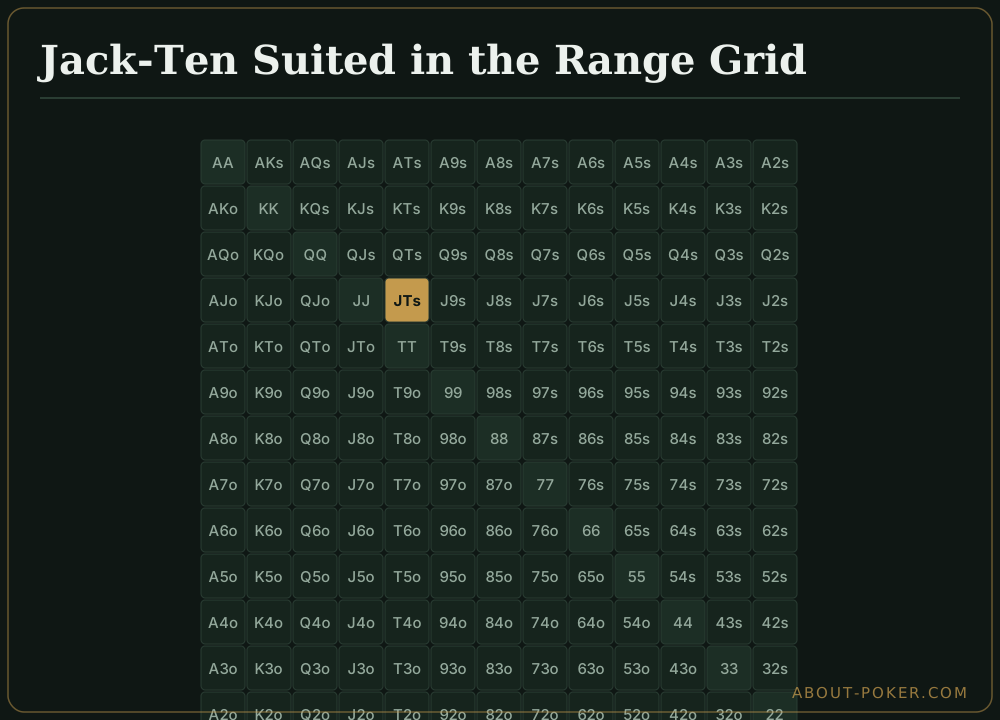
When facing an open, JTs is one of the first hands you add to your bluffing side of a 3-bet range. Three things make it ideal. First, it has real equity — even when called, it flops draws constantly. Second, it has blockers: holding a jack and a ten slightly reduces the combinations of JJ, TT, AJ, KJ, QJ, and AT your opponent can hold. Third, it plays beautifully in 3-bet pots, where the pot is already large and stacking off on the right board is easy.
Compare this to a hand like ace-jack suited, which prefers to call or value-3-bet because of its ace-blocker and top-pair strength. JTs, by contrast, is happier as a pure semi-bluff — it wants folds now and a big draw when called.
A worked example
You have J♠T♠ on the button and a middle-position player opens to 2.5bb. You 3-bet to 8bb as a bluff. They call. The flop comes Q♥-9♦-4♠.
This is a dream flop. You have an open-ended straight draw (any king or eight makes the nuts) plus a backdoor flush and two overcards to some of their range. With about eight clean outs to the straight — roughly 32% equity to improve by the river — you should continuation-bet and keep barreling. You are not just bluffing; you are semi-bluffing with a hand that is often ahead in equity and dominates their weaker draws.
Playing it postflop
JTs wants coordinated, wet boards where it can make or draw to the nuts. On dry, disconnected flops (K-7-2 rainbow), slow down — you have little equity and no reason to fire multiple barrels. On connected boards (Q-9-x, K-Q-x, T-9-x), lean aggressive, because your straight and flush potential lets you apply pressure with genuine backup.
The one discipline point: JTs makes a lot of second-best hands too. A jack-high flush loses to the ace-high flush, and a jack pair can be dominated. Bet your draws hard, but be cautious stacking off with mere one-pair hands on wet boards where your opponent’s continuing range is strong.
How the play changes by position and action
JTs is strong enough to appear in almost every preflop scenario, but its best role shifts depending on who acted before you.
- First in from any seat: open-raise. It clears the bar even under the gun in 6-max, and from late position it is a slam-dunk steal.
- Facing a single raise from late position: 3-bet as a bluff at a high frequency. This is JTs at its best — you have equity, blockers, and a hand that flops draws to the nuts.
- Facing an early-position raise: mix. Against a tight under-the-gun open, calling to see a flop in position is often better than 3-betting, because the opener’s range is strong enough that you would rather keep the pot small and realize your equity than get 4-bet off a hand with real playability.
- Out of position in the blinds facing a steal: 3-bet more than you call, since JTs plays poorly as a flat out of position but excels when it takes the initiative.
- Facing a 3-bet after you opened: call in position, fold some of the time out of position. JTs has enough equity to continue against most 3-betting ranges but does not want to 4-bet for value.
Stack depth matters more than for most hands
JTs gains value as stacks get deeper, because its payoff hands — straights and flushes — win their biggest pots when stacks are 150bb or more and someone stacks off with an overpair or a worse flush. At 200bb, lean into 3-betting and calling wider; the implied odds on hitting the nuts are enormous. At short stacks (40bb or less), JTs loses some of that appeal because you cannot get paid the full value of a made straight, so treat it more like a straightforward strong-equity hand: get it in when you have a big draw plus fold equity, and do not overvalue the implied-odds side of its game. Compare its deep-stack flexibility to ace-jack suited, which relies more on immediate top-pair value than on drawing to the nuts.
A second worked example: turning a flush draw into pressure
You open J♦T♦ from the cutoff and the big blind calls. The flop comes A♦-6♦-2♣. You hold the second-nut flush draw (only the K♦ beats you if it completes) plus a backdoor straight is dead here, so this is a pure flush draw with nine outs — about 35% to hit by the river. On an ace-high board your opponent will often have a weak ace or a missed hand, so a continuation bet does double duty: it can win immediately as a bluff, and it builds a pot you are happy to keep betting when the flush comes in. This is the recurring theme with JTs — you are rarely drawing dead, so aggression is backed by real equity rather than pure air.
Frequently asked
Is jack-ten suited a good hand?
Yes — JTs is the strongest suited connector in Hold'em. It can make the most straights of any starting hand (it hits four different straights) plus flushes and top pairs, giving it excellent playability. It is a standard open from every position and a common 3-bet bluff.
Should you 3-bet jack-ten suited?
Often, yes. JTs is a favorite bluff-3-bet because it has strong equity when called, blocks some of your opponent's strong hands, and plays well postflop. It is one of the first suited hands most solvers add to a 3-bet bluffing range from late position and the blinds.
What flops does jack-ten suited want?
JTs loves connected, coordinated boards. Any nine, queen, king, or ace gives it a straight or straight draw, and two of its suit brings a flush draw. It makes the nut or near-nut straight far more often than disconnected hands, which is why it plays so aggressively on wet boards.