How to Play Jack-Four Suited (J4s)
Jack-four suited is a six-gap trash hand that folds almost everywhere. Here is the narrow set of spots where J4s is playable and how to handle it.
On this page · 6 sections
Jack-four suited (J4s) is a six-gap suited hand and lands squarely in trash territory. With six ranks separating the jack and the four, the hand makes no useful straights at all — the four is a completely dead card for connectedness. That leaves J4s leaning entirely on its flush potential and the occasional freak two pair. It wins roughly 46% heads-up against a random hand, worse than a coin flip against an unknown holding. For practical purposes, J4s is a fold, and the only time it earns a place in your range is cheap, price-driven big-blind defense.
The one home: discounted big-blind defense
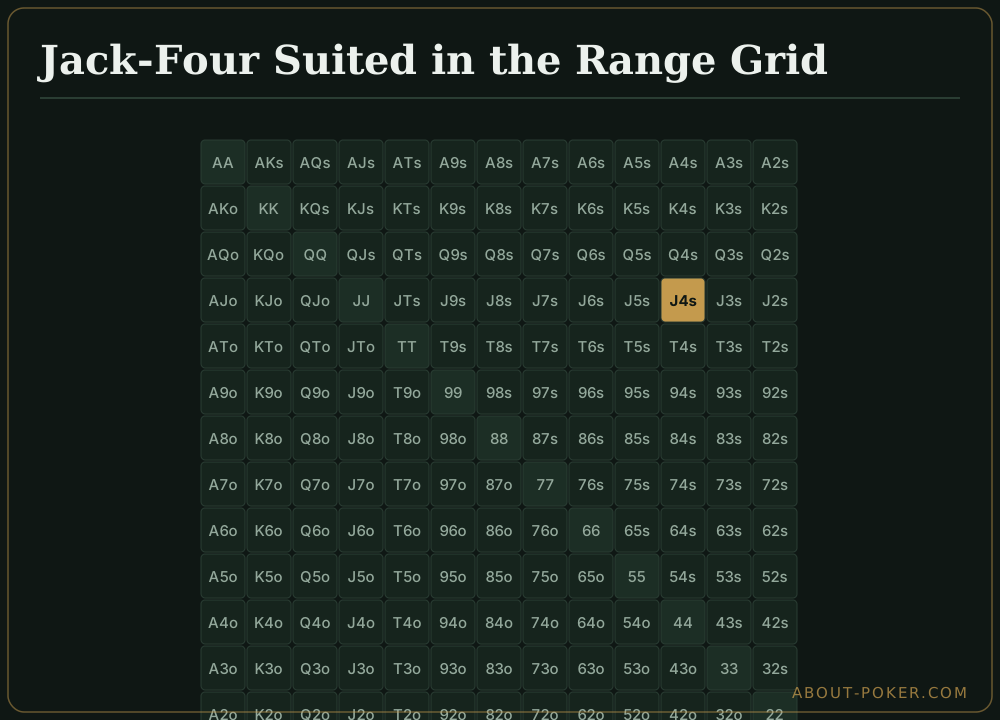
The single legitimate spot for J4s is defending the big blind at a deep discount. When a late-position player min-raises or makes a small open and you are closing the action at an excellent price, J4s can occasionally peel — you are partly invested already, no one can raise behind you, and the suit gives you a flush to draw to. This is the extreme edge of correct blind defense, where you defend far wider than you would ever open. J4s only qualifies against the widest ranges at the best prices, and even then it is one of the first hands to drop as the price gets worse.
As an open, J4s is always a fold. It is weaker than jack-five suited, which itself already fails to qualify from any standard seat. Your preflop opening ranges should list J4s as a fold everywhere, and treating it as an automatic muck removes a common losing spot from your game.
Why the gaps matter
Every gap in a suited hand strips away straights and piles on dominated pairs. J4s has six gaps — one more than J5s — so it makes no meaningful straights and offers only the weakest, most outkicked pairs. Flop a jack and you are routinely outkicked; flop a four and you are almost always beat. The flush is the one holding that wins a real pot, which is the entire reason suitedness keeps this hand from being pure junk.
A worked example
You defend the big blind with J♠4♠ against a button open and the flop comes A♠-9♠-2♦.
This is the flop J4s needs to justify a call: a flush draw, with any spade completing your flush. That is nine outs — about 35% equity to hit by the river. Facing a single reasonable continuation bet, you can check-call and hope to stack a strong ace when a spade arrives. Now swap the flop to K-7-3 rainbow and you have jack-high with no draw and no plan — an easy check-fold to any bet. That gap between “flush draw, keep going” and “air, give up” is the whole strategy for J4s.
The right mindset
Play J4s as a fold-first hand. Never open it, defend it only from the big blind at a real discount, and postflop continue solely with flush draws, strong two pair, or a rare disguised straight. Its entire profit comes from the handful of flops where suitedness manufactures real equity — and from the discipline to release it the many times it flops nothing.
When the big-blind defend qualifies
The defend with J4s is narrower than the general “defend wide from the big blind” advice suggests, so pin down the exact conditions. You want three things at once: a small raise size, a wide opener, and a clean heads-up pot in which you close the action. A min-raise or a 2.2x open from the button or cutoff, with you as the lone caller, is the textbook case — you are getting close to 3.5-to-1, the opener’s range is packed with hands you can outflop, and no one can re-raise behind you. The moment the price worsens, the call dies: against a 3x open you are getting a poorer price into a tighter range, and J4s should be folded. It is also a fold against any raise from early or middle position, against a small-blind 3-bet, and in every multiway pot where a caller has already narrowed the field to real hands. There is never a 3-bet with J4s — it has no value component and makes a weak bluff with no meaningful blockers.
One extra caution: even the flushes J4s makes are non-nut. A jack-high flush loses to any queen-, king-, or ace-high flush, so on a four-flush board or against heavy river aggression you should be prepared to fold the made flush rather than pay off a bigger one. The hand’s upside is real but genuinely capped.
Common mistakes with J4s
The most frequent error is opening it, usually rationalized as “it’s suited and I’m on the button.” No standard range opens J4s profitably; if it is in yours, cut it. The second mistake is defending too wide — calling large raises or defending it out of the small blind, where you neither close the action nor have position to fall back on. The third is over-valuing the pairs it flops: a pair of jacks with a four kicker is routinely outkicked, and a pair of fours is beaten by almost everything, so treating either as a value hand across multiple streets simply bleeds chips. The fourth is bluffing jack-high on a missed board; J4s has no story and no blockers that make a bluff credible against a range that opened wide. Keep the discipline mechanical: fold preflop by default, defend only cheaply and heads-up from the big blind, chase only the flush draw and truly strong made hands, and give up the rest. For the neighboring hand with one fewer gap, see how jack-five suited is played.
Frequently asked
Is jack-four suited ever worth playing?
Only very rarely. J4s is a six-gap suited hand with essentially no straight potential. Its lone home is defending the big blind at a deep discount against a wide late-position raise. From every other seat it is a clear fold.
Can you open jack-four suited?
No, not in any standard range. J4s sits below even the widest button opens. Folding it preflop is correct from every seat and costs you nothing meaningful in the long run.
How should you play J4s postflop?
Continue only with a flush draw or a genuinely strong made hand. A bare jack or four is almost always second-best. On any board where you have neither a flush draw nor a big pair, check and fold instead of bluffing.