How to Play King-Queen Suited (KQs)
King-queen suited is a premium broadway hand that makes top pairs, nut straights, and second-nut flushes. Learn when to open, 3-bet, and flat KQs.
On this page · 7 sections
King-queen suited (KQs) is one of the best non-ace broadway hands in Hold’em. It makes strong top pairs, the nut straight when the board runs A-J-T, and the second-nut flush in its suit. It flops well, has great playability, and belongs in your value ranges from every seat. Its only real weakness is domination: AK and AQ have your top pairs out-kicked, so the skill in playing KQs is extracting value when you are ahead without stacking off light against the exact hands that beat you.
Opening and 3-betting KQs
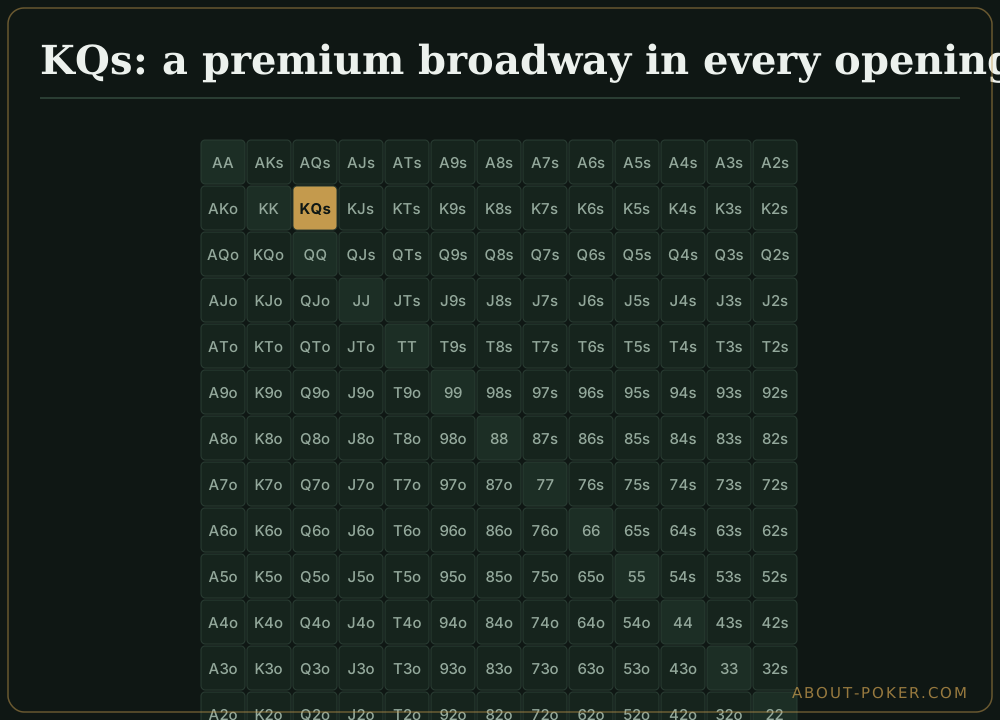
KQs is a standard open from any position — it sits comfortably inside the preflop opening ranges even under the gun at most stack depths. When facing a raise, KQs is versatile: it can 3-bet for value, 3-bet as a semi-bluff, or flat, depending on who opened and from where.
Against late-position opens (button, cutoff), KQs is a clear part of your 3-bet range. Those ranges are wide, so KQs is often ahead and dominates the many weaker broadways and suited hands your opponent opened. Against tight early-position opens, flatting is frequently better: 3-betting there can isolate you against a range full of AA, KK, AK, and AQ — hands that either crush you or dominate your top pairs.
Why domination shapes every decision
The whole strategy for KQs revolves around one idea: it dominates a lot of hands, and is dominated by a few. When you 3-bet KQs against a wide range, you are ahead of KJ, KT, QJ, QT, and countless suited connectors. When you jam it into a tight range, you are behind AK and flipping-or-worse against pairs. That is why position and opponent tendencies drive the call-versus-3-bet decision more than the raw strength of the hand.
A worked example
You open K♣Q♣ from the cutoff to 2.5bb. The big blind calls. The flop comes K♥7♠2♦ — top pair, good kicker, on a dry board.
Bet for value. You are ahead of every worse king (KJ, KT, K9 suited), all the pocket pairs below kings, and the many missed broadways in a big-blind defending range. Size around 33–50% pot to keep those worse hands paying. The one holding that has you dominated is AK, but that is a small slice of a big-blind calling range, which flats far more Kx and pairs than it does AK. Bet, get value from the many worse hands, and only slow down if a tight opponent shows real aggression that screams AK or a set.
Facing 3-bets and playing postflop
When you open and face a 3-bet, KQs is a comfortable continue. Because it flops so well and blocks premium broadways, it is a solid part of defending against 3-bets — usually a call, occasionally a 4-bet-bluff against aggressive 3-bettors, since holding a king and a queen blocks some of their strongest value hands.
Postflop, remember the ceiling and the floor. KQs makes the nut straight on A-J-T and the second-nut flush in your suit — those are big-pot hands, so build them. But a lone top pair with the queen kicker, while strong, is not the nuts; against a tight range piling in chips on a dry king-high board, respect that AK and sets exist. Value-bet relentlessly against wide ranges, and apply the brakes only when a narrow, aggressive range tells you your kicker is beaten.
How stack depth changes the plan
Depth quietly rewrites KQs strategy. At 100bb and deeper, its playability shines: it flops draws and pairs that can win a stack, so flatting to keep a dominated wide range in the pot is often more profitable than 3-betting them out. When you do get in a big pot deep, the second-nut flush and nut straight are exactly the hands you want, because implied odds reward you for the times you draw out on a made hand.
Short — say 20 to 30bb effective, as in the mid stages of a tournament — the calculus flips. There is little room to realize a marginal top pair over three streets, so KQs shifts toward a 3-bet-or-fold hand rather than a flat. As a short-stack shove or re-shove it is excellent: it has live cards against almost everything, dominates the loose portion of a shoving range, and is rarely in terrible shape even against a call. The one spot to respect is a very short, very tight stack all-in ahead of you, where AK, AQ, and big pairs make up too much of the range — there, KQs can be a fold you would never make with more chips.
Adjusting to opponent type
Read the player before you pick a line. Against a loose-passive opener who calls too much, flat and let them pay off your top pairs and draws — 3-betting just folds out the hands you dominate. Against an aggressive, wide 3-bettor, KQs is a strong 4-bet-bluff candidate: holding a king and a queen blocks AK, AQ, KK, and QQ, which shrinks their genuine value range and makes your bluff land more often. Against a tight, straightforward regular who only stacks off with premiums on a king-high board, believe them — fold the second-best top pair rather than paying off the hand that has you out-kicked.
A quick decision checklist
- Open KQs from every seat; never limp it.
- Facing a late-position open: lean 3-bet for value.
- Facing a tight early open: lean flat, and fold only versus extreme aggression.
- Flop top pair on a dry board: bet 33–50% pot for value against wide ranges.
- Flop the nut straight (A-J-T) or second-nut flush: build a big pot fast.
- Facing a big turn or river raise from a narrow range on a king-high board: slow down — AK and sets are live.
Play KQs like the premium broadway it is: open it everywhere, 3-bet it against wide ranges, flat it against tight ones, and chase its big draws — the nut straight and second-nut flush — while keeping one eye on the handful of hands that dominate your top pair. When you flop those draws, the plan is the same as with any strong suited broadway — see defending against 3-bets for how KQs fits a 4-bet-or-call framework.
Frequently asked
Should you 3-bet or call with KQs?
Both, depending on position and opponent. KQs is strong enough to 3-bet for value against late-position opens and works as a semi-bluff 3-bet against aggressive raisers. Against tight early-position opens it is often better to flat, because 3-betting can isolate you against a range that dominates you with AA, KK, and AK.
Is KQs a strong starting hand?
Yes. King-queen suited is a top-tier broadway hand that plays well from every position. It makes strong top pairs, the nut straight with A-J-T, and the second-nut flush. Its main weakness is domination by AK and AQ, so you avoid stacking off light on king-high or queen-high boards against tight ranges.
What beats KQs on a king-high flop?
Mainly AK and sets. When you flop top pair with KQs on a king-high board, you usually have the best hand, but AK has you out-kicked and any set of kings or the board pairs beat you. Against heavy aggression from a tight range, treat top pair with the queen kicker as strong but not unbeatable.