How to Play King-Seven Offsuit (K7o)
King-seven offsuit is a button-and-blinds steal, not a hand for big pots. Learn where K7o opens, why it flops dominated top pairs, and when to fold it.
On this page · 7 sections
King-seven offsuit (K7o) is a marginal hand that looks playable because of the king and rarely is. With a seven kicker and no flush potential, it flops dominated top pairs and second-best kings all day. There is a narrow window where K7o earns its keep — stealing from the button and blinds against tight opponents — but outside that window it is a fold. The skill in playing K7o is refusing to overvalue it.
Where K7o belongs
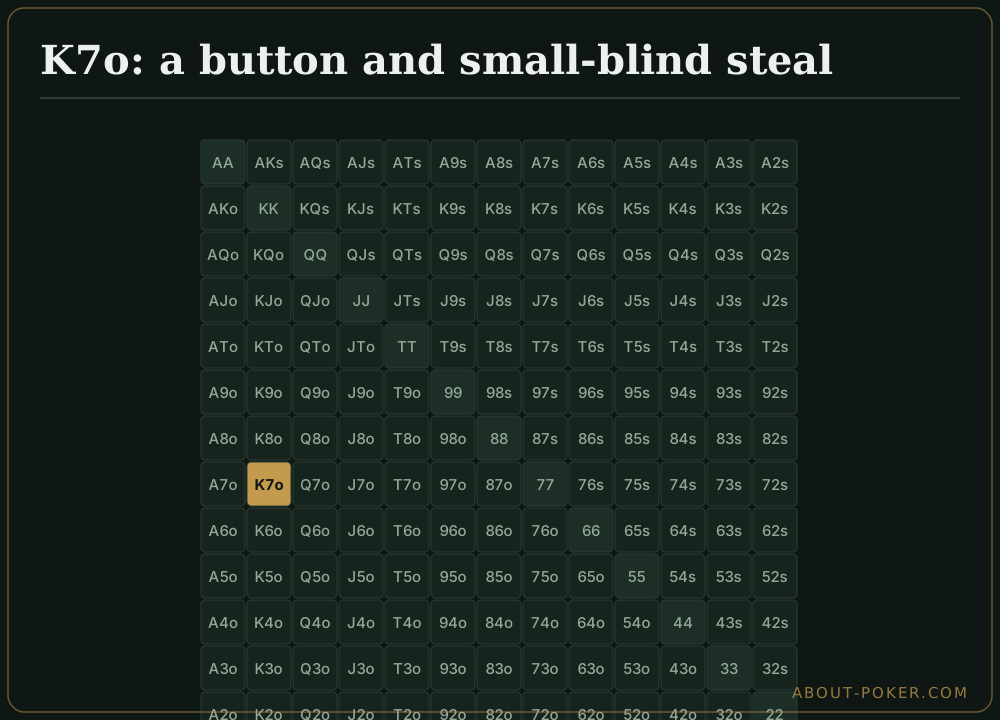
K7o is a button-and-blinds steal only. Open it from the button and small blind against blinds that fold too much, where the king dominates weaker kings and the whole hand steals dead money effectively. It sits near the bottom of your preflop opening ranges in those seats — a hand you open for its fold equity, not its showdown value.
From the cutoff and everything earlier at a full-ring or 6-max table, fold it. Too many hands behind you have K7o dominated, and it plays badly out of position. This is the essence of poker ranges by position: the same two cards are a thin button open and a clear early-position muck.
Why the kicker hurts
K7o’s weakness is that its two best flops both make trouble. Flop a king and you likely have the best kicker beaten by KT, KJ, KQ, AK — the exact hands that want to play a big pot. Flop a seven and you have a weak middle pair that folds to most pressure. Either way, K7o makes second-best hands: top pair with a bad kicker, or a pair too weak to stack off with.
That is why K7o belongs in small pots. It can open and win preflop, and it can bet a made pair once for thin value, but it should almost never build a large pot. It is also why it is not a 3-bet: with no flush and no dominating value, re-raising it just isolates you against ranges that beat it.
Defending the blinds with K7o
Against a late-position steal, K7o can appear at the very bottom of your big-blind defending range. When a button raises small and you are closing the action, K7o dominates the king-rag and ace-rag hands in a wide steal and flops enough top pair to defend. This is textbook blind defense — you call the cheap price with hands that beat the bottom of a wide range, then play cautiously postflop.
A worked example
You open K7o to 2.5 big blinds on the button and the big blind calls. The flop is K-9-3 rainbow. You have top pair — and a problem. You bet a third of the pot and get called. Against a range that continues with K9, K3, 99, 33, better kings, and gutshots, your seven kicker is behind much of what keeps calling. Bet once, then shut down. Firing three streets with a dominated top pair is the classic way K7o loses a stack it never should have contested.
If the flop comes 7-6-2 you have middle pair and can continue for one street, but K7o is never a hand to commit stacks with. When an opponent shows real strength, let it go. Treating K7o as the marginal steal it is — rather than a “king” worth defending to the river — is what keeps it profitable.
The domination math you should internalize
The reason K7o gets warned about so often is a specific kicker problem. When you flop a king, you hold top pair, but count the hands that also hold a king and beat you: AK, KQ, KJ, KT, and any king with an eight or nine kicker all have your seven outkicked. There are far more of those than there are worse kings (K6, K5, K4, K3, K2) that you actually beat. So “top pair” with K7o is usually behind the other top pairs, not ahead of them — the opposite of the intuition that a paired king is strong. Add in the sets and two pairs that also continue, and a bet-three-streets plan with K7o is spewing chips into a range that mostly crushes it. The fix is not complicated: bet once for thin value or protection, then treat the hand as a bluff-catcher and refuse to build a big pot.
How stack depth shifts the plan
K7o is a short-to-medium-stack steal, not a deep-stack hand. At 100bb, the deeper you are the more your dominated top pairs cost you, because there is more money behind to lose when you run into a better king. So keep it strictly in its late-position steal lane and play small. As stacks shorten in tournaments, K7o’s picture actually improves in one narrow way: around 12 to 20bb, a button or small-blind open-shove or open-raise leans on fold equity and preflop all-in equity, where the king-high plays fine against the hands that call. Below that, the king is a perfectly reasonable shoving card from the button and blinds. What does not change is the middle-stage cash-game reality: from early and middle position at any depth, K7o is a fold.
A quick decision checklist
- Seat: Button or small blind only, and only against blinds that fold too much. Otherwise fold.
- Action in front: Facing an open, fold or make a rare cheap big-blind defend — never 3-bet.
- Flopped a king: Bet once, then pot-control. Assume your kicker is behind the other kings.
- Facing a raise or heavy aggression: Let it go. K7o does not want a big pot.
Play K7o as a low-frequency steal that wins small pots, and it is a mild profit-add to your button and blind ranges. Overvalue the king and stack off with a dominated top pair, and it becomes one of the more expensive leaks in the deck. For where it fits seat by seat, lean on poker ranges by position and the preflop opening ranges reference.
Frequently asked
Can you open king-seven offsuit?
Only from the button and small blind against tight blinds, and even then it sits near the bottom of the range. The king dominates weaker kings and steals fee blinds well, but with a seven kicker and no flush, K7o is a fold from the cutoff and everything earlier at a full table.
Should you 3-bet K7o?
No, essentially never. It has no value component that wants a bigger pot and it lacks the suited version's flush equity, so it makes a poor bluff too. Against an open, K7o is a fold or an occasional blind defend, not a 3-bet.
Is K7o better than K7s?
No, the suited version is clearly better. K7s adds flush potential that lets it open earlier and continue on more boards. K7o loses that entirely, so it plays only from the button and blinds and stays out of big pots.