How to Play King-Six Offsuit (K6o)
K6o is a weak, easily dominated offsuit king that only opens from the button and blinds. Learn where K6 offsuit is a fold, when it steals, and how to play it.
On this page · 7 sections
King-six offsuit (K6o) is one of those hands beginners overvalue simply because it has a king in it. But an unpaired king with a small, disconnected kicker is fragile. It’s dominated by every stronger king (K7 through KQ) and by all the ace-x hands, and when it flops a pair it is usually the second-best pair in the pot. K6o has one narrow job — late-position steals and cheap blind defends — and outside of that it belongs in the muck.
Where K6o belongs preflop
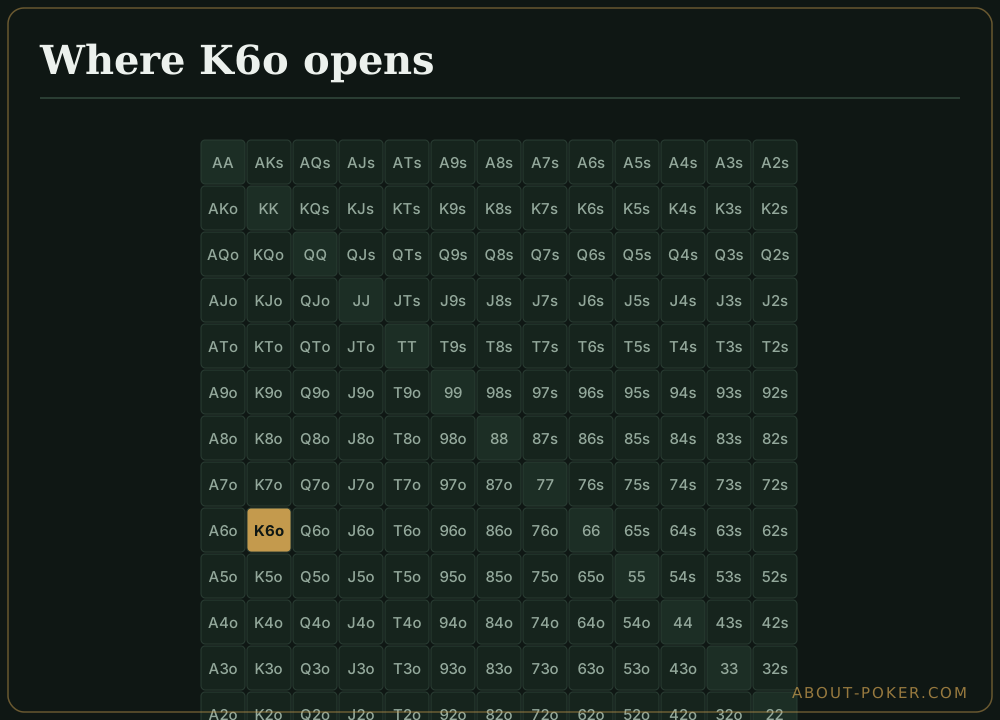
K6o is a raise-or-fold hand that only raises from the back of the table:
- Early and middle position: fold. Opening K6o here walks straight into dominating kings and aces, and it cannot handle a 3-bet.
- Cutoff: at best a marginal open, and many solid ranges fold it here.
- Button: a standard steal. With only the blinds behind, K6o picks up dead money and can flop top pair against random defends.
- Small blind: open (raise) rather than limp when it folds to you.
- Big blind: defend against a single raise when you are getting a good price, but do not get attached to it.
For the exact borders seat by seat, ground yourself in the preflop opening ranges. K6o sits at the very bottom edge of the offsuit kings you are ever allowed to open.
The kicker problem
K6o’s weakness is the same as every weak offsuit king: kicker trouble. When you flop top pair with the king, your six kicker loses to K7, K8, K9, KT, KJ, KQ, and every stronger king. On top of that, K6o has almost no straight or flush potential — it is a wide offsuit gapper — so it rarely improves to anything strong. That is exactly why cold-calling a raise with K6o is a leak: you will be dominated when you pair the king and behind when you pair the six.
The one place K6o gains a little life is against wide ranges. The king blocks some of the strong Kx and top pairs in a stealer’s range, so K6o can occasionally appear as a blind-versus-blind attack or defend. Those spots are marginal and situational; the general framework for them lives in blind vs blind play and in defending the blinds.
Facing 3-bets and 4-bets
When you open K6o and get 3-bet, fold in nearly every case. You are dominated by stronger kings and aces, and out of position you have no comfortable way to continue. Only against a wildly aggressive blind 3-bettor, in position, might you flat occasionally, and even then it is a low-priority play. Against a 4-bet, folding is automatic.
A worked example
You open K♠6♥ from the button and the big blind, a solid regular, calls. The flop comes K♦ 9♣ 4♠ — top pair, weak kicker. You bet, and your opponent calls. The turn is a 7♦. Ask yourself what continues against you here: better kings (K9 just made two pair, KT through KQ have you outkicked), plus the occasional set or nine. Your six kicker beats bluffs and worse pairs, but loses to almost everything that wants to build a big pot. Against a passive player you can value bet thin once, but you should fold to real aggression — this is a modest one-pair hand, not a stack-off. Heads-up, K6o has roughly 56% equity against a random hand, but that edge disappears when only stronger hands stick around to the river.
What the button steal is really doing
When K6o opens from the button, it is not because the king makes it strong — it is because the two blinds behind fold often enough that stealing the dead money profits on its own. The king does add one small extra: it blocks some of the strong Kx and AK combos the blinds might otherwise 3-bet or defend with, which nudges your fold equity up a touch. But the core reason to open is still that you take down the blinds a large share of the time, not that K6o wants a fight.
That case breaks against the wrong opponents. A blind that 3-bets aggressively removes your fold equity and forces you off the hand, so cut K6o from your button opens against a frequent 3-bettor. A loose, sticky caller in the big blind is nearly as damaging: you rarely win preflop and end up playing flops out of position with a dominated king. Look at who is behind you before treating K6o as a steal.
Playing K6o after the flop
The occasional flop you see with K6o should stay cheap:
- You pair the king: top pair, weak kicker. Value bet once against a passive opponent, but do not build a big pot — K7 through KQ have you outkicked and are exactly what calls raises.
- You pair the six or flop bottom pair: bluff-catcher against small bets only; fold to real pressure.
- You miss (the usual case): check and give up unless you pick up a genuine draw. A single c-bet on a dry, disconnected board against one opponent can steal it; multi-barreling air just loses chips.
How K6o compares to nearby hands
Placed next to its neighbors, K6o’s weakness is clear. K8o and K9o are modestly better as the kicker climbs, but they still fold from early seats. KTo and KJo clear a higher bar because the kicker itself is a broadway card that can make a second strong pair. K6s is meaningfully stronger than K6o purely from the nut-flush potential the suit adds. K6o has none of those upgrades — a disconnected offsuit king with a small kicker, ranking just above K5o through K2o — which is why it sits at the very bottom edge of the openable kings and folds everywhere earlier than the button and small blind.
Open K6o from the button and small blind, defend it cheaply in the big blind, and fold it everywhere else. Treat it as a small tool with one job, not a hand to build pots with.
Frequently asked
Is K6 offsuit a good hand?
No. K6o is a below-average offsuit king that is dominated by every stronger king and by all ace-x hands. It only opens from the button and small blind and is a fold from every earlier seat.
Should I ever open K6 offsuit?
Only from the back. K6o is a fine button steal and a small-blind open when the action folds to you. From early or middle position it should be folded because you constantly run into dominating kings and aces.
Can I call a raise with K6 offsuit?
Almost never. Cold-calling an offsuit king out of position is a classic leak because you are so often dominated. K6o is a raise-or-fold hand, not a caller, apart from cheap big-blind defends.