How to Play King-Seven Suited (K7s)
K7s is a weak suited king that opens mostly from the button and small blind. Learn where K7s belongs, why domination hurts it, and how to play it postflop.
On this page · 6 sections
King-seven suited (K7s) is a bottom-of-the-range suited king. It carries the same two assets every suited king has — a high card and the second-nut flush — but the seven kicker is weak enough that the hand only earns a spot in the last couple of seats. Treat K7s as a positional flush-and-blocker hand, not a top-pair machine, and it will make you money in the right spots without costing you in the wrong ones.
Where K7s belongs preflop
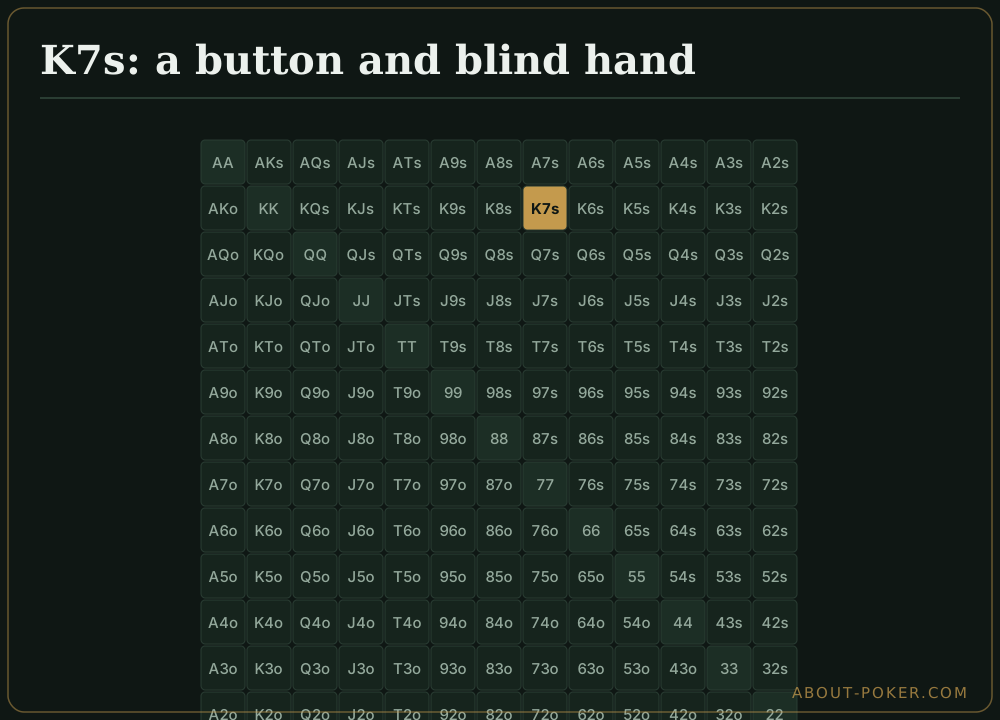
By seat, K7s is barely inside the playable range:
- Early, middle, and cutoff: fold at a full table. K7s is not strong enough to open into a field that can hold better kings and aces, and it sits below the cutoff’s opening threshold at most tables.
- Button: a standard open. The button’s range is very wide, and K7s clears the bar here comfortably.
- Small blind: open (raise) instead of limping, so you take the initiative rather than playing a weak hand out of position for a cheap price.
- Big blind: defend against button and cutoff opens when the price is right, but don’t stretch to defend it against tighter early opens.
Anchor the exact borders in the preflop opening ranges and watch how they widen from seat to seat in poker ranges by position.
Domination is the whole story
The defining weakness of K7s is domination. When you flop top pair with the king, you beat only weaker holdings and lose to the entire family of better kings — A-K, K-Q, K-J, K-T, K-9, K-8 — plus you’re behind any ace that pairs. The seven kicker almost never wins a pot on its own. So the king-high pair you flop is a hand to control the pot with, not to build a big pot around.
The counterweight is the second-nut flush. When K7s makes a king-high flush, it’s a genuinely strong hand, beaten only by the ace-high flush. That flush, plus the blocker effect of holding a king, is the entire reason K7s appears in any opening range. Play it for the draw and the occasional two pair, and fold the marginal top pairs cheaply.
Facing a raise: fold more than you call
When someone else opens, K7s should mostly go in the muck:
- In position vs a button open: a light flat is defensible with a good price, purely on flush and two-pair equity.
- Out of position: fold. From the small blind you’d play the whole hand out of position with a dominated king, which is a losing proposition.
- From the big blind: defend narrowly against late opens; see how far that stretches in defending the blinds.
- As a 3-bet: don’t — it’s dominated when called and a poor bluff.
A worked example
You open K♠7♠ from the button. Only the big blind calls. The flop comes K♦ 7♥ 2♣ — you’ve flopped top two pair, a rare strong flop for this hand.
You bet, the big blind calls. The turn is the 4♦; you bet again for value against worse kings, sevens, and draws. The river is the 6♣, which completes a 3-4-5 gutshot and some straight draws, so you size down for thin value against the worse one-pair hands that can still call. That’s the K7s payoff: it usually flops something marginal, but when it flops two pair in position, you extract steadily.
Now flip the seat. The same K♠7♠ from the small blind on a K-high flop is a guessing game — you’re out of position against the initiative, unsure whether your king is good, and forced to make decisions blind on every street. Same flopped strength, far worse spot. That gap is why K7s is a button-and-blind hand only.
Postflop in one paragraph
When K7s flops a flush draw, it’s the second-nut flush draw and a clean semi-bluff. When it flops top pair (king), pot-control it — the seven kicker means you’re rarely ahead of a better king, so avoid building a big pot. When it flops the seven or air, treat it as a give-up or single-barrel hand depending on texture, leaning on the king high and backdoor equity. K7s wants flush boards and two-pair flops; on everything else it folds cheaply and moves on.
Where to go next
K7s is a hand for the button, the small blind, and the occasional big-blind defend — and nowhere else. Anchor the seat logic in poker ranges by position, tighten your opens with preflop opening ranges, and connect the pieces through the preflop strategy hub.
Frequently asked
Is K7 suited a good hand?
K7s is a weak, situational hand. It's a fine open only from the button and small blind and a big-blind defend against late opens; everywhere else it's a fold. Its value is essentially the second-nut flush and the king blocker — the seven kicker adds very little.
Should I 3-bet with K7 suited?
No. K7s is dominated by the kings it would want value from and is a poor bluff because the seven kicker gives it weak straight and pair potential. Call in position or fold rather than 3-betting.
Can I call a raise with K7 suited?
Only in position with a good price, and even then it's marginal — it plays for the flush and the occasional two pair. Out of position it's a fold, because the king is frequently dominated and you'll be at a disadvantage on every street.