How to Play King-Ten Suited (KTs)
King-ten suited is a playable suited broadway with straight and flush potential, but heavy domination. Learn when to open, 3-bet bluff, and fold KTs.
On this page · 6 sections
King-ten suited (KTs) is the most marginal of the strong suited broadways — a step below king-jack suited, but still a hand worth playing from the right seats. It makes the nut straight with Q-J-A on the board, strong flushes in its suit, and top pairs on king-high boards. Its problem is that it is dominated by a lot of hands: AK, KQ, KJ, AT, and every big pair. Play KTs for its drawing upside and its blocker value, open it in position, and stay disciplined when your top pair runs into a range that beats your kicker.
Where KTs belongs
KTs is a comfortable open from middle and late position in 6-max, and a fold from early seats at full ring. It is more position-dependent than KJs because it is dominated more heavily — check your preflop opening ranges for the exact cutoffs, but the guiding idea is that KTs wants to be the aggressor in position, not the caller out of position against a strong range.
When you open KTs late, you dominate the many weaker kings and tens the field holds. When you play it out of position against early raisers, you are the dominated one — which is exactly why it slides out of the range up front.
KTs as a 3-bet bluff
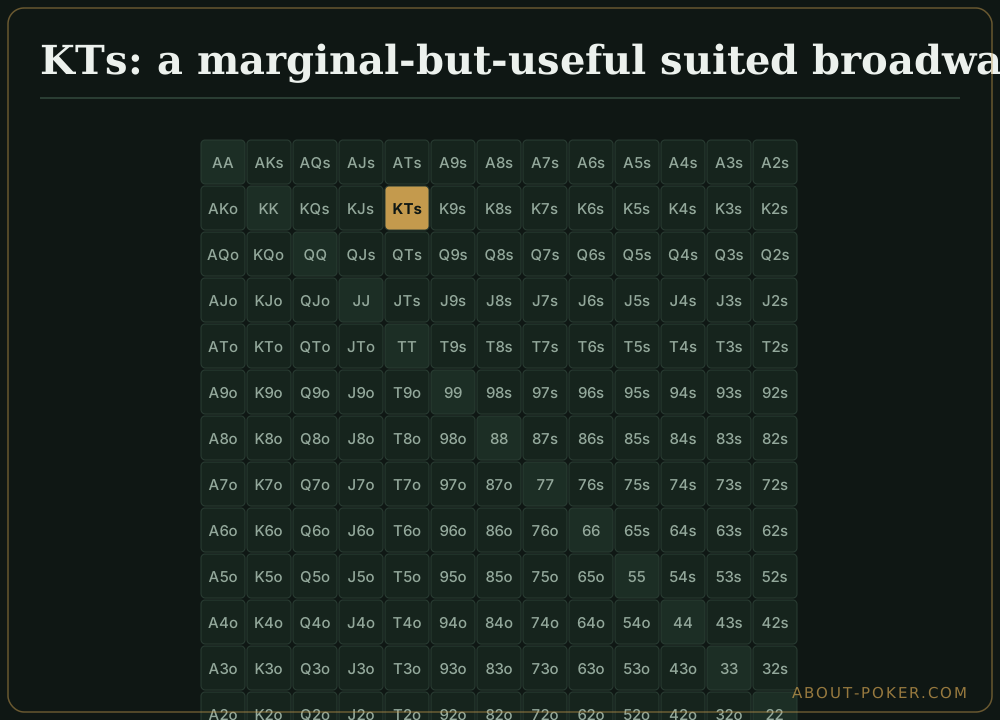
Against wide late-position opens, KTs works as a semi-bluff 3-bet. It holds a king that blocks AK, KQ, and KJ, and a ten that blocks some straights and sets, while its suited body gives it a nut-flush-adjacent draw and straight potential when called. That is the classic blocker-plus-backup profile for a light 3-bet range.
Against tight early-position raisers, fold it. Their range is dense with the premiums and dominating broadways that leave KTs drawing thin, and 3-betting only builds a pot you are behind in.
A worked example
You open K♥T♥ from the cutoff to 2.5bb and the big blind calls. The flop comes K♣6♠3♦ — top pair, ten kicker, on a dry board.
Bet, but keep it modest. Against a wide big-blind defending range you are ahead of K9, K8, K7 suited, all the underpairs, and the missed floats — a bet around a third of the pot gets value from those worse hands. The catch with KTs is the kicker: AK, KQ, and KJ all have you dominated, and while they are a minority of a wide defense, they are the hands most likely to keep raising. So value-bet one street, and be ready to check down or fold if a tight opponent applies serious pressure. Betting three big streets with second-tier top pair is how KTs loses stacks it never needed to risk.
How KTs changes by stack depth and opponent
The way you play KTs is not fixed — it swings with how deep you are and who you are up against.
- Deep (150bb+): KTs gains value. Deep stacks reward hands that make the nuts, and KTs makes nut straights and strong flushes that can win a full stack. Its 3-bet-bluff and set-mining-adjacent upside grows, so you can be a touch more willing to play big pots when you connect hard.
- Short (40bb or less): KTs loses value fast. There is no room to realize a flush or straight draw across three streets, and top pair with a ten kicker becomes a stack-off-or-fold hand rather than a maneuverable one. Tighten up — KTs is closer to a fold or a simple open-fold-to-3-bet holding here.
- Versus a calling station: value-bet your top pair harder and bluff less. Stations pay off worse kings, so lean into the value side.
- Versus an aggressive regular: your blocker 3-bets go up (you block their AK/KQ/KJ value), but your thin value-bets go down, because they will float and raise you off marginal top pairs.
The through-line: KTs is a hand whose whole profile — draw-chasing upside versus dominated top pair — gets more or less attractive depending on how much money is behind and how your opponent pays off.
A second worked example: playing a draw
You open K♠T♠ from the button and the big blind calls. The flop is Q♠J♦4♠ — a monster draw. You have an open-ended straight draw (any A or 9 completes it, and A-K-Q-J-T is the nut straight) plus the nut flush draw in spades. That is roughly 15 outs and better than a coin flip against most made hands.
This is the KTs dream flop, and it is a semi-bluff to build around. Bet, and keep firing on most turns — you have so much equity that getting called is fine and getting folds is a bonus. If the flush or straight lands, you have a hand worth stacking someone with, and because the board reads as high cards, your completed nut hand is well disguised. Contrast this with the earlier dry-board top-pair spot: there you bet once for thin value and shut down under pressure; here you are the one applying maximum pressure with a hand that wants a big pot.
Draws are the real prize
KTs makes its money when it hits its big draws, not when it grinds out a thin top pair. With Q-J on the board you have an open-ended draw to the nut straight (A-Q-J-T-K); in your suit you draw to a strong flush. Those completed hands are worth building big pots around, so barrel your combo draws as semi-bluffs and extract value when they get there.
The discipline, as with every dominated broadway, is to treat one pair as a modest holding. Top pair with a ten kicker is fine for a bet or two against a wide range, but it is not a stack-off hand against a narrow, aggressive line. When a tight range piles in chips on a king-high board, respect that AK, KQ, and sets are exactly what is doing it.
Play KTs like the marginal-but-useful broadway it is: open it in position, fold it up front, 3-bet it as a blocker-heavy bluff against wide ranges, chase its straight and flush draws, and never let a second-tier top pair turn into a stack-off.
Frequently asked
Is king-ten suited worth playing?
Yes, but selectively. KTs is a playable suited broadway that opens well from middle and late position and makes strong straights and flushes. It is heavily dominated by AK, KQ, KJ, AT, and big pairs, so it is not an early-position hand at full ring and should not be stacked off lightly on king-high boards.
Should you 3-bet KTs?
Mostly as a bluff against wide, late-position opens. KTs blocks some strong broadways and has a suited body for backup equity, making it a reasonable semi-bluff 3-bet from the blinds and button. Against tight early raisers, folding is usually better because their range dominates you.
How does KTs compare to KJs?
KTs is a notch weaker than KJs. It shares the same suited-broadway profile but its top pair has a worse kicker and it is dominated by more hands, including KJ itself. It also gains a little straight connectivity. Overall, play it slightly tighter than KJs, favoring late position and selective 3-bet bluffs.