How to Play King-Three Offsuit (K3o)
King-three offsuit is a weak king: a marginal button and small-blind steal but a dominated call. Here is how to open, defend, and fold K3o.
On this page · 6 sections
King-three offsuit (K3o) is a weak king — a hand carried entirely by its high card. The king is a strong top card and a mild blocker to premium holdings, but the three is a poor kicker and the offsuit nature removes any flush potential. That combination makes K3o a marginal late-position steal and a poor call almost everywhere else. Unlike a weak ace, K3o can’t even make the nut-flush or a wheel straight in its suited cousin’s style once you remove the suit, so its whole case rests on stealing blinds and occasionally flopping a workable king. Play it by raising first from the right seats and folding it the rest of the time.
Opening king-three offsuit
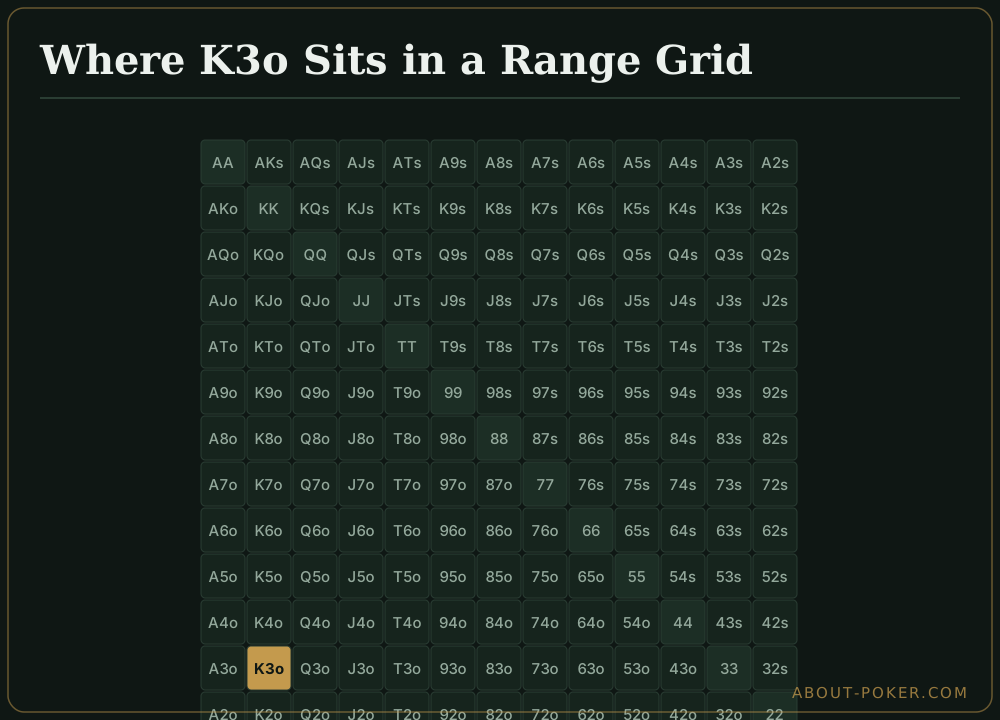
K3o is a marginal open from the button and small blind only. In those seats you are attacking a limited number of players, your king blocks some of their strong hands, and you frequently pick up the blinds without a fight. From the cutoff and earlier, K3o is a fold in the great majority of games — there are simply too many better kings and pairs waiting behind you that dominate it. If you play a very loose 6-max style you might stretch it to the cutoff, but the button and small blind are its true home.
The suited version, king-three suited, opens wider because the flush adds meaningful equity and playability. Take the suit away and K3o becomes a high-card-and-blocker hand only. Your preflop opening ranges should show K3o as a late-position steal at most and a fold from every earlier seat.
The domination problem
The defining weakness of K3o is that it is dominated whenever it makes its best flop. Pair the king and you are behind KQ, KJ, KT, K9, and every other stronger king; you also lose to any pair that flopped a set or held an overpair. That means “top pair” with K3o is often second-best when serious money goes in. The correct approach is to value-bet it thinly against worse hands but to control the pot and treat it as a bluff-catcher facing aggression — going broke with a three kicker is one of the classic ways weak kings lose money.
This domination is also why K3o rarely wants to call a raise. Flatting out of position with a hand that makes dominated pairs is a losing proposition; if you would not raise it, fold it.
Blind-vs-blind play
Where K3o earns its keep is the blind-vs-blind battle. When you are in the small blind against just the big blind, or defending against a small-blind open, ranges are extremely wide and a king-high hand with a blocker sits comfortably ahead of the field. In that context K3o is a raise or a defend rather than a fold, because your opponent is holding weaker unpaired hands far more often than at a full table.
A worked example
You open K♣3♦ on the button and the big blind calls. The flop comes K♦-8♠-4♥. You have top pair, weak kicker. Bet for value — worse kings, eights, floats, and draws will pay you — but keep the pot small and stay alert. If the big blind check-raises and continues firing on a blank turn, your three kicker is a bluff-catcher, not a stack-off hand, and folding is often correct. That flop is the whole lesson of K3o: good enough to bet, too weak to commit.
Adjusting to opponents
K3o is opponent-dependent, so read the table before leaning on it. Against tight players who fold their blinds too often and play fit-or-fold after the flop, K3o steals well and folds cheaply when it misses — exactly the profile you want. Against loose, calling-station opponents who defend wide and never lay down a pair, the hand suffers: your steals get called more often, and your dominated top pairs get paid only when you are behind. In those lineups, trim K3o back toward the button and small blind and rely on it mostly in blind-vs-blind spots where ranges stay very wide. The king blocker helps everywhere, but the steal value that carries the hand shrinks fast against players who refuse to fold.
The takeaway
K3o is a raise-or-fold weak king. Open it only from the button and small blind, use it in wide blind-vs-blind spots, and fold it from earlier seats and against 3-bets. When you flop a king, bet thin and respect the kicker. Handled that way, K3o’s steal value and blocker keep it a small winner instead of a domination trap.
Frequently asked
Should you open king-three offsuit?
Only from the very latest positions. K3o is a marginal open from the button and small blind, where its steal value and its king blocker matter. From the cutoff and earlier it is a fold in most games, since it is easily dominated by better kings.
Is K3o strong enough to call a raise?
No. K3o is dominated by every better king and by all pairs, and it plays poorly cold-calling out of position. Facing an open you fold it, and against a 3-bet it is a trivial fold. Its only value is raising first in late position.
How should you play K3o when you flop a king?
Bet for thin value but keep the pot small. A king with a three kicker is outkicked by KQ, KJ, KT, and other better kings, so treat top pair as a bluff-catcher against real aggression rather than a hand to stack off with.