How to Play King-Three Suited (K3s)
K3s is a marginal suited king that only opens from late position and the blinds. Learn where K3s plays, when to fold it, and how to handle it postflop.
On this page · 6 sections
King-three suited (K3s) is one of the weakest kings still worth putting into a raising range — and only in the right seats. It has the same two redeeming traits every suited king shares: a king-high flush draw and a king blocker that shaves combos off your opponent’s premium range. What it lacks is any real kicker value. The three almost never plays as a good pair, so K3s lives and dies by its draws, its blocker, and your position.
Where K3s belongs preflop
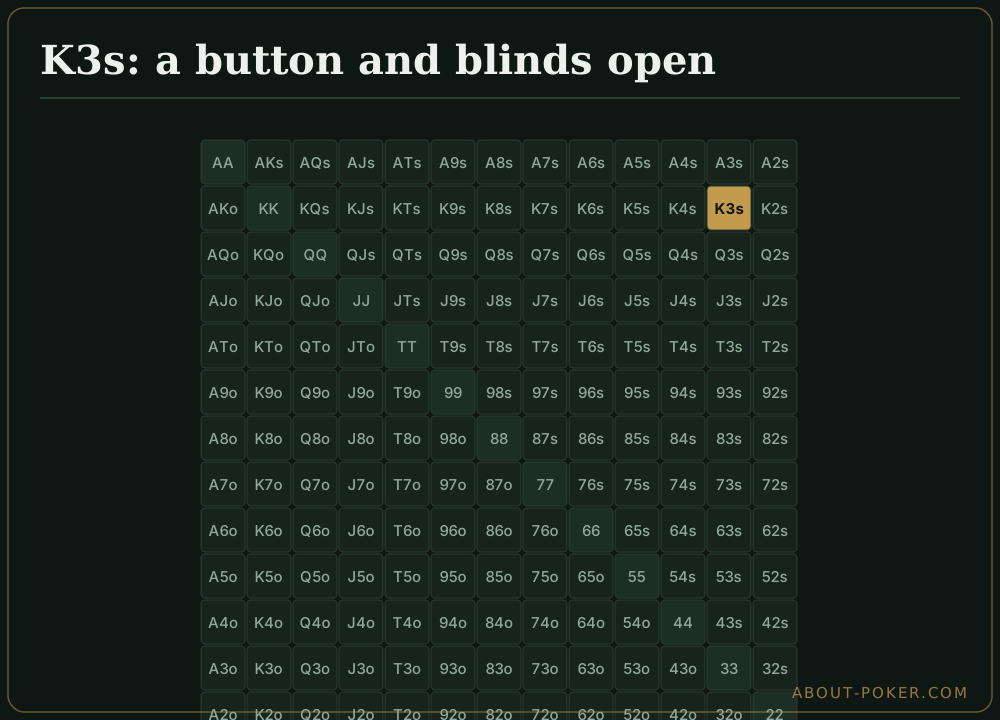
By position, K3s is strictly a late-seat and blind hand:
- Early and middle position: fold. You’d be opening into too many players who can dominate a king, and the three gives you nothing when you pair it.
- Cutoff: a marginal open at best, and many ranges leave it out. If your table folds a lot, it’s playable; otherwise it’s a fold.
- Button: a standard open. You’re raising a very wide range here, and K3s sits comfortably inside it because you’ll be in position every street.
- Small blind: open (raise) rather than limp when the action folds to you, since you don’t want to play a flop out of position for cheap.
- Big blind: defend against late-position opens with a good price.
If the borders feel fuzzy, ground the seat-by-seat logic in the preflop opening ranges and how they widen as you move around the table in poker ranges by position.
The dominated-king problem
The recurring danger with any weak king is domination. When K3s makes top pair on a king-high board, you’re frequently either narrowly ahead of a weaker king or badly behind A-K, K-Q, K-J, or K-T. The three kicker is the culprit — it almost never plays, so your top pair is a bluff-catcher at best.
This is exactly why K3s opens so late. The wider the field in front of you, the more likely someone holds a better king, and the less your top pair is worth. From the button, only two players remain and you have position to control the pot; from early position, the whole table can wake up with a dominating hand.
Facing a raise
When someone opens in front of you, K3s becomes a mostly fold hand. It’s too weak to 3-bet for value and too dominated to flat call profitably out of position. The one real exception is the big blind, where a good price lets you defend and realize equity cheaply. As a 3-bet bluff it’s playable but low-priority: the king blocks K-K and A-K, but suited connectors and better suited kings unblock more of your opponent’s folding range. Reach for those first.
A worked example
You open K♥3♥ from the button. The big blind calls. The flop comes K♦ 9♠ 4♥ — you’ve flopped top pair with a backdoor flush draw. This is a decent hand, but the three kicker means you’re not thrilled about building a huge pot.
You make a small continuation bet; the big blind calls. Turn is the 2♣, no help. Now pot control matters: if you fire a big second barrel and get raised, you have an easy but unhappy fold. So you check back or bet small, keeping the pot manageable and getting to showdown against the many worse kings, second pairs, and missed draws in the big blind’s range. River is the 7♥, giving you nothing extra. You check behind or make a thin value bet — your top pair with no kicker is a bluff-catcher, and overplaying it is how weak kings lose stacks. Position let you see all five cards cheaply; that’s the whole reason K3s is playable here at all.
Postflop in one paragraph
When K3s flops a flush draw, it’s the king-high flush draw — strong, but be aware a higher flush is possible, so barrel it while keeping the pot from ballooning against obvious strength. When it flops top pair, size small for value and pot-control aggressively; you’re often ahead of worse kings but crushed by better ones. When it flops air, the king blocker and backdoor equity make it a fine one-and-done bluff on the right boards. As always with weak suited kings, the value is in the draws and the blocker, not the pair.
Where to go next
K3s is close to the bottom of the playable suited kings — a button and blinds hand that punishes early-position opens. Anchor the seat logic in poker ranges by position, tighten your opens with preflop opening ranges, sharpen the blind spots in blind vs blind play, and connect it all through the preflop strategy hub.
Frequently asked
Is K3 suited a good hand?
K3s is a marginal hand. It's a fine open from the button, small blind, and sometimes the cutoff, but it's a clear fold from any earlier seat. Its value comes from the king-high flush potential and a decent blocker, not from the weak three kicker.
Should I 3-bet with K3 suited?
Not for value. K3s can occasionally be a 3-bet bluff because the king blocks K-K, A-K, and K-Q, but it's a lower-priority bluff than suited connectors or better suited kings. Most of the time you either open it, fold it, or call in the blinds.
Can I call an open with K3 suited?
In the big blind with a good price, yes — you're getting the right odds to see a flop with a hand that flops flushes and pairs. In the small blind or in position it's usually a fold or a raise-or-fold decision rather than a flat call.