How to Play King-Two Offsuit (K2o)
K2o is a weak offsuit king that only opens from the button and defends some blinds. Learn where K2 offsuit plays, when to fold it, and how to play it postflop.
On this page · 6 sections
King-two offsuit (K2o) sits near the bottom of the offsuit-king family. It has the king blocker and can flop top pair, but the deuce kicker is dead weight and, unlike K2 suited, there’s no flush draw to add equity. K2o is a positional and pricing hand — you play it because you’re in the right seat and getting the right odds, not because the cards themselves are strong.
Where K2o belongs preflop
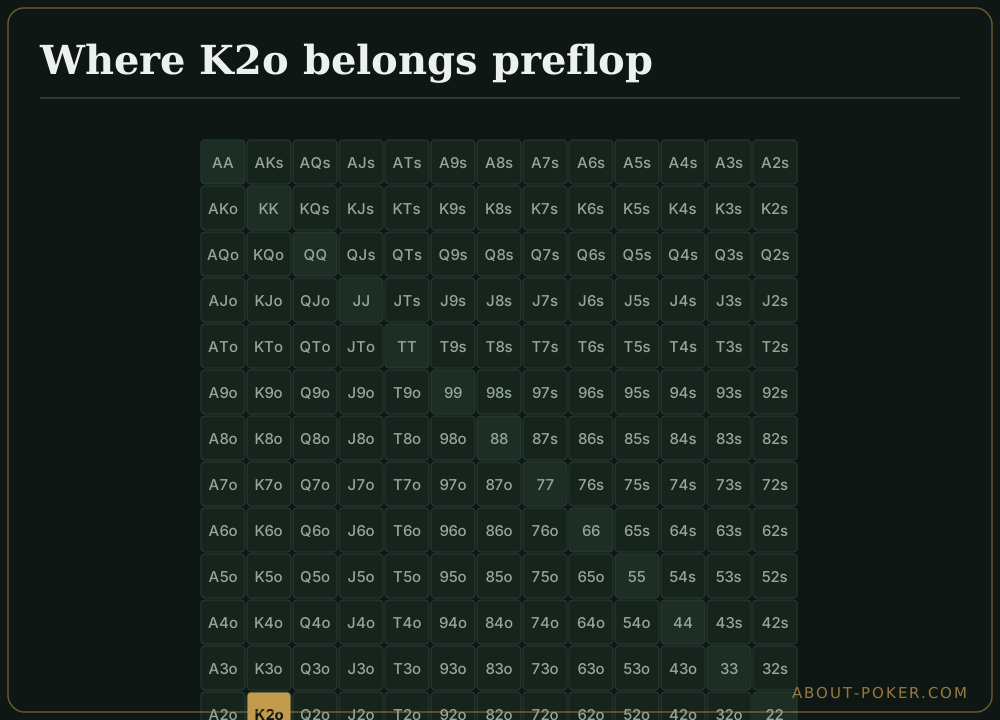
In a standard 6-max game, K2o is not a default open until you reach the button. From the button you’re opening a very wide range against just two blinds, and any king with a live blocker earns a spot. From the cutoff and everywhere earlier, fold it — the offsuit gap and dead kicker make it a clear loss of expected value against the tighter ranges you face there.
The other place K2o shows up is blind defense. In the big blind against a late-position open at a good price, you can flat-call some K2o combos because you’re closing the action cheaply and only need modest equity to continue. If you want to see exactly which seats open which hands, the preflop opening ranges chart lays out where each king enters the mix.
What K2o is not is a 3-bet hand. It’s too weak to raise for value and a poor bluff because it unblocks most of the hands that call a 3-bet. If you want a light 3-bet, reach for a suited king or a suited connector instead.
Why the offsuit gap matters
The single deuce kicker is the whole story. When you flop top pair with a king, you’re routinely out-kicked by better kings, and against a raise you’re often drawing thin. Compare that to a suited holding, which adds flush equity and a nut-flush blocker in some spots. K2o has neither, so its equity is almost entirely tied to flopping a pair of kings and getting to showdown cheaply.
That makes K2o a “fold or top-pair” hand postflop. You’re not chasing draws with it and you’re not bluffing multiple streets — the deuce gives you no backdoor straight potential worth speaking of.
A worked example
You open K♣2♦ on the button to 2.5bb. The big blind calls, and the flop comes K♥ 8♠ 4♣. You’ve flopped top pair, deuce kicker.
This is a c-bet, but a small one — around one-third pot. You have a made hand that wants to get called by worse (weak kings, eights, gutshots) while keeping the pot manageable, because your kicker means you don’t want to build a huge pot against a range that has you dominated. If the big blind check-raises, you’re rarely ahead: your kicker plays terribly, and folding is usually correct against a raising range full of better kings, two pair, and sets. Save the chips.
If instead the flop came Q♥ 9♠ 4♣, you have king-high and nothing else. Give up. There’s no draw to continue with and no reason to turn a dead hand into a bluff here.
How K2o compares to its neighbors
Among offsuit kings, K2o is the weakest — the same way K2 suited is the weakest suited king. It plays slightly worse than K3o and K4o simply because the deuce cannot make a wheel-flavored straight the way middling kickers occasionally can. In blind-versus-blind pots, where ranges are widest, K2o becomes genuinely playable; for a deeper look at those spots see blind vs blind play.
The practical takeaway: open it only from the button, defend it selectively at a good price, and treat it as a fold-or-top-pair hand once you see a flop. Discipline with a hand this weak protects your overall win rate far more than the occasional pot it wins.
How stack depth changes K2o
The correct treatment of K2o shifts with the effective stack, and getting this wrong is a common leak.
- Deep (100bb+): implied odds do nothing for a hand with no draws. K2o can’t stack anyone because it never makes a big hand — top pair with the worst kicker is not a stack-off holding. Deep-stacked, tighten up: the button open is still fine as a steal, but blind defenses get worse because you’re more likely to face postflop pressure across multiple streets and your hand can’t withstand it.
- Medium (40–60bb): roughly the default assumptions in this article. Button opens and selective big-blind defenses at a good price.
- Short (15–25bb): here the king’s raw high-card strength matters more and the kicker matters less, because pots are more likely to go all-in preflop or on the flop before the kicker is tested. K2o becomes a reasonable button open-shove or steal at these depths, since you’re taking the blinds and antes uncontested most of the time and, when called, a king is a live card.
The through-line: K2o’s value comes from fold equity and a live king, not from making strong postflop hands. Shorter stacks lean into the fold equity; deeper stacks expose the weak kicker.
A short decision checklist
When K2o shows up, run through this before acting:
- Am I on the button with folds to me? If yes, opening is fine. If I’m in any earlier seat, fold.
- Am I in the big blind facing a late open at a good price? A cheap flat is defensible; anything expensive or out of a tight opener, fold.
- Did I flop top pair? Bet small for value or check; do not build a big pot, and fold to a check-raise.
- Did I flop nothing? Give up — K2o has no draws to bluff with profitably.
- Am I tempted to 3-bet or call a 3-bet? Don’t. It’s neither a value 3-bet nor a good bluff, and it’s far too weak to defend against one.
Follow the list and K2o stays what it should be: a marginal positional hand that occasionally steals blinds and otherwise stays out of your way. For the wider blind-battle context where it’s most playable, see blind vs blind play.
Frequently asked
Is K2 offsuit a good hand?
No. K2o is one of the weakest offsuit kings and a below-average hand overall. It can open only from the button in a full ring or 6-max game and shows up in some blind-defense spots, but it should be folded from every earlier position.
Should I 3-bet with K2 offsuit?
Almost never. K2o is far too weak to 3-bet for value and a poor bluff because it blocks little of your opponent's continuing range. Suited kings and offsuit broadways make much better 3-bet bluffs.
Can I defend K2 offsuit in the big blind?
Occasionally, against a late-position open at a very good price. You have a king blocker and can make top pair, but it flops weak and dominated pairs often. Play it cautiously and fold to real pressure.