How to Play Pocket Twos (22)
Pocket twos is the smallest pair and a classic set-mining hand. Learn where 22 opens, when to call for set value, and how to play deuces before and after the flop.
On this page · 7 sections
Pocket twos — “pocket deuces” — is the smallest pair in Hold’em, and its strategy is almost entirely about one thing: flopping a set. Preflop it’s a modest holding that’s often behind two overcards, but the moment you flop trip deuces it becomes one of the most profitable and deceptive hands in the game. Play 22 for its set value and you’ll avoid the classic mistake of overplaying a tiny pair.
Where pocket twos belongs preflop
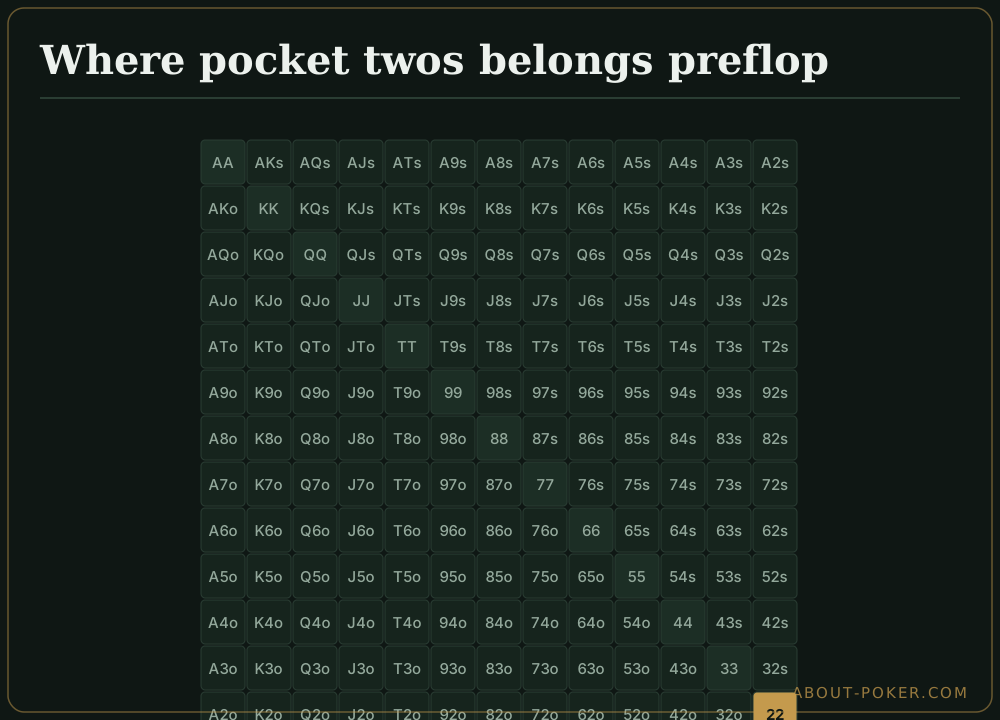
As a pocket pair, 22 opens from more positions than you might expect. In 6-max you can open it from every seat, though from under the gun it’s a lower-frequency raise than the middling pairs. The pair has inherent showdown value against non-pairs and can always improve to a set, so it earns a spot in most opening ranges. See exactly how it fits each seat in the preflop opening ranges chart.
Against a raise, deuces become a set-mining call. You’re calling to flop a set and stack someone — so the key question is whether the stacks are deep enough to pay you off when you hit. This is the heart of cold-calling ranges: flat with position and depth, fold when the price or the stacks make set-mining unprofitable. As a rough guide, you want your call to be a small fraction of the effective stack, so that the ~11.8% of the time you flop a set, the payoff covers all the times you miss.
The set-mining math
Every pocket pair flops a set about 11.8% of the time — roughly 1 in 8.5. The common “rule of 10 or 20” says you want to be able to win at least 10–20 times your call when you hit, to justify chasing that 12%. Deuces are the purest set-miner because they almost never have showdown value when they miss: an unimproved pair of twos is behind nearly everything by the river. That’s why the discipline is simple — hit your set and play a big pot, miss and give up cheaply.
A worked example
You call a middle-position raise with 2♣2♠ on the button, 100bb deep. The flop comes K♠ 7♦ 2♥ — you’ve flopped bottom set.
This is exactly why you called. The raiser will often c-bet with a king, an overpair, or air, so you can just call the flop to keep their range wide and let them keep barreling. On the turn and river you shift to raising and building the pot, because a set of deuces on a K-7-2 board is far ahead of top pair. If the board pairs the king (K-7-2-K), be a little more careful — you’re now beaten by trips with a better kicker and full houses — but bottom set is still a strong hand you’re rarely folding.
Now the far more common outcome: you call with 22 and the flop comes A♥ Q♦ 9♣. You have an unimproved pair of deuces against two overcards on a coordinated board. Fold to any c-bet. There’s no reason to invest further — you were set-mining, you missed, and giving up cheaply is the whole point of the strategy.
Common mistakes with deuces
The biggest leak is overplaying them. Calling a raise, missing the set, and then trying to “represent” something with the smallest pair in the deck is a fast way to lose chips. The second leak is set-mining too shallow — if the stacks aren’t deep enough to pay you when you hit, folding preflop is correct. In blind-versus-blind pots the calculus shifts because ranges are so wide that 22 has more raw value; for those spots see blind vs blind play.
Set-mining by stack depth
The whole set-mining plan lives or dies on stack depth, so make it a conscious calculation rather than a habit. The common shorthand is the “rule of 10 to 20”: to justify calling a raise purely to flop a set, you want to be able to win at least 10 to 20 times your call when you hit, because you only flop the set about 12% of the time and you rarely win anything when you miss. At 100 big blinds deep, calling a 3bb open with deuces is easy — the implied odds are enormous if you stack an overpair. At 40 big blinds, the same call is marginal and you need position and a likely payoff to continue. Below about 20 big blinds, set-mining stops working entirely: there simply aren’t enough chips behind to reward the 1-in-8.5 times you hit, so deuces become a fold or, over very wide late-position ranges, an occasional re-shove on raw equity rather than a speculative call.
Implied odds also depend on your opponent. A tight, straightforward player who only stacks off with strong hands will not pay you when you flop your set, which quietly ruins your price. A loose, sticky opponent who cannot fold top pair or an overpair is the ideal target — against that player, set-mining deuces deep is one of the most profitable calls in poker.
Playing your set on later streets
Flopping the set is only half the hand; you still have to extract. On a dry board like K-7-2, your bottom set is almost always best, so let the aggressor keep barreling into you on the flop and raise later to build the pot before the board gets scary. On a wet, coordinated board — say 9-8-7 with two of a suit — bottom set is more vulnerable to straights and flushes, so you play faster and more aggressively to charge the draws and deny equity, rather than slow-playing into a card that beats you. Watch board pairs closely: if the board pairs above your set (for example K-7-2-K), you can be counterfeited by trips with a bigger kicker or a full house, so proceed with more caution even though bottom set is rarely a fold. The general rule is simple — slow-play only on the safest boards, and speed up as the board gets more dangerous.
A quick decision checklist
- Facing a raise? Deep and in position: call to set-mine. Shallow or out of position: usually fold.
- Flopped a set on a dry board? Slow-play one street, then build the pot.
- Flopped a set on a wet board? Play fast and charge the draws.
- Missed the flop? Fold to any bet — that is the plan working.
- Blind vs blind? Ranges are wide, so 22 has more standalone value; see blind vs blind play.
Bottom line: open pocket twos from most seats, call to set-mine when you have depth and position, stack people when you flop a set, and let it go cheaply when you don’t. Treat 22 as the disciplined set-miner it is and it will quietly add to your win rate.
Frequently asked
Is pocket twos a good hand?
Pocket twos (also called pocket deuces) is the weakest pocket pair but still a playable hand. Its value comes almost entirely from flopping a set. You can open it from most positions and set-mine against raises when the stacks are deep enough.
What are the odds of flopping a set with pocket twos?
About 11.8%, or roughly 1 in 8.5. That's the same for any pocket pair. It's why small pairs are 'set-mine or fold' hands — you want to be deep enough that the times you flop a set pay for the times you miss.
Should I 3-bet with pocket twos?
Usually not for value. Deuces play best as a call to keep an opponent's range wide and realize set value. In some late-position or blind-versus-blind spots you can 3-bet them as a bluff, but flatting is the default.