How to Play Queen-Five Suited (Q5s)
Queen-five suited is a bottom-of-range button steal that plays as a flush draw with a wheel kicker. Learn how to play Q5s and when it is a fold.
On this page · 7 sections
Queen-five suited (Q5s) is one of the weakest hands you will ever voluntarily put chips in with, and even then only from the button. The queen and the five are five ranks apart, so they never combine into a normal straight, and the five contributes almost nothing as a kicker. What keeps Q5s barely playable is the same thing that saves every trashy suited hand: the flush draw, plus the fold equity of a late-position steal. Everywhere but the button and the occasional small blind, Q5s is a clean fold.
Q5s is a pure button steal
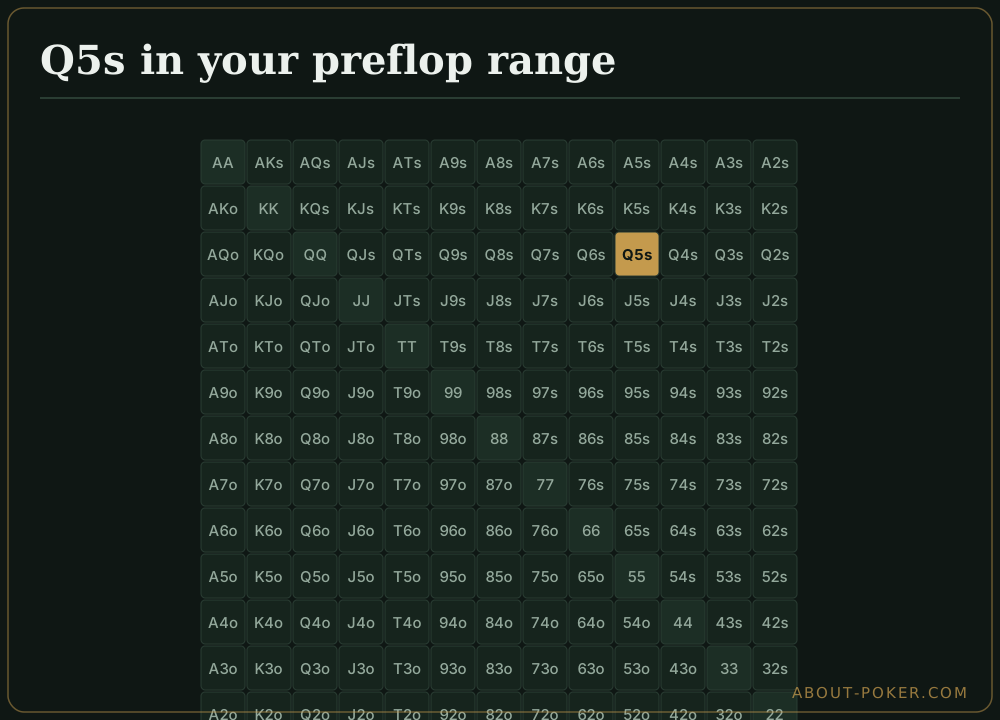
In typical 6-max preflop opening ranges, Q5s shows up only at the very bottom of the button’s raise-first-in range, with a rare small-blind steal. From under the gun through the cutoff it is a fold. The reason is entirely about position: on the button you attack two capped blind ranges with the last action and a flush draw to fall back on when called. Remove the position and fold equity and the hand collapses — no straight potential, no kicker, and a top pair that is dominated whenever it appears.
It sits a rung below even queen-six suited, since the extra gap eliminates essentially all realistic straight outs.
The five does almost nothing
A common misconception is that the five helps make the wheel. In practice it does not matter: the only straight the five participates in is A-2-3-4-5, which does not use your queen at all, so you would be playing a five-high straight on a board where your “big” card is irrelevant. For all practical purposes, Q5s is a queen-high flush draw with a dead second card. It can flop a weak top pair, but that pair is dominated by nearly every queen your opponent continues with.
A worked example
You open Q5s on the button and the big blind calls. The flop comes K-9-2 with two of your suit. You have a queen-high flush draw — nine outs, about 35% equity by the river against a made hand — with no pair and no straight draw. Those nine outs plus fold equity against the big blind’s many missed hands make a small continuation bet a reasonable semi-bluff.
Change the flop to K-9-2 rainbow with none of your suit and Q5s becomes queen-high air: no pair, no draw, near-zero equity, and an automatic check-fold. That binary — big draw or nothing — is the entire playbook for Q5s. When the flush draw arrives you have a hand worth barreling; when it does not, you give up without a fight.
From the blinds: fold first
From the big blind, Q5s is at best a thin defend against a button open at a very good price where you close the action; against opens from earlier positions, fold it. From the small blind, never flat it — a 3-bet-or-fold framework, as covered in defending the blinds, keeps this fragile hand out of the out-of-position pots that punish it most.
How stack depth changes the picture
Q5s only earns its button open at typical 100-big-blind cash depths, where you have room to steal, fire a continuation bet, and give up cheaply when called. Change the stack and the calculus shifts. In a short-stacked spot around 15 to 25 big blinds — common in tournaments — the queen-high flush draw matters far less because you rarely see a river to complete it; here Q5s is closer to a raw fold, since you cannot lean on postflop playability. Deep-stacked at 200 big blinds or more, the reverse-implied-danger grows: when you flop top pair with the queen, deep money means you can lose a large pot to a better queen or to a flush that beats yours (an ace-high or king-high flush over your queen-high one). Deep stacks reward hands that make the nuts, and Q5s almost never makes the nut flush. So the sweet spot for opening Q5s is medium-depth, position-based stealing — not shallow shove stacks and not deep, implied-odds pots.
A quick decision checklist
Before you put Q5s in the pot, run through four questions. Are you on the button (or, rarely, an unopened small blind)? If not, fold. Are stacks in the roughly 40-to-150-big-blind band where postflop play has value? Has the action folded to you, so you actually have fold equity against just the blinds? And on the flop, did two of your suit arrive? If the answer to any of the first three is no, muck preflop. If the flop question is no, check-fold. Only when all four line up do you have a hand worth betting — a queen-high flush draw with real semi-bluff equity, roughly nine outs and about 35% against a made hand by the river.
The bottom line
Q5s is a button-only steal that plays as a flush draw with a queen and a dead five attached. Do not overvalue top pair, do not defend it against strong ranges, and never 3-bet it. Open it on the button, semi-bluff the flush-draw flops, and fold it cleanly everywhere else. Handled with that discipline, Q5s contributes a little late-position stealing frequency without turning into a leak — but the moment you start playing it for value in big pots, it will cost you.
Frequently asked
Is queen-five suited a good hand?
Q5s is a weak, bottom-of-range hand playable only as a button steal and, marginally, a small-blind steal or big-blind defend. The queen and five are far apart, so straights are almost impossible, and its equity comes mainly from the flush draw. Fold it from most positions.
Should you open queen-five suited?
Only from the button in most 6-max games, and rarely from the small blind. It is a fold everywhere earlier. When you open Q5s, you are stealing the blinds with position and fold equity, not raising a hand with real showdown value.
Does the five in Q5s help make straights?
Barely. The five is too far from the queen to combine into a standard straight, and the only wheel straight it makes (A-2-3-4-5) does not use the queen. In practice Q5s is a flush-draw hand, and the five is essentially a dead kicker.