How to Play Queen-Jack Offsuit (QJo)
QJo is a connected offsuit broadway that opens from middle and late position and folds up front. Learn where QJo plays, when to fold it, and how to play it postflop.
On this page · 6 sections
Queen-jack offsuit (QJo) is the most playable of the offsuit broadways because it’s connected — the queen and jack sit next to each other, so QJo makes plenty of straights, including some of the strongest ones on broadway boards. That connectivity partly offsets the usual offsuit-broadway curse of domination, but only partly. QJo is a good open in the right seats and a discipline test in the wrong ones.
Where QJo belongs preflop
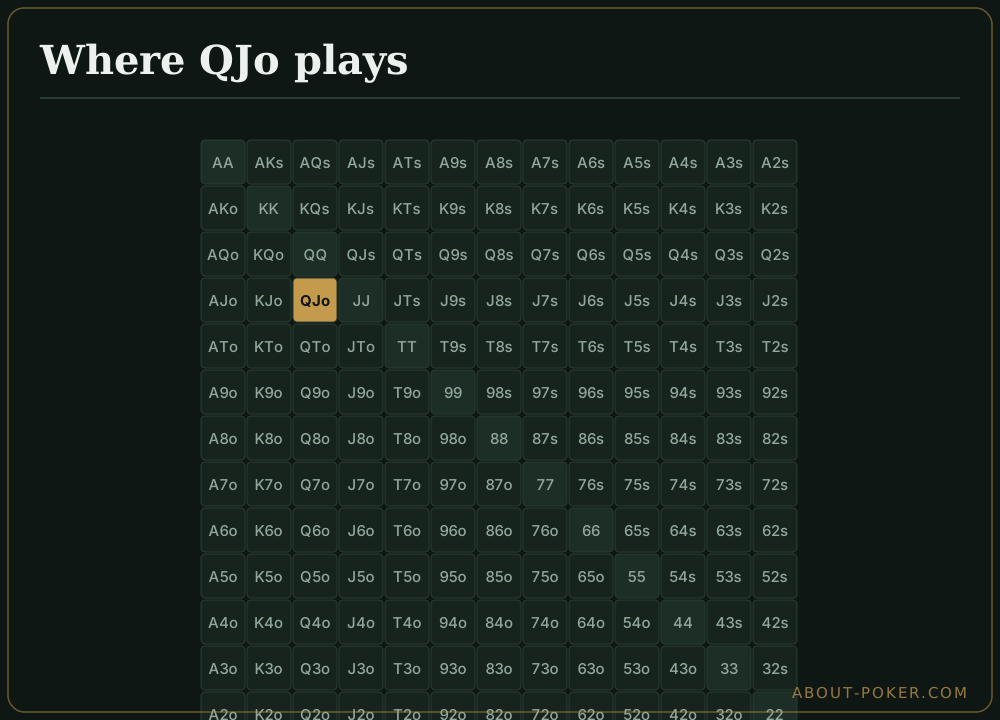
By position, QJo is a middle-and-late open:
- Early position (full ring / UTG at 6-max): fold in tight games; a borderline open in loose 6-max pools. Too many players behind can have you dominated.
- Middle position: a standard open. The field has narrowed enough for QJo to fit comfortably.
- Cutoff and button: an easy open every time. Late position lets you steal and realize equity in position.
- Small blind: open (raise) rather than limp when it folds to you.
- Big blind: defend widely; QJo is a comfortable defend against most opens.
Ground the borders in the preflop opening ranges and see how QJo climbs from an early fold to a routine late open in poker ranges by position.
Connectivity softens the domination problem
Like every offsuit broadway, QJo suffers domination: your queen loses to AQ and KQ, your jack loses to AJ and KJ, and big pairs beat both. But its saving grace is that the connected structure makes strong straights. On a KT-x or T9-x board, QJo can flop or turn the nut straight — a payoff that dominated hands like KJo or QTo hit less often. That straight potential is why QJo out-earns the other offsuit broadways and why it’s worth defending fairly wide, especially from the big blind. See how those defenses run in defending the blinds.
Even so, QJo still wants to play in position and heads-up. Its pairs are fragile, and out of position against strength you’ll often be guessing whether your top pair is good.
Facing a raise
When there’s a raise in front of you, QJo is mostly a call-or-fold hand rather than a 3-bet. Against a tight opener, 3-betting isolates you against AQ, KQ, AJ, and big pairs — the exact hands that dominate you. Against a wide late opener or in blind-versus-blind, QJo is ahead of the range and can 3-bet for value or as a semi-bluff.
In position with a good price, calling a single raise is fine because you flop top pairs and nut-straight draws. Out of position against a tight raiser, folding is usually best unless the price is very good.
A worked example
You open Q♦J♣ from the cutoff and the big blind calls. The flop comes K♠ T♥ 4♦ — you’ve flopped an open-ended straight draw to the nuts (any ace or nine makes Broadway or the queen-high straight, giving you eight clean outs).
The big blind checks. You continuation-bet as a semi-bluff: with eight outs you have roughly 31% equity to hit by the river with two cards to come, plus fold equity if the big blind folds a weak hand now. The big blind calls. Turn is the A♠ — you make the nut straight. Now you bet for value; a king, a two-pair hand, or a slowplayed set will pay you off, and you’re drawing dead to nobody. River is the 3♣; you size up for a final value bet, targeting the strong-but-second-best hands that can’t fold. That flopped draw turning into the nuts is exactly the payoff that makes QJo worth playing.
Contrast that with flopping just top pair — Q♠ 7♦ 2♣. Now you hold a queen with a jack kicker that’s easily dominated; bet once for thin value at most and be ready to fold to pressure. QJo’s money is in the straights, not the pairs.
Postflop in one paragraph
When QJo flops a straight draw — especially an open-ender or a nut gutshot on a broadway board — semi-bluff it aggressively, because the equity and payoff are large. When it flops top pair, extract thin value against wide ranges but pot-control against ranges full of bigger kickers and sets. When it flops middle pair or worse, it’s usually a give-up or a single-barrel bluff. The theme is that QJo earns its keep by making strong straights, so lean into the draws and stay disciplined with the pairs.
Where to go next
QJo is the best of the offsuit broadways thanks to its connectivity, but it still rewards restraint against strength. Sharpen your opens with preflop opening ranges, study the seat-by-seat borders in poker ranges by position, and connect the whole framework at the preflop strategy hub.
Frequently asked
Is QJ offsuit a good hand?
QJo is a solid but easily dominated broadway. It opens from middle and late position and defends the big blind well, but it's a fold from early position at a full table. It plays well because it's connected and makes strong straights, but its pairs are often second-best.
Should I 3-bet with QJ offsuit?
Only against wide ranges. QJo can 3-bet a loose late opener or in blind vs blind where you're ahead. Against a tight early raise it's usually a call or fold, because you're dominated by AQ, KQ, AJ, and better.
Can I call a raise with QJ offsuit?
In position at a good price, yes — QJo flops top pairs and nut straights. Out of position against a tight raiser it's often a fold because you'll be dominated and struggle to realize equity outside of hitting a straight.