How to Play Queen-Jack Suited (QJs)
QJs is a strong suited broadway that opens from every seat and flops straights, flushes, and top pairs. Learn how to play queen-jack suited preflop and postflop.
On this page · 6 sections
Queen-jack suited (QJs) is one of the most playable hands in Hold’em. It’s a suited broadway that opens from every seat, makes the nut straight on plenty of runouts, flops flushes and flush draws, and pairs into strong top pairs. Its playability is the whole point: even when it doesn’t make a made hand, it flops a draw so often that you can keep applying pressure. QJs is a hand you open confidently and play aggressively, while staying aware that its top pairs can be dominated.
Where QJs belongs preflop
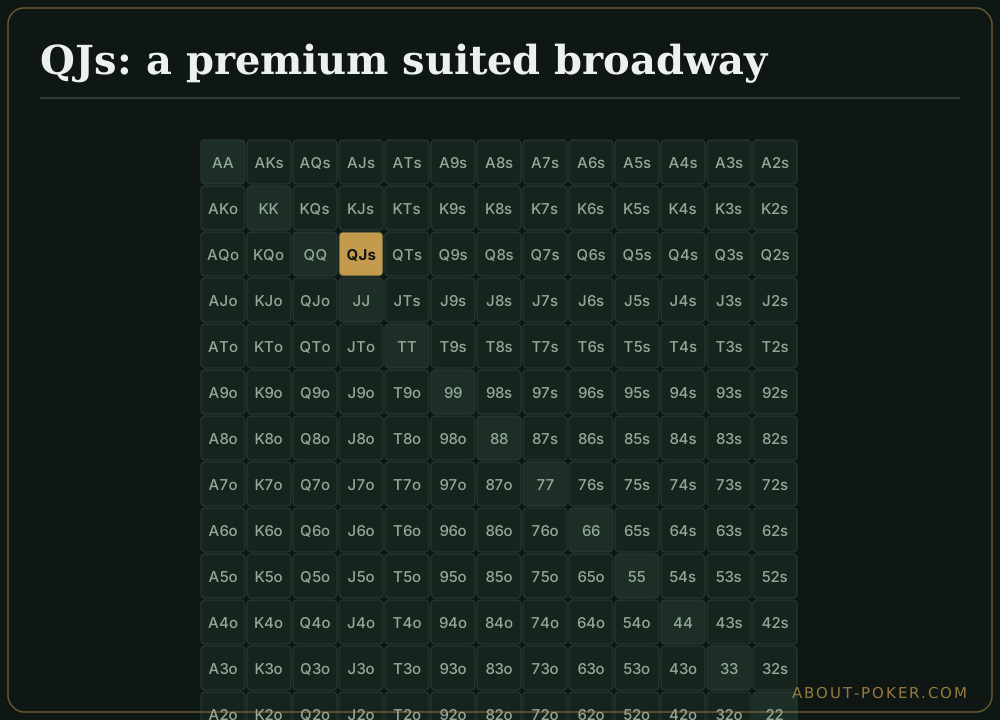
QJs is a universal open at most table types:
- Early position (UTG): open at nearly every table, especially 6-max. QJs is comfortably inside your UTG range thanks to its suitedness and connectedness.
- Middle and late position: an automatic, easy open.
- Small blind: raise (not limp) when it folds to you — you’d rather play a raised pot than a passive one with a hand this playable.
- Big blind: defend widely, and mix in 3-bets against late openers.
Because QJs opens everywhere, the interesting choices are how you respond to raises. Anchor the opening frequencies in the preflop opening ranges and see how the range broadens by seat in poker ranges by position.
Why QJs plays so well
The strength of QJs is coverage. On a huge fraction of flops it connects: it flops a pair, an open-ended straight draw, a gutshot, a flush draw, or some combination. That connectivity is exactly what lets a hand keep barreling — when you continuation-bet and get called, you usually still have outs to improve, which turns give-up spots into semi-bluffs.
QJs also makes the nut straight on ideal runouts (like a KT-x or AT9-type board completing Q-J-x-x-x into Broadway or a lower straight), and its flushes are strong even if not always the nuts. The tradeoff is that its top pairs — a pair of queens or jacks — can be outkicked by AQ, KQ, and AJ, so you shouldn’t treat every top pair as a stack-off.
3-betting and facing 3-bets
As a 3-bet, QJs is best used as a semi-bluff against wide late-position openers. It has real equity when called — it flops draws constantly — so it’s not a pure bluff; it’s a hand that can win the pot preflop and also make strong hands postflop. Against a tight UTG open, flatting in position is usually better than 3-betting into a range full of the bigger broadways that dominate you. The 3-bet range guide covers how QJs fits as a bluff versus a flat.
When you open and face a 3-bet, position drives the decision. In position with a fair price, call and lean on your excellent equity realization. Out of position against a tight 3-bettor, folding is fine when the price is bad, since domination by AQ/KQ/AJ is a real cost. The defending against 3-bets guide shows how to build a continuing range that keeps your draws and folds your most dominated combos.
A worked example
You open Q♠J♠ from the cutoff. The button calls. The flop comes T♠ 9♦ 4♠ — a spectacular flop for QJs. You have an open-ended straight draw plus the second-nut flush draw, giving you roughly 15 outs and around 54% equity against a single pair on the flop.
You continuation-bet as a strong semi-bluff and the button calls. Turn is the 2♣, a brick, but you still hold a monster draw, so you barrel again — you have huge fold equity and, when called, plenty of outs to a straight or flush. River is the 8♦, completing your straight (Q-J-T-9-8). You now hold a near-nut hand and bet for value, targeting the two pairs, sets, and worse straights the button can hold. This is QJs at its best: a draw so powerful you can bet every street and often win whether you hit or not. Contrast that with flopping just a bare pair of jacks on a queen-high board, where you’d pot-control because your kicker is often behind.
Postflop in one paragraph
QJs is a draw-and-broadway hand postflop. When you flop a combo draw (straight plus flush outs), it’s one of the best semi-bluffing hands in poker — barrel aggressively, since you have both fold equity and monster equity when called. When you flop the nut or near-nut straight or a strong flush, play it fast for value. When you flop top pair, bet for value but pot-control against strong ranges because AQ, KQ, and AJ outkick you. When you whiff completely, the two broadway overcards and backdoor equity still make it a fine one-barrel bluff. The unifying theme is that QJs almost always has something — a made hand, a draw, or a blocker — which is why it earns its spot in every opening range.
Where to go next
QJs is a premium suited broadway defined by its playability: open it everywhere, use it as a semi-bluff 3-bet against wide ranges, and lean on its draws postflop. Calibrate your opens with preflop opening ranges, sharpen your bluff-3-bet spots in the 3-bet range guide, learn to continue correctly with defending against 3-bets, and tie it all together at the preflop strategy hub.
Frequently asked
Is QJ suited a good hand?
Yes, QJs is a strong suited broadway and a standard open from every position, including under the gun at most tables. It makes flushes, open-ended straights, and strong top pairs, and it has excellent playability because so many flops give it a pair or a draw.
Should I 3-bet with QJ suited?
Sometimes, as a bluff or semi-bluff. QJs makes a good 3-bet bluff against wide late-position openers because it has strong equity when called, flopping flushes and straights. Against tight early-position raisers, flatting in position is often better since you're dominated by their bigger broadways.
How do I play QJ suited against a 3-bet?
In position with a reasonable price, call. QJs realizes equity well because it flops so many draws and pairs. Out of position against a tight 3-bettor it's closer, and folding is fine when the price is bad, since you can be dominated by AQ, KQ, and AJ. When you continue, lean on your draws rather than thin top pairs.