How to Play Ten-Five Suited (T5s)
Ten-five suited is a marginal suited hand — an occasional button steal and a big-blind defense card, but a clear fold almost everywhere. Here is how to play T5s.
On this page · 6 sections
Ten-five suited (T5s) is close to the bottom of the suited-hand pile. It is a two-gapper with a weak five kicker, so it makes few straights, weak top pairs, and only rarely the nut flush. That does not make it worthless — suitedness is worth real equity — but it does mean T5s only belongs in a couple of very specific spots. The skill with a hand this marginal is knowing when to fold it, which is almost always.
Where T5s belongs
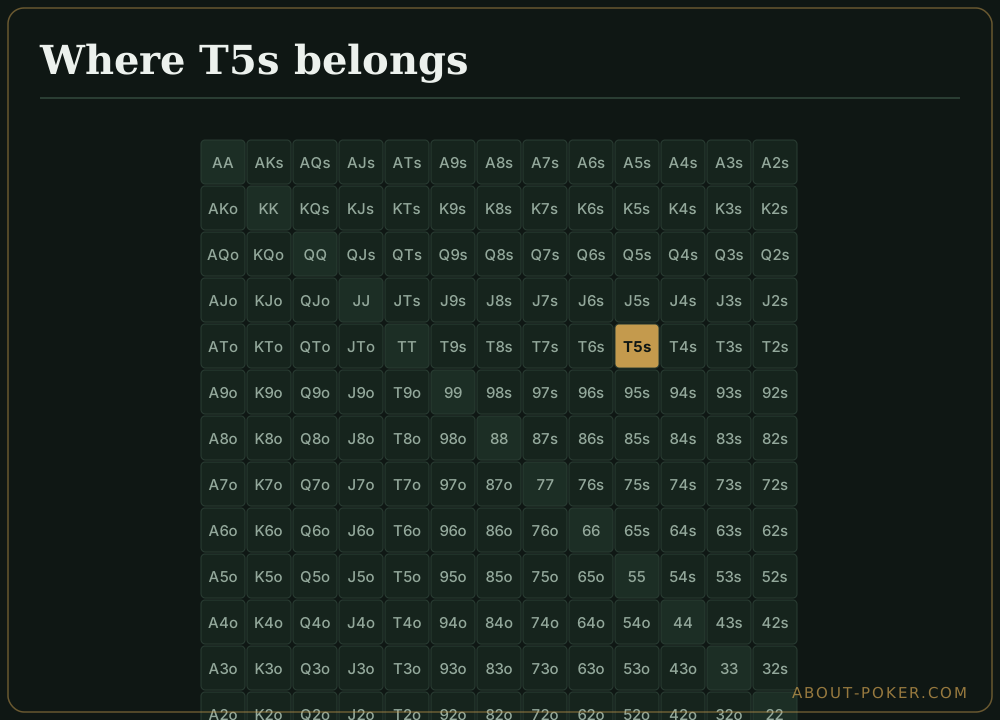
T5s is a button-fringe hand. From the button, with only the blinds left to act, your widest steals can include hands like T5s at a mixed frequency — but plenty of solid ranges just fold it, and you should never feel obligated to open it. It sits right at the edge of the widest preflop opening ranges, and unlike a suited ace or a tighter connector, it has no business opening from the cutoff or earlier.
If you are newer to reading these charts, the reason T5s appears in some button ranges but not others is frequency mixing — the solver plays it as a raise only part of the time. Poker ranges explained walks through why some hands are pure raises and others are close mixes like this one.
Defending the big blind
The most reliable spot for T5s is big-blind defense against a late-position raise. When you are closing the action and getting a discount, T5s clears the bar to call because it flops enough draws to continue and you never have to act first postflop with the initiative against you. This is standard wide blind defense — you call with speculative suited hands to see cheap flops, not because T5s is strong.
Keep the plan simple: continue when you flop a draw or a real piece, and fold when you miss. Do not call 3-bets with it, and do not turn a ten-high hand into a big bluff.
A worked example
You defend T5s (Ts-5s) in the big blind against a button raise. The flop is Qs-8s-3h. You have flopped a flush draw — nine spades give you a flush, so you have roughly 35% equity against a single overpair by the turn-and-river, and more if your ten can also pair.
With a draw this strong and position against you, check-calling is fine, and check-raising as a semi-bluff is also reasonable because you have equity when called and fold equity when they give up. Either way, you have a clear, aggressive plan.
Now change the flop to Ah-Kd-7c. You have a ten-high, no pair, no draw, and two overcards on the board. Check and fold. That is the honest outcome most of the time with T5s — the flush draw above is the exception, not the rule.
Bottom line on T5s
T5s is a fold-first hand. Its only legitimate homes are a mixed button steal and wide big-blind defense at a good price. Everywhere else, muck it. When you do play it, chase your draws aggressively and abandon your air quickly. Get greedy — opening it from early seats, calling 3-bets, barreling ten-high into strong ranges — and it turns from a tiny edge into a reliable leak.
How stack depth and opponents shift the spot
The value of T5s tracks its ability to realize equity, and that depends heavily on stack depth and who is behind you. Around 40-100bb, the button steal is at its most reasonable: you have room to see a flop and use position, and the flush and straight draws it makes have implied odds when they hit. As stacks get short — 15-25bb in a tournament, for instance — the picture changes. The speculative side of T5s (chasing draws for a big pot) evaporates because there is little to win behind, so the hand becomes almost purely a fold-equity steal. It is fine to jam or open-fold it as a wide steal short-stacked, but do not flat-call raises with it, since you cannot profitably see flops without the implied odds a deep stack provides.
Opponents behind you matter as much as depth. A button open with T5s wants blinds that fold too much or play straightforwardly postflop. If the small blind 3-bets aggressively or the big blind is a sticky calling station who never folds a flop, drop T5s from the steal — you will either get blown off the hand or forced to play a weak two-gapper out of position with the worst of it. Against loose-passive blinds who call and then check-fold, the steal prints. Reading those tendencies is what turns a mixed, marginal hand into a clear open or a clear fold.
A second worked example: the straight draw
You defend T5s in the big blind against a button open and the flop comes 7-6-4 rainbow with no flush draw for you. You have flopped an open-ended straight draw — any 8 or any 3 completes your straight, eight outs, for roughly 31% equity by the river. This is a very different kind of continuing hand from the flush-draw example above: your draw is disguised, and if you hit, an eight or a three is unlikely to be on your opponent’s radar. Check-calling one bet is standard, and a check-raise semi-bluff is defensible against an opponent who folds too often, since you have real equity when called. The key difference from a flush draw is nut quality — an 8 gives you the nut straight here, but be alert that a 3 makes only the low end (3-4-5-6-7), which can be second-best against a hand holding an 8. Play the draw aggressively, but respect the difference between the nut end and the idiot end when the straight actually comes in. As always with a hand this marginal, the moment you have neither a pair, a real draw, nor strong equity, check and fold and move on.
Frequently asked
Can you open ten-five suited?
Only as a marginal, mixed-frequency steal from the button, and many solid ranges simply fold it. T5s is a wide two-gapper with a weak kicker, so it relies almost entirely on the button's positional edge. From any earlier seat it is a fold.
Is T5s a good hand to call raises with?
Mostly only from the big blind when you are getting a large discount. T5s plays as a speculative flush-and-straight draw hand that wants cheap flops. It is not a hand to cold-call raises with out of position or to call a 3-bet with.
How is T5s different from T6s or T7s?
The gap matters. T7s connects more tightly and makes more straights, T6s is a one-gapper, and T5s is a two-gapper — the widest and weakest of the three. Each step down loses straight equity and showdown value, which is why T5s is playable in fewer spots.