How to Play Ten-Seven Suited (T7s)
Ten-seven suited is a speculative two-gapper that opens from late position only. Here is how to open, bluff, and play T7s postflop without leaking money.
On this page · 6 sections
Ten-seven suited (T7s) is a two-gapper — the ten and seven leave two ranks (the nine and eight) between them — which places it at the speculative edge of the suited-connector family. Two gaps meaningfully cut into its straight-making, so T7s cannot lean on connectivity the way ten-eight suited or T9s can. What it keeps is its suitedness and a few draw structures, which is enough to make it a selective late-position open but not much more. The whole discipline with T7s is playing it only where position and steal equity justify a speculative hand.
Where T7s belongs preflop
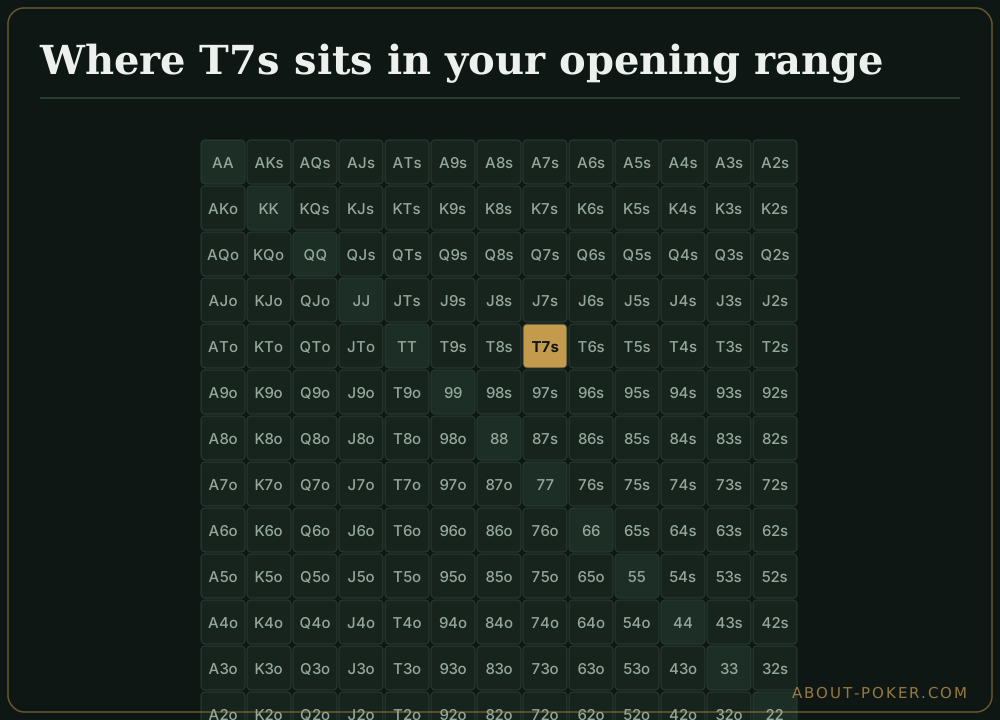
By seat, T7s is strictly a late-position and small-blind hand:
- Early and middle position: fold. A two-gapper has no business in a pot with many players behind and no position.
- Cutoff: a marginal open in loose games, closer to a fold in tight ones.
- Button: a reasonable open — this is T7s’s main home, where position and steal equity carry it.
- Small blind: open (raise) when it folds to you.
- Big blind: a fine defend against a single late open at a good price; fold to raises-and-callers or tight early opens.
Anchor the borders in the preflop opening ranges, and note that T7s opens tighter than the one-gap ten-eight suited because the extra gap costs it straight potential.
What two gaps cost you
Every gap between your cards removes straight combinations. A connector like T9s can complete straights through several run-outs; a two-gapper like T7s needs specific boards — it makes straights mainly through the 8-9 filling cards (like 8-9 or 9-J is out of reach; realistically 6-8-9 or 8-9 boards) and open-enders such as 8-9. In practice T7s makes clearly fewer straights than T8s, so it leans more on its flush draws and backdoor equity than on straights. That shift matters postflop: T7s is more of a flush-and-overcard hand than a straight machine, and it wants position so it can barrel its draws and fold its air cheaply.
Facing a raise
Against an opener, T7s is mostly a fold, with an occasional low-priority 3-bet bluff from the button or small blind against a very wide opener. Its blocker value and suitedness give it a place in a balanced bluffing range, but only after better connectors are already in the mix. In position at an excellent price you can flat a single raise, but out of position or against a tight range, folding is correct. Keep T7s near the bottom of your bluff selection in the 3-bet range.
A worked example
You open T♠7♠ from the button and the big blind calls. The flop comes A♠ 9♠ 3♦ — you have flopped a flush draw (nine spades left gives you nine outs) plus a backdoor straight draw. The big blind checks. You continuation-bet as a semi-bluff: with nine outs to the flush you have roughly 35% equity to reach the river with two cards to come, plus fold equity because the ace on board is scary and the big blind will fold much of their air. The big blind calls. The turn is the 2♠ — you complete the flush and bet for value, getting paid by top-pair-ace hands that cannot fold. That flush is the primary way T7s wins a big pot; its straights are rarer than a connector’s.
Now suppose the flop came T♦ 6♣ 2♥ instead — top pair, ten-high, with a weak seven kicker. That is a thin one-pair hand at best; take a small stab or check and fold to pressure. T7s makes its money on flushes and disciplined folds, not on marginal pairs.
Postflop in one paragraph
When T7s flops a flush draw, semi-bluff it aggressively — that is its main source of equity and payoff. When it flops a straight draw, treat it the same, though these come up less often than with a connector. When it completes a flush, bet for value and expect calls from top pair. When it flops top pair or worse, take small value or give up cheaply, because the hand is speculative and out of its depth in big pots. Lean on the suit, respect the gaps, and fold the misses.
Where to go next
T7s is a speculative two-gapper for late position only, playable mostly for its flush and steal equity. Sharpen your opens with preflop opening ranges, compare it to the stronger one-gap ten-eight suited, and connect the framework at the preflop strategy hub.
Frequently asked
Is ten-seven suited a good hand?
T7s is a speculative two-gap suited hand that is playable only from late position and the small blind. It flops flush draws and some straight draws, but the two-card gap costs it straight combinations, so it is weaker than T8s and T9s. Play it selectively and lean on its flush and backdoor equity.
Should you open ten-seven suited?
Only from late position. T7s is a fold from early and middle seats but a reasonable open from the button and small blind, where position and steal equity make its speculative draws worthwhile. In tighter games it is closer to a fold even on the button.
Can you 3-bet bluff ten-seven suited?
Occasionally, and low in the priority order. T7s can be a 3-bet bluff from the button or small blind against a very wide opener, mostly for its blocker value and suitedness. It is a worse candidate than T8s or T9s, so use it sparingly and prefer better connectors first.