How to Play Ten-Four Suited (T4s)
Ten-four suited is almost always a fold. Learn the rare spots where T4s is playable — the widest button steals and cheap big-blind defense — and when to muck it.
On this page · 6 sections
Ten-four suited (T4s) is, for practical purposes, a fold. It is a three-gapper with a bottom-tier kicker, so it makes almost no straights, weak top pairs, and only occasionally a flush. If you are picking up T4s and wondering how to play it, the honest and correct answer most of the time is: you don’t. But there are one or two razor-thin spots where suitedness and price make it barely playable, and knowing those keeps you from either over-folding or over-playing it.
Where T4s belongs (almost nowhere)
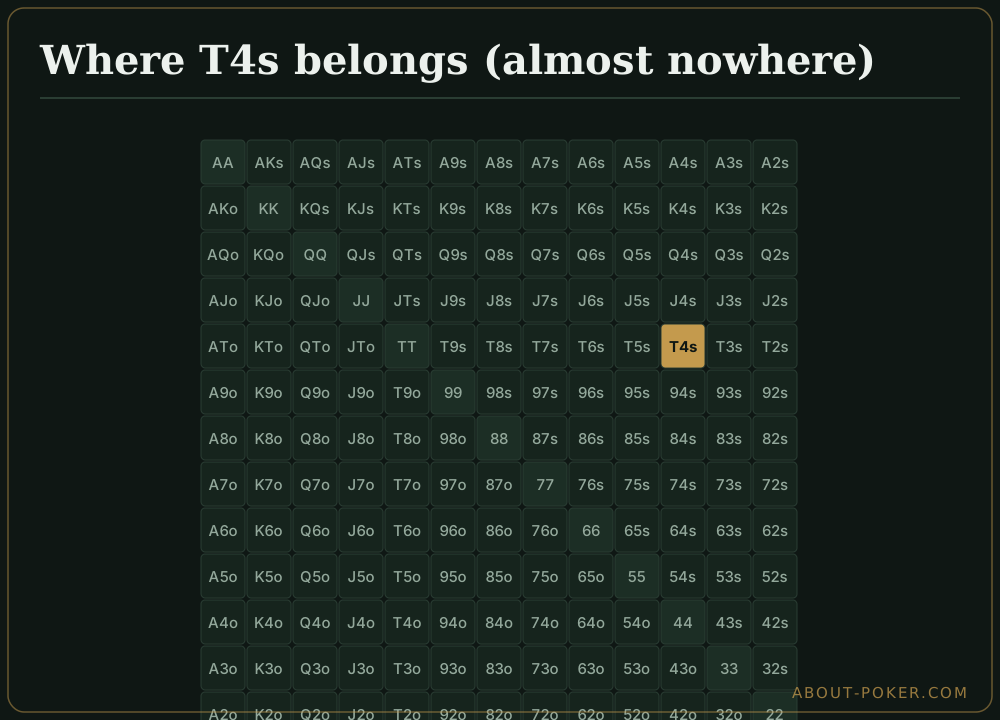
T4s is below the standard opening threshold from every seat. It is not in early, middle, or even most cutoff ranges. On the button it is, at best, a very-low-frequency mix that many solid ranges omit entirely — you will lose nothing by simply folding it there. It sits outside the widest preflop opening ranges, and treating it as a real opener is a mistake.
If you are still building intuition for which hands make the cut, it helps to think in terms of the whole range rather than one hand. What is a poker range explains why the marginal hands at the bottom — like T4s — are the ones you should be quickest to cut.
The only real spot: cheap big-blind defense
The single legitimate use for T4s is defending the big blind against a small raise at a great price. When you are closing the action and the pot odds are generous, T4s is a bottom-of-range call because it flops the occasional flush draw or two pair and costs you almost nothing to see the flop. This is the far edge of wide blind defense — you are not defending because T4s is good, you are defending because the price is too cheap to fold.
The rule with T4s in this spot is strict: continue only when you flop a strong draw or better, and fold everything else immediately. No floats, no ten-high bluffs, no calling 3-bets.
A worked example
You defend T4s (Td-4d) in the big blind against a min-raise. The flop comes 8d-5d-2c. You have a flush draw — nine diamonds complete it — giving you roughly 35% equity by the river against a typical overpair. That is a genuine reason to continue: check-call, and you have a clear plan to make your hand.
Now take the far more common outcome: the flop is Kh-9s-6c. You have ten-high, no pair, no draw. Check and fold. There is nothing to think about — a ten-four with no piece and no draw is a trivial muck. That lopsided ratio, one good flop to many hopeless ones, is exactly why T4s is barely playable even at a discount.
How opponents and price change the call
Whether T4s scrapes into your big-blind defense depends heavily on the raise size and the raiser. Against a 2x min-raise you’re often getting better than 3.5-to-1 to close the action, and a hand that only needs to realize a sliver of equity can profitably peek at a flop. Push the raise up to 3x or 4x and the price collapses — T4s is a clean fold, because you now need to win far more often to justify the call and this hand simply doesn’t.
The opponent matters as much as the number. A tight late-position raiser has a strong, condensed range that dominates your weak ten and easily beats your low flush draws’ backdoors; fold and move on. A loose, multi-limping table is the friendlier spot, because your suitedness plays well in a family pot where a flush gets paid and nobody has a premium. If a 3-bettor is lurking behind you, that risk is gone — you close the action in the big blind, which is exactly why this seat, and only this seat, gives T4s any life at all.
A short decision checklist for T4s
- Opening? Fold. Every seat, including the button. There is no standard open with T4s.
- Facing a raise from outside the blinds? Fold. Cold-calling out of position with a three-gapper is a pure leak.
- In the big blind, small raise, closing the action, great price? A bottom-of-range call is defensible — but optional, never mandatory.
- Flopped a flush draw, big two pair, or a disguised straight? Continue, usually check-call, and keep the pot controlled unless you improve.
- Flopped a weak pair, ten-high, or air? Check and fold. No floats, no ten-high bluffs, no hero calls.
- Facing a 3-bet with it? Fold instantly. T4s has no business continuing against a reraise.
Internalizing that list turns a fiddly, tempting hand into a two-second decision at the table, which is exactly what you want from the bottom of your range.
Bottom line on T4s
T4s is a fold in essentially every spot. Its only defensible use is the cheapest, most price-driven big-blind defense, and even that is optional. Do not open it, do not cold-call raises with it, and do not get creative postflop. When you do end up with it in a family pot from the big blind, chase real draws and fold your air. Master the discipline of folding hands like T4s and you plug one of the most common beginner leaks — playing junk suited cards just because they are the same color.
Frequently asked
Should you ever open ten-four suited?
Almost never. T4s is below the threshold of most standard opening ranges, and even on the button it is a fold or a very low-frequency mix at best. It is a three-gapper with a weak kicker, so its playability comes almost entirely from being suited.
Can you defend T4s in the big blind?
Only against a small raise when you are getting a very good price and closing the action. Even then it is at the very bottom of your defending range. T4s wants a cheap flop and folds the instant it misses.
Why is T4s so weak?
It is a wide three-gapper — the ten and four are far apart, so it makes few straights — and the four is a bottom kicker that loses most showdowns. Its only redeeming feature is the suited flush potential, which is not enough to play it in most spots.