How to Play Ten-Four Offsuit (T4o)
Ten-four offsuit is a six-gap trash hand that folds from every seat. Here is why T4o has no opening range and the lone spot it ever plays.
On this page · 7 sections
Ten-four offsuit (T4o) is a bottom-tier Texas Hold’em starting hand. The ten and the four are separated by six ranks, which means the two cards can never combine into a natural straight, and because they share no suit there is no flush to chase either. That leaves T4o depending entirely on pairing up and holding a mediocre kicker — a formula that loses money in raised pots. Heads-up against a random hand T4o wins only about 44% of the time, and against any realistic opening range it does far worse. The right play is nearly always to fold before the flop.
Why T4o folds everywhere
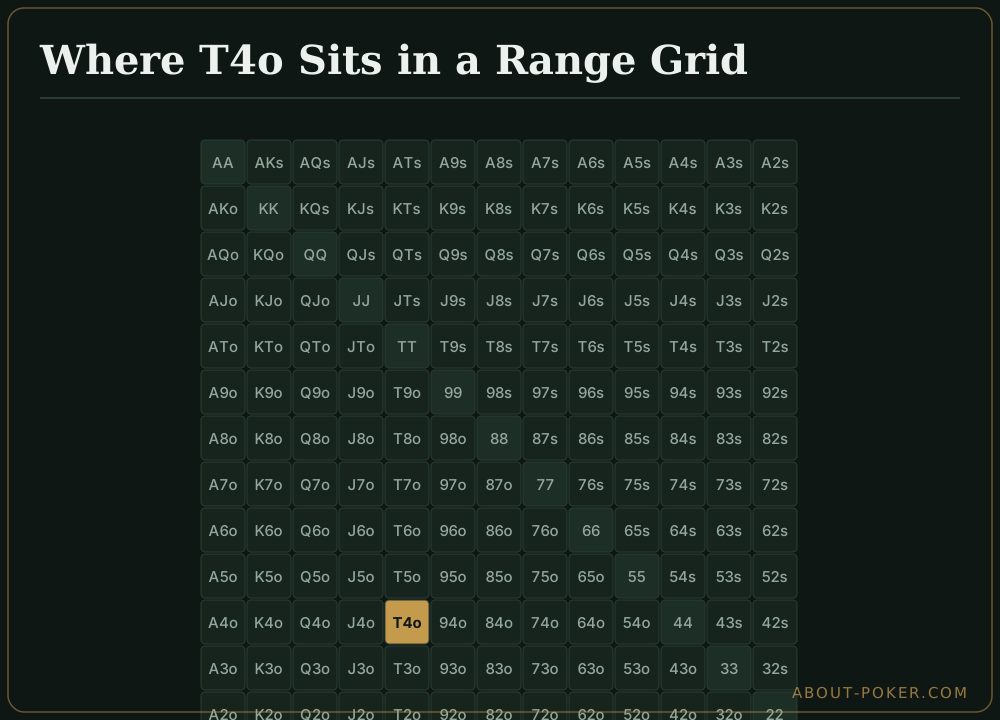
Good starting hands draw equity from high cards, straight potential, or flush potential. T4o has almost none of the three. The ten is a middling high card that gets outkicked by every stronger ten, the four is dead weight for making straights, and the offsuit holding kills any flush. Pair the ten and you are often dominated; pair the four and you are behind nearly the whole board. There is no flop texture that turns T4o into a comfortable hand.
The suited version, ten-four suited, keeps a slim flush draw that lets it sneak into the cheapest big-blind defends. Take the suit away and even that thin case collapses. Every standard preflop opening range marks T4o as a fold from all nine seats, so mucking it on sight is exactly correct and removes a recurring leak.
The lone exception
The only spot where T4o is even discussed is defending the big blind against a small-blind min-raise. When the pot is already inflated relative to the tiny raise and you are guaranteed to close the action, you get a price good enough to peel almost any two cards. This is the far edge of blind defense, where the calling range stretches well below any opening range.
Even in that spot, T4o is one of the very first hands to fold as conditions worsen — a larger raise, a tighter opener, or a multiway pot all push it back into the muck. Treat this as a technicality, not a strategy. In practice, across nearly every table, T4o is a fold.
A worked example
You hold T♠4♥ in the big blind and the cutoff opens to 2.5 big blinds. Fold. The cutoff’s range is packed with hands that dominate you — better tens, all pairs, every ace and king — and T4o brings neither straight nor flush equity to fight back. Peeling here just donates chips over time.
Swap in a different spot: the small blind min-raises to 2 big blinds and you are in the big blind getting roughly 3-to-1 with position locked for the hand. Now T4o is a borderline call, and folding is still fine. The only thing that separated the two decisions was price and range width — proof of how narrow the window is for a hand this weak.
Placing T4o in context
To make the fold feel automatic, it helps to see where T4o sits among neighboring hands. T7o and T8o are one- and two-gappers with genuine straight potential and better kickers, and they still fold from most seats — so a six-gapper like T4o is far below the line. The ten is a slightly better high card than the seven or eight in something like 74o, but a better kicker on a hand with no connectivity and no suit does not rescue it. Group T4o mentally with the offsuit junk you never deliberate over. The payoff of that habit is not just folding this one hand correctly; it is folding an entire tier of similar low, gapped, offsuit holdings on sight, which removes a huge share of your losing preflop decisions.
The three sources of equity, and why T4o has none
Every playable starting hand earns its place through at least one of three sources of equity. Walking T4o through all three shows exactly why it fails.
- High-card strength: hands like AJo or KQo win pots simply by pairing a big card and holding a good kicker. T4o’s best card is a ten, which is outkicked by every stronger ten in an opponent’s range, and its four is nearly worthless. Pairing up rarely produces a hand that is actually ahead.
- Straight potential: connected and one-gap hands (like 76o or T8o) can flop and turn straights. The six-rank gap between the ten and the four makes a natural straight impossible — the two cards can never sit inside the same five-card run. This entire source of equity is dead.
- Flush potential: suited hands can flop and complete flushes, which is why even weak suited cards outrank their offsuit twins. T4o is offsuit, so there is no flush to chase.
Zero of three. A hand needs to hit on at least one of these dimensions to justify voluntarily putting money in, and T4o hits on none. That is the structural reason it folds everywhere — not a judgment call, but arithmetic.
Where T4o sits on the hand-strength ladder
It helps to see the ladder from the top down. The strongest hands (pairs, big suited Broadways) win by high-card strength and have backup draws. The middle tier (suited connectors, suited aces) trades some high-card strength for straight and flush potential. The bottom tier is offsuit, gapped, and low — and within that bottom tier, connectivity still separates the survivors from the trash. A hand like T7o at least has a three-gap and can occasionally make a straight; T4o’s six-gap removes even that. It sits alongside hands like 92o and 84o in the true bottom rung of the 169 starting-hand chart — the cluster you fold on sight without a moment’s thought. Building that reflex is worth real money: it removes an entire tier of losing preflop decisions rather than just this one hand.
The takeaway
T4o is a fold-first hand. Do not open it, do not cold-call it, and defend it only in the cheapest, widest big-blind spots. Snap-folding hands like this is one of the simplest ways to tighten up a leaky preflop game. If you doubt just how far behind you sit, run T4o against a cutoff opening range in an equity calculator and the fold will confirm itself.
Frequently asked
Can you open ten-four offsuit?
No. T4o is a fold from every position, including the button and small blind. It is a six-gap offsuit hand with no straight or flush potential, and it falls below the threshold of even the widest steal ranges.
Is T4o ever a big-blind defend?
Only at the extreme edge, against a small-blind min-raise when the price is very good and you close the action. Even then it is a marginal call at best and one of the first hands to drop as the raise grows.
Why is T4o worse than a hand like T7o?
The four is a dead card for connectivity. T7o has a three-gap and can catch straights with the right board; T4o's four sits too far from the ten to ever help make a straight, so it loses that entire source of equity.