How to Play Ten-Seven Offsuit (T7o)
Ten-seven offsuit is a fold from nearly everywhere and a bottom-of-range button steal at most. Learn why the gap and weak kicker make T7o so hard to play.
On this page · 6 sections
Ten-seven offsuit (T7o) is a hand that tempts loose players because it looks like a connector. It is not — there is a two-card gap between the ten and the seven, and with no matching suit it makes fewer, weaker straights and no flushes. What is left is a middling ten, a weak seven kicker, and thin drawing potential. T7o is a fold from almost every seat, with one narrow steal spot on the button. Playing it well mostly means folding it.
Where T7o belongs
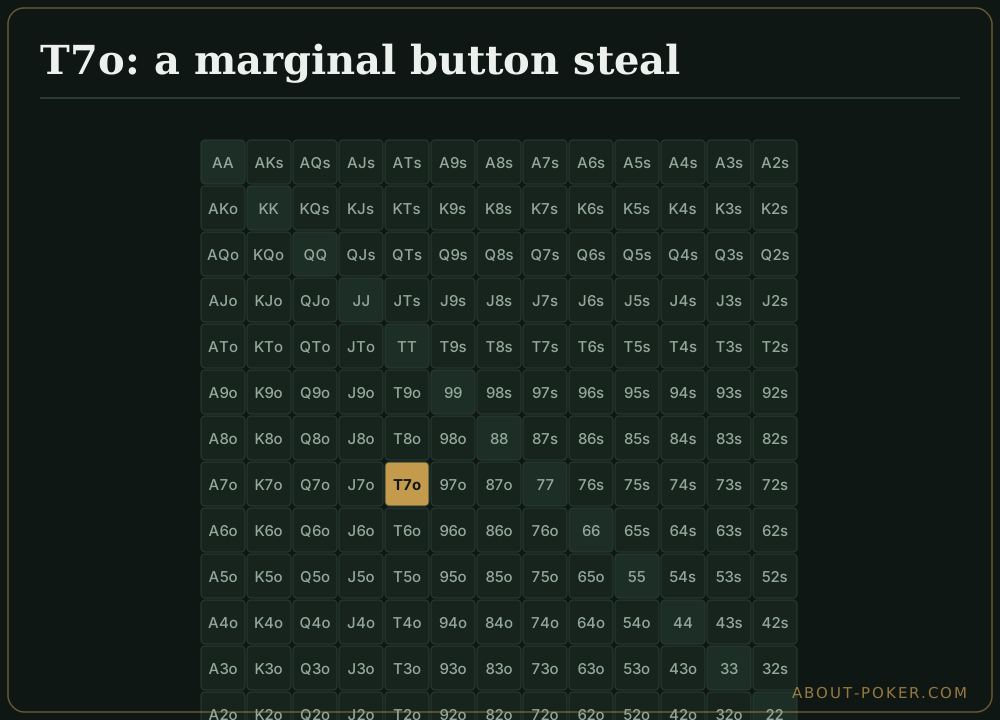
T7o is, at most, a bottom-of-range button steal. Against blinds that fold too often you can open it from the button to take dead money, but it lives at the very edge of your preflop opening ranges and drops out entirely against blinds that defend well.
From the cutoff and everything earlier, fold it at a full-ring or 6-max table. The ranges behind you are full of better tens, pairs, and high cards, and T7o cannot fight them out of position with so little equity. This is poker ranges by position at the boundary — a hand that barely opens from the button and folds everywhere else.
Why the gap matters
The two-gap is the crux. A true connector like T9 makes open-ended straight draws on many boards; T7 needs a very specific middle card to fill its straights and often makes only a gutshot. Flop a ten and you are frequently behind TJ, QT, KT, AT; flop a seven and you have a weak middle pair. Offsuit, there is no flush draw to rescue a marginal hand, so T7o repeatedly makes second-best pairs and thin draws.
That is why T7o is a small-pot hand at most. It can steal preflop and bet a made pair once, but it should never build a big pot and is never a 3-bet — it lacks both value and a credible bluffing backup.
The rare defend
T7o can show up at the very bottom of a big-blind defend against a min-raise, when the price is cheap and you close the action. That is standard blind defense: call the discount, see a flop, and fold quickly when you miss. Against a normal open, or from the small blind, T7o is a fold.
A worked example
Suppose you open T7o on the button against a tight big blind and get called. The flop is 9-8-3 rainbow — a gutshot to the jack (you need a J for T-9-8-7-J… actually J gives you J-T-9-8, a straight). You have four outs to a straight and no pair. This is a fine spot for a single continuation-bet as a semi-bluff, because you have some equity and fold equity, but it is not a hand to fire multiple barrels or stack off with. If called and you brick the turn, give up.
Now flop a ten on T-6-2: top pair, weak kicker. Bet once for thin value at most and shut down against resistance, since better tens have you dominated. The recurring theme is the same as with every weak offsuit hand — T7o wins small pots and steals blinds, but it loses stacks whenever you talk yourself into treating it as strong. In practice, fold it most of the time.
Why suited matters so much here
The single biggest reason T7o folds while its suited cousin can open is the flush. Suitedness is worth far more than it looks: a suited hand adds roughly four to five percentage points of raw equity over its offsuit version, but the real value is in playability. A suited hand flops a flush draw about 11% of the time, and those flush draws are the backbone of profitable semi-bluffing — they let you barrel with real equity, apply pressure, and get paid when they complete. T7o has none of that. When it misses a pair it has only the occasional gutshot and no backup draw, so it cannot credibly keep betting. Strip the flush away from a marginal two-gapper and you are left with a hand that makes weak pairs and thin straight draws and nothing to fall back on — which is precisely why T7 suited sneaks into wider ranges and T7o does not.
A short decision checklist
When T7o shows up, run it through a few quick questions before you get involved:
- Am I on the button with the pot folded to me, against blinds that fold too much? If yes, a bottom-of-range steal is defensible. If no, fold.
- Am I facing any raise from an earlier seat? Fold — T7o has no value that wants a bigger pot and makes a poor offsuit bluff.
- Am I in the big blind facing a min-raise with a cheap price to close the action? A marginal defend is fine; plan to check-fold most flops.
- Postflop, do I have a pair plus a draw, or a strong draw? If yes, one continuation-bet is reasonable. If I have only a weak pair or air, check and give up.
The through-line is that T7o is a fold in the large majority of situations, and the handful of exceptions are all cheap, in-position, or price-driven. Treat it as a small-pot hand at most, never a 3-bet, and lean on your poker ranges by position and your preflop opening ranges to keep it out of the spots where it quietly loses money.
Frequently asked
Can you open ten-seven offsuit?
Only as a bottom-of-range button steal against blinds that fold too much, and even then it is marginal. From the cutoff and every earlier seat it is a fold — the two-gap and weak kicker leave T7o with too little playability.
Should you 3-bet T7o?
No. It has no value that wants a bigger pot and, offsuit, makes a poor bluff. Against an open it is a fold, or at most a very cheap big-blind defend.
Is T7o a connector?
It is a gapped semi-connector, not a true connector. There is a two-card gap between the ten and the seven, so it makes fewer and weaker straights than hands like T9 or 98, and offsuit it has no flush to add equity.