How to Play Ten-Six Offsuit (T6o)
T6o is a weak offsuit ten that folds from nearly every seat. Learn the rare late-position spots for Ten-Six offsuit and how to play it carefully after the flop.
On this page · 7 sections
Ten-six offsuit (T6o) is a hand that new players sometimes open because a ten “connects” to a lot of boards, but the offsuit, gapped version has very little going for it. It’s dominated by every stronger ten (T7 through TJ), and it loses top-pair fights to every jack, queen, king, and ace that pairs the board. With no suited flush potential and only a wide one-gap connection, T6o rarely makes anything strong. It folds from nearly every seat and has only a marginal late-position role.
Where T6o belongs preflop
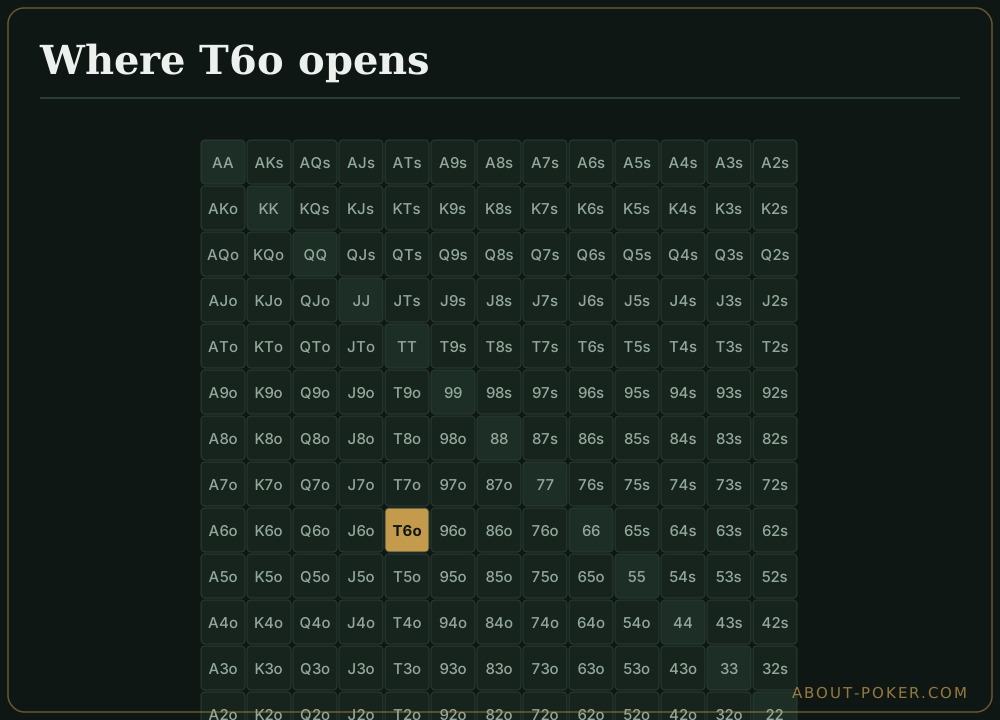
T6o is a raise-or-fold hand that barely raises at all:
- Early and middle position: fold. There is no profitable open here.
- Cutoff: fold in most solid ranges; too many hands still to act dominate you.
- Button: at most a bottom-of-range steal when it folds to you. It can pick up dead money and flop top pair against random defends.
- Small blind: open (raise) occasionally when it folds to you, or fold; never limp it in.
- Big blind: defend against a single raise when the price is right, then proceed carefully.
For the exact borders seat by seat, anchor yourself in the preflop opening ranges. T6o sits below the cutoff for most positions and only touches the very bottom of the button and small-blind ranges.
Why T6o is a fold most of the time
T6o has a weak top card and a weak kicker. A ten is not high enough to hold up when overcards come, and when you do flop top pair on a ten-high board your six kicker loses to T7, T8, T9, and TJ. Because the hand is offsuit, it has no flush potential, and the two-gap between the ten and six means straight draws are thin and often “second-best” draws. Add it up and T6o rarely improves to anything that wants to play a big pot — which is exactly why cold-calling raises with it bleeds money.
The one place T6o gets a little life is against very wide ranges. In a blind-versus-blind battle, both players hold weak ranges and equities run close, so a hand like T6o can occasionally attack or defend. Those spots are marginal and read-dependent; the framework is in blind vs blind play and in defending the blinds.
Facing 3-bets and 4-bets
If you open T6o and get 3-bet, fold. You are dominated by better tens and by every broadway and ace-x hand, and you have no comfortable continue out of position. There is no realistic 4-bet bluff case for a hand this weak. Against any reraise, T6o is a fold.
A worked example
You open T♠6♥ from the button and the big blind, a solid regular, calls. The flop comes T♦ 8♣ 3♠ — top pair, weak kicker. You bet, and your opponent calls. The turn is a 7♦, giving you a gutshot to a nine on top of top pair. Ask what continues against you: better tens (TJ, T9, T8 just made two pair), any set, and floats with an overcard that could outdraw you. Your six kicker beats bluffs and worse pairs but loses to nearly everything that wants a big pot; the gutshot is your main reason to keep barreling. Against a passive player you can bet once for thin value plus the draw, but fold to real aggression. Heads-up, T6o has roughly 51% equity against a random hand — essentially a coin flip that collapses once stronger hands stay in.
What the button steal is really doing
When T6o opens from the button, the raise has nothing to do with the strength of the hand — it is a bet on the two blinds folding. The two players left to act muck a large share of random hands, so a raise that picks up the blinds outright is profitable on its own. That is fold equity at work, and it is the entire reason a hand this weak ever leaves your hand.
The steal stops making sense against the wrong opponents. A blind that 3-bets frequently strips away your fold equity and forces you to give up the pot you tried to steal, so drop T6o from your button range against that player. A loose caller in the big blind is nearly as bad: you rarely win preflop and instead see flops out of position with a dominated, thin-drawing hand. Check who is behind you before treating T6o as a steal at all.
Playing T6o after the flop
The few times you take T6o to a flop, keep the pot small:
- You pair the ten: top pair, weak kicker. One value bet against a passive opponent is the ceiling; fold to a raise, since T7 through TJ have you outkicked.
- You flop a draw (open-ender or gutshot): this is your best reason to keep betting — semi-bluff once, but respect that many of your straight draws are to the low end and can be dominated.
- You miss (the usual case): check and give up unless you have a real draw. A lone c-bet on a dry board against one player can work; barreling air does not.
How T6o compares to nearby hands
Placing T6o next to its neighbors makes its weakness obvious. T8o and T9o are noticeably better because the kicker gap shrinks and the straight potential jumps — T9 in particular connects with far more boards. T8s or T9s are stronger still because the flush adds clean equity. T6o has neither the connectedness nor the suit: it is a two-gap offsuit ten with a small kicker, sitting just above T5o through T2o. That is exactly why it folds from early and middle position and only flirts with the very bottom of the late-position ranges.
Fold T6o from early and middle position, treat it as a rare button or small-blind steal, defend it cheaply in the big blind, and never cold-call raises with it out of position.
Frequently asked
Is T6 offsuit a good hand?
No. T6o is a weak offsuit ten dominated by every stronger ten and by all broadway and ace-x hands. It folds from nearly every seat and only appears as a marginal late-position steal or cheap blind defend.
Should I ever open T6 offsuit?
Rarely. T6o is at most a bottom-of-range button steal and an occasional small-blind open when it folds to you. From early, middle, and usually the cutoff it should be folded.
Can I call a raise with T6 offsuit?
No, except for a cheap big-blind defend when priced in. Cold-calling an offsuit ten out of position is a clear leak because you are dominated often and rarely improve to a strong hand.