How to Play Ten-Six Suited (T6s)
Ten-six suited is a fringe suited hand — a light button steal and a blind-defense card, but a fold almost everywhere else. Learn exactly where T6s makes money.
On this page · 7 sections
Ten-six suited (T6s) is a fringe hand. It is not part of any strong opening range, it does not dominate much, and it makes weak top pairs. What keeps it from being a pure trash fold is a small amount of suited, semi-connected playability plus the fold equity you get from the button. Play it in the one or two spots where those edges exist, and fold it everywhere else. That discipline is the whole strategy for a hand like this.
Where T6s belongs
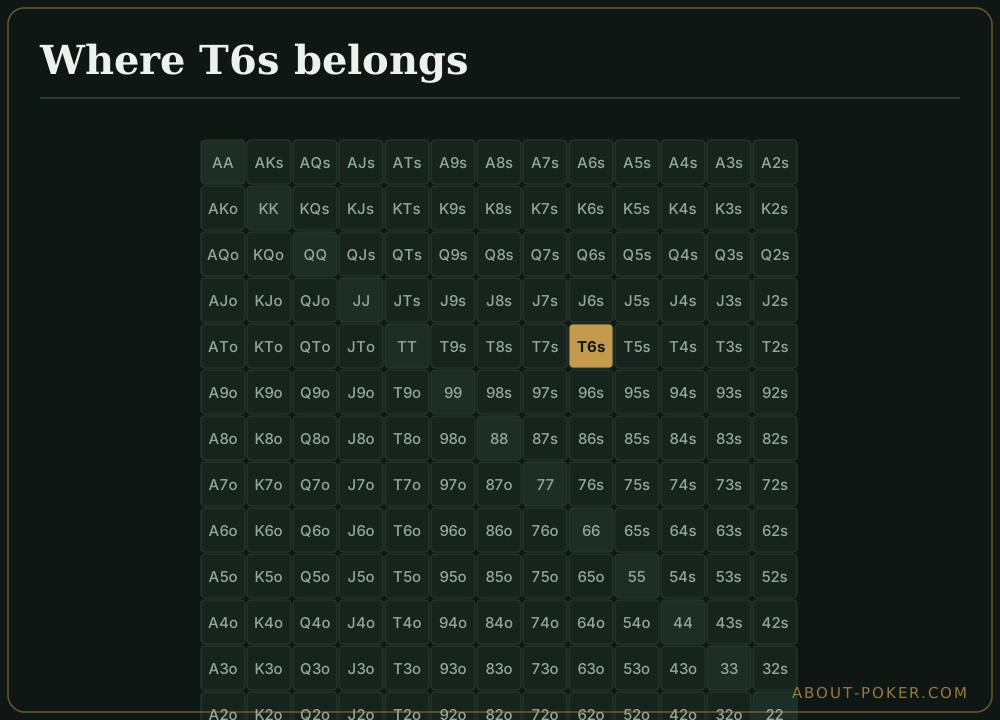
T6s is, at most, a button-only hand. From the button you are last to act, only the two blinds remain, and marginal suited cards clear the bar for a steal because you fold out a lot of hands and realize your equity well when called. Even there, solvers open T6s at a mixed frequency rather than always — it sits right on the threshold of your widest preflop opening ranges.
From the cutoff and earlier, fold it. There are too many players left to act, and T6s is dominated by the connectors and broadways that continue against you. Compare that to a hand like A9s, which can open several seats earlier — the difference in raw strength is exactly what poker ranges by position captures.
The big blind is its real home
Where T6s actually earns its keep is defending the big blind. When a late-position player raises and you are getting a discount to call from the big blind, T6s is a fine addition to your defending range. You are closing the action, the price is good, and the hand flops enough draws to continue profitably. This is a core idea in defending the blinds: you defend wide with hands that have suited and connected playability rather than raw high-card strength.
Do not overdo it, though. T6s wants to see a cheap flop and then fold when it misses. It is not a hand to call a 3-bet with or to stack off light.
A worked example
You have T6s on the button. Folded to you, blinds are 100. You raise to 250 as a mixed steal. The big blind calls.
The flop comes 9s-7d-2s. You have a gutshot straight draw (an eight makes your straight) plus a backdoor flush draw and two overcards to the deuce. On a board like this you can continuation-bet small: you have equity, some fold equity, and position. If the big blind check-raises, you fold — your draw is thin and you have no made hand.
Now change the flop to Kh-Qc-4d. You have nothing: no pair, no draw, two undercards. Check back and give up. That miss-and-fold pattern is the whole point of a hand like T6s — you are playing to hit, not to bluff big pots with a ten-high hand.
What T6s actually flops
Knowing the real distribution of flops keeps you from overrating the hand. Roughly two flops in three completely miss a hand like T6s — no pair, no meaningful draw — which is exactly why the miss-and-fold discipline matters so much. When it does connect, the good outcomes break down like this:
- Flush draw: about 11% of flops when suited, giving you around nine outs and the ability to semi-bluff.
- A pair (top, middle, or bottom): you will pair one of your cards on roughly a third of flops, but a ten with a six kicker or a bottom pair of sixes is a weak, pot-control holding, not a stack-off hand.
- Straight draws: because T6 is a one-gapper, open-enders are relatively rare and you will more often flop a gutshot (for example, holding T6 on a 9-8-x or 7-5-x board).
- Two pair or trips: infrequent, but these are the hands that win you a real pot, so play them fast.
The takeaway is that T6s is a draw-and-steal hand. Its equity lives in the flush and straight draws and in fold equity, almost never in made top pairs.
How the decision shifts by opponent and depth
- Loose, sticky blinds. The button steal loses value because you get called and then outplayed; tighten your open. But their looseness also means when you flop a draw, you get paid on the streets you hit.
- Nitty blinds. The steal is at its best — you pick up the blinds uncontested often enough that even a weak suited hand shows a profit.
- Deep stacks. T6s improves slightly as a big-blind defend because the implied odds on your flushes and straights grow; you can win a big pot when you hit and lose only a small one when you miss.
- Short stacks. The implied-odds upside shrinks, so the speculative value drops. Lean toward folding rather than defending marginally.
A quick decision checklist
- On the button, folded to me, blinds not too sticky? A mixed steal is fine. Otherwise fold.
- In the big blind at a real discount against a late open? Defend. At a normal price or from the small blind? Fold.
- Flopped a flush or straight draw? Semi-bluff or continue aggressively.
- Flopped a weak pair? Keep the pot small. Flopped nothing? Give up immediately.
Bottom line on T6s
Treat T6s as a situational card, not a real hand. Open it as a mixed steal from the button, defend it in the big blind at a good price, and fold it from every other seat. Its profit comes from position and price, never from showdown strength. When you flop a draw, play it aggressively; when you flop a weak top pair, keep the pot small; when you miss, let it go. Played that way, T6s is a small, quiet contributor. Played loosely from bad seats, it is a steady leak.
Frequently asked
Can you open ten-six suited?
Only from the button, and even there it is a marginal steal that mixes with folding. T6s is a one-gapper with modest high-card strength, so it needs the button's positional and fold-equity edge to show a profit. From every other seat at a full or 6-max table it is a fold.
Is T6s good enough to call a raise with?
Rarely, and mostly from the big blind at a good price. T6s plays like a speculative hand — it wants cheap flops where it can flop a flush draw, straight draw, or two pair and get away otherwise. It is not a hand to cold-call an early open with out of position.
What does T6s flop well?
It flops flush draws when suited connects, gutshots and open-enders around the ten and six, and occasional two pair. Its value is in draws and steals, not in made top pairs — a ten with a six kicker is easily dominated at showdown.