How to Play Ten-Three Offsuit (T3o)
T3o is a trash offsuit ten that folds from almost every seat. Learn the rare button and blind spots where Ten-Three offsuit is playable and how to handle it.
On this page · 6 sections
Ten-three offsuit (T3o) is a trash-tier holding. The ten can flop top pair on low boards, but the trey kicker is dead weight and the two cards are three ranks apart, so straight potential is thin. Unlike T3 suited, there is no flush draw to add equity. For nearly all of your table time, T3o is a fold.
Where T3o belongs preflop
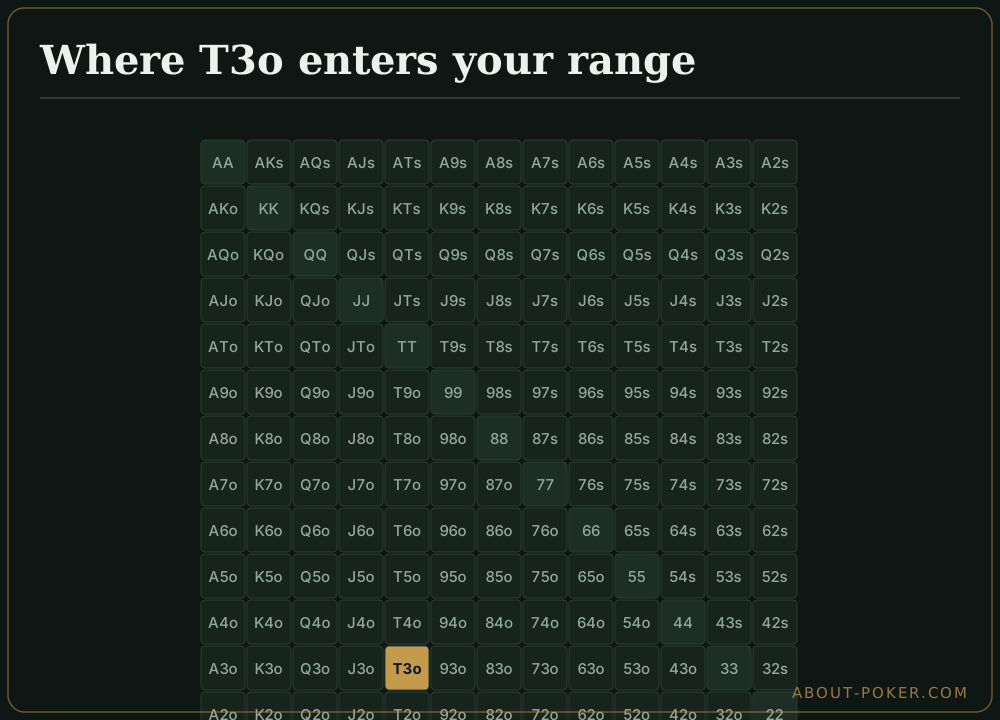
In a standard 6-max game, T3o does not open profitably until the button, and even there it sits right on the fringe of your widest steal. From the button you are attacking just two blinds, so a ten with any live potential occasionally sneaks into the mix. From the cutoff and everywhere earlier, fold it — the offsuit gap and dead kicker make it a losing open against the tighter ranges you face.
The other place T3o appears is blind defense. In the big blind against a late-position raise at a good price, you can flat-call a small number of T3o combos because you are closing the action cheaply. Against earlier opens, the raiser’s range is too strong and you should fold. The preflop opening ranges chart shows precisely where marginal hands like this enter and exit.
T3o is never a 3-bet hand. It is far too weak to raise for value and a bad bluff because it unblocks the hands that call a 3-bet. When you want a light 3-bet, choose a suited ten or a suited connector.
Why the disconnected offsuit shape matters
Two problems stack up. First, the trey kicker means that when you flop a pair of tens you are frequently out-kicked. Second, the three-gap between ten and trey means you almost never flop a real straight draw — at best an inside gutshot on a specific board. Add no flush potential and T3o is left relying on flopping a pair of tens and reaching showdown cheaply.
That makes T3o a “fold or top-pair” hand postflop. You are not chasing draws, and you are not firing multiple streets — there is no equity behind the bluff.
A worked example
You open T♣3♦ on the button to 2.5bb. The big blind calls, and the flop comes T♥ 6♠ 2♣. You have top pair, trey kicker.
C-bet small — around one-third pot. You want calls from worse (weak tens, sixes, gutshots) while keeping the pot controlled, because your kicker means a big pot is dangerous against a range that may dominate you. If the big blind check-raises, you are rarely ahead: fold to a raising range full of better tens, two pair, and sets.
If the flop instead came K♥ 9♠ 4♣, you have ten-high and nothing. Give up — there is no draw worth continuing and no reason to bluff a dead hand.
How the spot changes with position and opponent
T3o’s tiny window shifts with two variables: your seat and who you are up against. From the button, you are attacking only two players and opening your widest range, so a live-ten holding like T3o can occasionally sneak in as a steal — but it is the very last hand you would add, and against blinds that defend or 3-bet aggressively you should drop it first. From the cutoff you face one extra player and a tighter required range, and T3o falls out entirely. From every earlier seat it is never close.
Opponent type matters just as much as position. Against a nitty big blind who folds too often, a button steal with T3o profits mostly on the fold, not on the hand’s showdown value. Against a station who calls wide and rarely folds postflop, the steal loses its point: you get called light, flop a dominated ten, and have no way to barrel because the hand has no equity behind a bluff. Read the seat before you fold, and read the player before you open.
How stack depth affects T3o
Stack depth quietly narrows T3o’s already-thin window. At short stacks — say 15 to 25bb — a button open with T3o still functions as a pure steal, because the pot you are stealing is large relative to your raise and you rarely see difficult postflop spots. Deeper, at 100bb or more, the hand gets worse: postflop pots get bigger, being out-kicked with a pair of tens costs you more, and the dead trey kicker gives you no implied odds to make up the difference. The deeper the money, the more you want cards that flop draws or dominate kickers — and T3o does neither. When in doubt at deep stacks, fold and move on.
How T3o compares to its neighbors
Among offsuit tens, T3o sits near the bottom, roughly level with T2o and a touch behind T4o, since the trey rarely helps make a straight. It plays clearly worse than T3 suited, which at least offers backdoor flush equity. In blind-versus-blind pots, where ranges stretch widest, T3o becomes marginally playable; for those dynamics see blind vs blind play.
The practical takeaway: open it only from the button at the very edge of your range, defend it selectively at a great price, and treat it as fold-or-top-pair once you see a flop. Folding disconnected offsuit tens is nearly free money.
Frequently asked
Is T3 offsuit a good hand?
No. T3o is a weak, disconnected offsuit ten that folds from nearly every position. It appears only at the very edge of a button steal and in a handful of big-blind defenses at a great price; otherwise muck it.
Should I 3-bet with T3 offsuit?
No. T3o is far too weak to 3-bet for value and a poor bluff because the trey blocks almost nothing your opponent continues with. Use a suited connector or a suited ten for a light 3-bet instead.
Can I defend T3 offsuit in the big blind?
Only rarely, against a late-position open at a very good price. You can occasionally flop top pair or a gutshot, but the hand is dominated often and should be folded to any real postflop aggression.