What Is All-In in Poker?
Going all-in means betting every chip you have in front of you. Here's exactly how all-in works, how side pots form, and when shoving is the right play.
On this page · 6 sections
Going all-in means pushing every chip you have in front of you into the pot on a single hand. Once you are all-in, no bet can force you out — you are locked in to see the hand through to showdown for whatever portion of the pot your stack entitles you to. It is the most decisive action in poker, and it comes with a specific set of rules worth knowing cold.
The all-in exists because of a simple principle: you can only lose the chips on the table, and you can only win from each opponent an amount equal to what you yourself have wagered. That principle drives everything else, including side pots.
How going all-in works
When you say “all-in” or push your entire stack forward, you commit every chip you have. If your bet is at least a full raise, betting reopens for other players. If it is a short all-in — less than a full raise — some house rules cap the reopening, so a player who already acted may only call, not re-raise. Either way, you are done acting for the hand.
From that moment you cannot fold and cannot be pushed off the pot. You are guaranteed to reach showdown, though you can only win chips up to the size of your own committed stack from each opponent.
Side pots: the crucial mechanic
This is where all-ins confuse new players. Suppose three players see a flop and the shortest stack goes all-in for fewer chips than the others have. The chips everyone can match go into the main pot. Any additional betting between the two larger stacks goes into a separate side pot that the all-in player cannot win.
The all-in player competes only for the main pot. The remaining players compete for both. This keeps things fair: nobody is forced to fold just because they lack chips, and nobody can win money they never risked.
A worked example
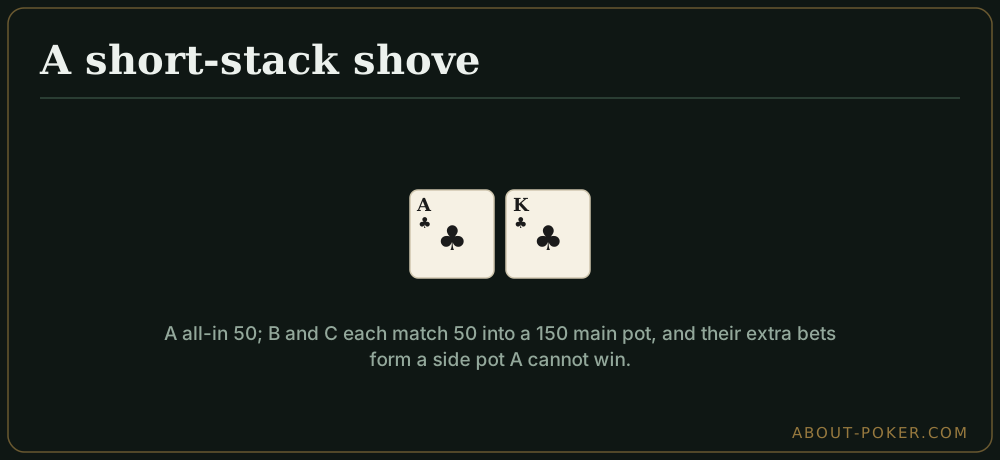
Three players are in a hand:
- Player A has 50 and goes all-in.
- Player B has 200 and calls, then bets more.
- Player C has 200 and calls B.
The main pot is built from 50 from each of the three players — 150 total — and only A, B, and C compete for it. All the chips B and C wager beyond 50 form a side pot that only B and C can win.
If A wins the hand, A takes the 150 main pot, and the side pot is awarded to whoever of B and C has the better hand. A cannot touch the side pot because A never had chips at risk in it. That is the “you can only win what you wagered” rule in action.
When shoving all-in is correct
- Short stacks in tournaments. With around 10 to 15 big blinds or fewer, raising to anything less than all-in leaves you pot-committed anyway. A clean open shove maximizes fold equity and removes tough postflop decisions.
- When you are already pot-committed. If the pot has grown so large relative to your remaining stack that folding is mathematically wrong, get the rest in. Being pot committed means the price to continue is too good to pass up.
- Maximizing value or fold equity with a polarized range. Strong made hands and good semi-bluffs both benefit from putting maximum pressure on an opponent when stacks are the right depth.
Common mistakes
- Shoving too deep. Going all-in for 100 big blinds with one pair turns a modest edge into a coin flip and risks your whole stack on a thin margin. Deep-stacked, prefer smaller bets that keep worse hands in and let you fold to real strength.
- Misreading side-pot eligibility. Players sometimes assume an all-in short stack can win everything. They cannot — only the main pot is theirs.
- Calling all-ins on emotion. An all-in call for your tournament life should clear a clear equity bar. As a rough anchor, a slight underdog like a flip is close to break-even only when the pot odds justify it; a big underdog is a fold.
Quick checklist
Before you push, ask:
- How deep are the effective stacks — is all-in the right size, or too much?
- If called, do I have enough equity to justify the risk?
- Will side pots form, and which pot am I actually competing for?
Answer those and the all-in stops being a leap of faith and becomes what it should be: a calculated, decisive bet.
Frequently asked
What does all-in mean in poker?
Going all-in means committing every chip you have in front of you into the pot on a single hand. Once you are all-in you cannot be forced out; you are entitled to see the hand to showdown for the portion of the pot you can win.
Can you win more than your stack when all-in?
No. You can only win as much from each opponent as you had in your own stack. Any extra chips other players wager beyond your stack go into a side pot that you are not eligible to win.
What happens if you go all-in and lose?
In a cash game you lose the chips you committed and can rebuy. In a tournament, losing an all-in for your whole stack eliminates you unless you have chips left in a side situation or a re-entry option.