What Is Main Pot in Poker?
The main pot is the pot every all-in player can win, capped at the smallest all-in. Learn how main pots and side pots split, with a clear worked example.
On this page · 6 sections
The main pot is the portion of the pot that every player still in the hand is eligible to win. It exists because poker lets players go all-in for different amounts, and the rules have to be fair: you can win chips from an opponent only up to the amount you yourself put at risk. The main pot is where that fairness gets enforced.
Any time a player goes all-in for less than others want to bet, the chips get separated into a main pot and one or more side pots. The main pot is the one the short stack can win. Everything above their contribution goes into side pots they have no claim to.
Why the main pot exists
Picture three players. One has only 20 chips left, the other two have 200 each. The short stack shoves all-in for 20. The other two want to keep betting — say they each put in 100 more. It would be unfair for the 20-chip player to scoop all of those chips at showdown, because they never risked anything close to that amount.
So the dealer builds a main pot capped at the smallest all-in. Each player matches the short stack’s 20, creating a main pot of 60 that all three can win. The extra chips the two big stacks bet form a side pot that only those two can win. The main pot protects the principle that you win from each opponent only what you had in front of you.
Main pot vs. side pot
The distinction comes down to eligibility.
The main pot is contested by everyone in the hand, including the shortest all-in player. Its size equals the smallest all-in amount multiplied by the number of players who called it. A side pot is built from the additional chips wagered by the players who still had money behind, and only they can win it. The short all-in player is locked out of every side pot because they contributed nothing to them.
At showdown the pots are awarded from the outside in — side pots first, then the main pot — but the eligibility rule is what matters: no player can win chips they were not matched against.
Worked example: three-way all-in
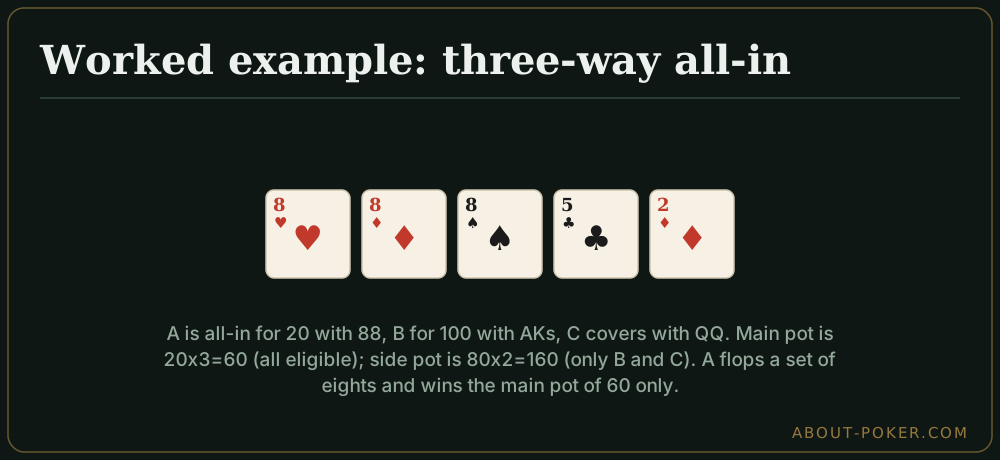
Let’s put real numbers on it.
- Player A is all-in for 20 with 8h 8d.
- Player B is all-in for 100 with As Ks.
- Player C covers everyone and calls 100 with Qc Qd.
The dealer builds two pots. The main pot is 20 x 3 = 60, and all three players can win it. The side pot is the extra 80 that B and C each committed, so 80 x 2 = 160, and only B and C can win it.
Board runs out: 8s 5c 2d Jh 3h.
Player A hits a set of eights — the best hand at the table. Player A wins the main pot of 60. But A cannot touch the side pot, because A never contributed to it. Between the two players eligible for the side pot, B (ace-king high) beats C’s queens? No — C’s pair of queens beats A’s already-counted set only for pots C is in, and here C’s queens beat B’s ace-high. So Player C wins the side pot of 160.
A doubles up their short stack, C takes the larger chunk, and B, despite entering with the best preflop hand, wins nothing. That is exactly why side pots exist: everyone got paid only in proportion to what they risked. If A had lost, A would simply bust while B and C fought over both pots.
Common mistakes and confusions
- Thinking a short all-in can win everything. They cannot. The short stack’s upside is capped at the main pot, no matter how strong their hand.
- Assuming the biggest hand always wins the whole pot. The best hand wins each pot it is eligible for, which can leave a strong hand winning only the side pot and not the main.
- Miscounting the main pot. It is the smallest all-in times the number of callers, not the whole pile of chips on the table.
- Forgetting there can be several side pots. With three or more different all-in amounts, you get one main pot and multiple stacked side pots, each with its own eligible players.
A quick reference for building the pots
- Find the smallest all-in amount. Everyone matches it — that stack of chips is the main pot.
- Move to the next-smallest all-in. The chips above the first cap form the first side pot, contested only by players who put in that much.
- Repeat upward for each larger all-in until the biggest stacks’ extra chips form the final side pot.
- At showdown, award each pot to the best hand among its eligible players.
Keep going
The main pot is a small idea that quietly keeps multiway all-ins fair, and understanding it saves you from awkward moments at the table. For the mechanics of committing your whole stack, read what all-in means, and browse the full poker glossary for the rest of the terms you will meet in a live or online game.
Frequently asked
What is the main pot in poker?
The main pot is the portion of the pot that every player still in the hand is eligible to win. It is capped at the smallest all-in stack times the number of players contributing, so no one can win more than they had in front of them from each opponent.
What is the difference between the main pot and a side pot?
The main pot is contested by everyone, including the shortest all-in player. A side pot is built from the extra chips bet by the remaining players and can only be won by those who contributed to it — the shortest all-in player has no claim to it.
Can an all-in player win the side pot?
Only if they contributed to it. A player who is all-in for less than the others is locked out of the side pot; they can win only the main pot. Players with more chips compete for both.
Who wins the main pot?
The player with the best hand among everyone eligible for it, shown down at the end. If the shortest all-in player has the best hand overall, they win the main pot but not any side pots they did not contribute to.