What Is Backdoor Draw in Poker?
A backdoor draw needs both the turn and river to complete. What runner-runner means, the real odds, and how backdoor equity affects your bets.
On this page · 6 sections
A backdoor draw — also called a runner-runner draw — is a drawing hand that needs help on both the turn and the river to complete. On the flop you have three cards toward a flush or straight and would need two more perfect cards to arrive back to back. Because both streets have to cooperate, backdoor draws are long shots, but they quietly add equity to a lot of hands and can turn into strong disguised holdings when they hit.
What “backdoor” really means
A normal draw is one card away from completing. If you have four cards to a flush on the flop, a single turn or river card of your suit finishes it. A backdoor draw is two cards away. Say the flop comes with two hearts and you hold one heart. You have only three hearts toward a flush — you would need the turn to be a heart and the river to be a heart. That double requirement is what “backdoor” describes: you sneak in the back door with two running cards rather than the front door of a single obvious out.
The same applies to straights. Holding J-T on a board of 9-4-2, you have a backdoor straight draw: a turn 8 gives you an open-ended draw, and only then can a river card complete the straight.
The real odds
Here is the number that keeps backdoor draws honest. To complete a backdoor flush from three cards of a suit, you need roughly a 4.2 percent chance — about 1 in 24. The math: the turn must be one of your remaining ten suit cards out of 47 unseen (about 21 percent), and then the river must be one of the remaining nine out of 46 (about 20 percent). Multiply those and you get about 0.042, or 4.2 percent.
A backdoor straight is usually a bit lower, often around 1.5 to 4.5 percent depending on the exact cards, because there are fewer combinations of running cards that connect. Either way, the message is the same: on its own, a backdoor draw is close to worthless. You will miss it more than 95 percent of the time.
Why it still matters: the bonus effect
If backdoor draws are such long shots, why do good players care about them? Because equity stacks. A backdoor draw is almost never a reason to continue by itself, but it is a real reason to continue when added to something else.
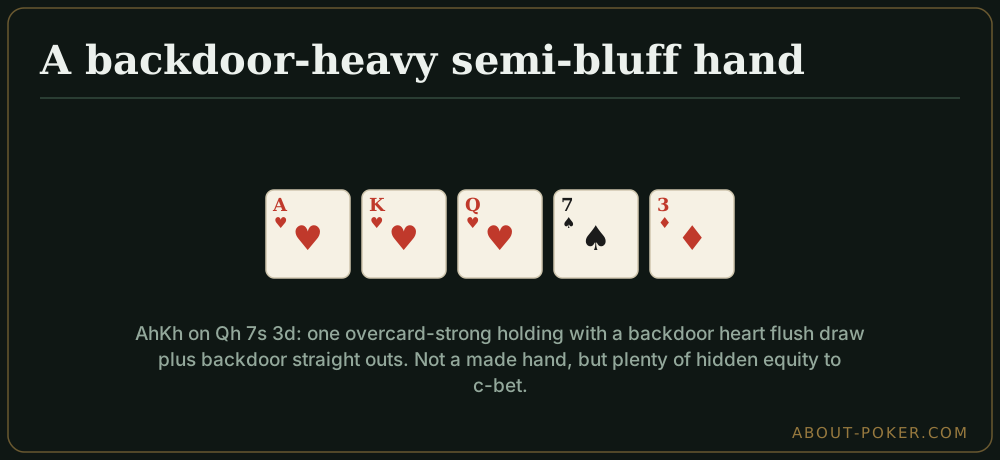
Suppose you hold A♥ K♥ and the flop is Q♥ 7♠ 3♦. You have two overcards (an ace and king that beat the current top pair if they pair up) plus a backdoor heart flush draw plus a backdoor straight draw with the right runners. None of those alone is much, but together they push your hand well past the point where a continuation bet or a call makes sense. The backdoor flush adds a few percent of equity; the backdoor straight adds a bit more; the overcards add more still.
A worked example
You raise with A♣ 5♣ and get called. Flop: K♣ 8♣ 2♦. You have nothing made, but you hold the ace-high flush draw backdoor — wait, two clubs on board plus two in hand means this is actually a live front-door flush draw. Change the board to K♣ 8♥ 2♦: now you hold only one club plus the board’s one club, a true backdoor flush draw, along with an ace overcard and a backdoor wheel straight draw with a 3 and 4.
If you bet and get called, the turn 7♣ gives you a live flush draw and now a real reason to keep firing. That is the backdoor draw “graduating” into a front-door draw — one of the most valuable moments in a hand because your equity jumps and your opponent rarely sees it coming.
How it changes your betting
Backdoor equity is a major reason skilled players continuation-bet so many flops. When you hold overcards plus a backdoor flush or straight, your hand has enough hidden equity to bet as a semi-bluff: you can win the pot immediately when they fold, and you have outs to improve when they call. Boards that give you backdoor draws are good bluffing boards; boards that give you nothing at all are worse.
Common mistakes
Do not call big bets “for the backdoor.” At 4 percent, the pot would need to be enormous to justify it, and it almost never is. The correct way to treat backdoor equity is as a tiebreaker: when you are already close to continuing for other reasons, backdoor draws tip the decision toward playing on. And when a running card does arrive to complete your hand, remember that it is well disguised — opponents rarely put you on runner-runner, so you can often get paid.
Frequently asked
What are the odds of hitting a backdoor flush?
About 4.2 percent, or roughly 1 in 24. You need the turn to give you a fourth card of the suit and the river to give you the fifth, so both streets have to cooperate.
Is a backdoor draw worth chasing?
Never on its own. Backdoor equity is too small to call bets for. It matters as a bonus on top of other reasons to continue, such as overcards, position, or the value it adds to a semi-bluff.
What does runner-runner mean?
Runner-runner means you needed both the turn and the river to make your hand, hitting two perfect cards in a row. A backdoor draw and a runner-runner draw are the same thing.