What Is Big Blind Ante in Poker?
The big blind ante is a single ante posted by the big blind to cover the whole table. Here's how it works, why tournaments use it, and how it affects play.
On this page · 6 sections
The big blind ante is a single ante posted by the player in the big blind that covers the entire table’s ante for that hand. Rather than every player tossing in a small ante each deal, one player posts one larger ante, and that duty rotates around the table along with the button.
The big blind ante was created to fix a practical problem: collecting a small ante from every player every hand slows the game and creates constant disputes over short antes. By concentrating the ante into one post, tournaments deal more hands per hour with far less friction. It is now the standard in nearly every major tournament series.
How the big blind ante works
Each hand, the player in the big blind posts two amounts: their normal big blind, and an additional ante — usually equal to one big blind — that stands in for the whole table’s antes. Both amounts go into the pot. Because the big blind position rotates one seat clockwise every hand, each player pays the full table ante exactly once per orbit, so over a full round everyone contributes the same amount they would under a traditional ante.
For example, at a 500/1000 level with a big blind ante of 1000, the big blind puts in 1000 for the blind plus 1000 for the ante — 2000 total from that one seat. The small blind still posts 500, and no one else antes.
This is simply a streamlined version of the traditional ante: same dead money in the pot, collected from one player instead of nine.
Why tournaments use it
The big blind ante solves three real problems. First, speed: dealers no longer wait for nine separate antes each hand, so tables see more hands per hour. Second, accuracy: there are no more short or missing antes to track and correct. Third, fairness for late arrivals and short stacks, since the ante burden is spread evenly across the orbit rather than nickel-and-diming everyone every hand.
The one wrinkle is short stacks. If a player in the big blind cannot cover both the blind and the full ante, house rules dictate the order in which their chips are applied — most rooms take the ante first, then the blind, or vice versa. Always check the specific tournament’s rules if you are near all-in in the big blind.
Does it change strategy?
For the most part, no. The total dead money in the pot is essentially the same as under a traditional ante, so the strategic consequences are identical: steal the blinds wider from late position, defend your big blind wider because of the improved pot odds, and open more hands from every seat to claim your share of the antes.
The one seat that feels different is the big blind itself. Because you are posting an extra big blind as the ante, you have even more invested in the pot on the hands you are big blind, which strengthens the case for defending — including profitable 3-bet resteals — rather than folding cheaply to a raise.
A worked example
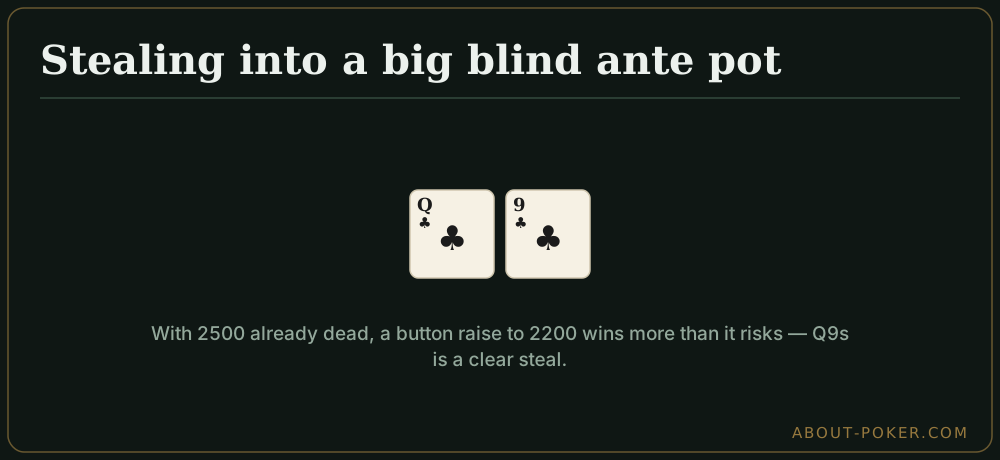
It is nine-handed, blinds 500/1000, with a 1000 big blind ante. The pot starts with 1500 from the blinds plus 1000 from the big blind ante — 2500 chips of dead money before anyone acts. It folds to you on the button with Qc 9c. You raise to 2200. Because 2500 already sits in the middle, a successful steal wins you more than your raise. Both blinds fold and you collect the 2500. That is the same dead-money incentive a traditional ante creates, just gathered from one seat — and it is exactly why late-position aggression pays in big blind ante games. Note how a straddle creates a similar big-pot dynamic in cash games, though it is voluntary rather than structural.
Common mistakes with the big blind ante
- Under-defending your big blind. You have posted an extra big blind as the ante — folding too readily to raises hands that dead money to the raiser.
- Not stealing enough. The pot already holds meaningful dead money each hand; passive late-position play leaves it uncontested.
- Panicking as a short stack in the big blind. Know the rule for how your chips apply when you cannot cover both the blind and ante, so you are not surprised at showdown.
- Miscounting the pot. Beginners forget the extra ante when calculating pot odds. Always include the big blind ante in your dead-money count.
Quick big blind ante checklist
When you sit down in a big blind ante tournament, keep three things in mind: the pot always starts larger than the blinds alone, so steal and defend wider than you would with no ante. Your big blind seat carries extra invested money, so lean toward defending it. And know the house rule for short-stacked big blinds before you get there. Do that and the big blind ante becomes a familiar, profitable part of your tournament game.
Frequently asked
What is a big blind ante in poker?
A big blind ante is a single ante posted by the player in the big blind that covers the entire table's ante for that hand. Instead of every player posting a small ante, one player posts one larger ante, and the responsibility rotates around the table with the button.
How big is the big blind ante?
It is typically equal to one big blind, though the exact size is set by the tournament structure. So in a 500/1000 level with a big blind ante, the big blind posts 1000 as the blind plus 1000 as the ante for the whole table.
Does the big blind ante change strategy?
The total dead money is roughly the same as a traditional ante, so the underlying strategy — steal wider, defend wider, play more aggressively — is unchanged. The main practical difference is that it speeds up dealing and simplifies chip handling.