What Is Backdoor Flush in Poker?
A backdoor flush needs both the turn and river to be your suit. Learn the real 4.2% odds, how backdoor equity affects betting, and when it matters.
On this page · 6 sections
A backdoor flush — also called a runner-runner flush — is when you have exactly three cards of one suit after the flop and would need both the turn and the river to be that same suit to complete the flush. Because two streets in a row have to cooperate, it is a genuine long shot. But backdoor flush equity quietly shows up in a huge number of hands, and knowing how to value it separates disciplined players from ones who chase ghosts.
What a backdoor flush actually is
To have a backdoor flush draw you need three cards of a suit on the flop: usually two in your hand and one on the board, or one in your hand and two on the board. That leaves you two suited cards short of a five-card flush. The turn must bring a fourth card of the suit, and only then does the river have a chance to bring the fifth.
Compare that to a normal flush draw, where you already have four to the flush and a single card finishes it. A backdoor flush is one full step further back. That is why the word “backdoor” fits: you are not walking in the front door with an obvious draw, you are sneaking in through two running cards nobody expects.
The real odds
Here is the number that keeps backdoor flushes honest. Starting from three cards of a suit, the chance to complete is about 4.2 percent, or roughly 1 in 24. The math is simple. There are 10 remaining cards of your suit among the 47 unseen cards, so the turn hits about 21 percent of the time (10 ÷ 47). If it does, 9 suit cards remain among 46 unseen, so the river hits about 20 percent (9 ÷ 46). Multiply 0.21 by 0.20 and you get about 0.042 — 4.2 percent.
That means you miss a backdoor flush more than 95 percent of the time. As a standalone reason to continue, it is close to worthless. The value lives entirely in how it stacks with other equity.
Why it still matters: equity stacks
If it completes so rarely, why do strong players care? Because a backdoor flush is almost never a reason to continue by itself, but it is a real reason when it is added to something else.
Say you raise with A♥ K♥ and the flop is Q♥ 7♠ 3♦. You have two overcards (an ace and king that beat top pair if they pair), a backdoor flush draw in hearts, and a backdoor straight draw. None of those alone is much. Together they push your hand past the threshold where a continuation bet makes clear sense. The backdoor flush adds roughly 4 percent, the backdoor straight adds a bit more, and the overcards add the most — and the whole thing adds up to a comfortable semi-bluff.
A worked example
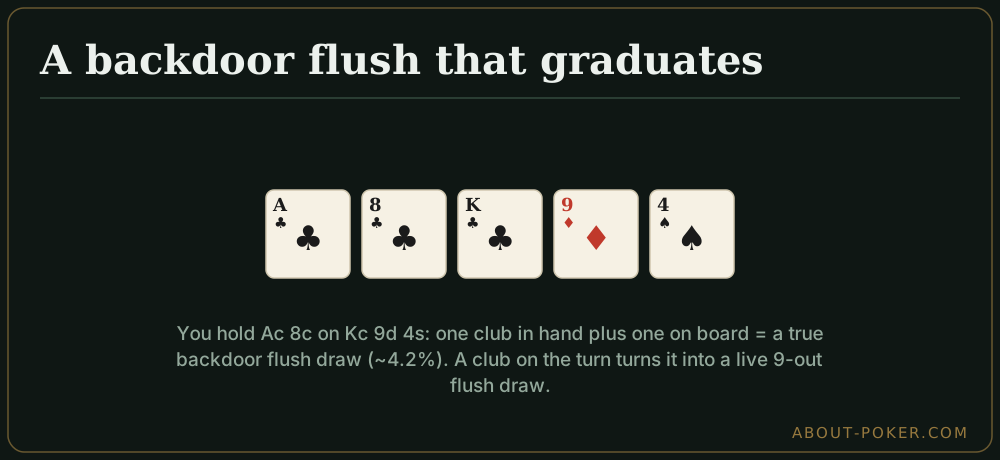
You open A♣ 8♣ and get one caller. The flop comes K♣ 9♦ 4♠. You have one club in hand and one on the board, so this is a true backdoor flush draw plus an ace overcard. On its own you have missed the flop, but you still have a small c-bet with hidden equity.
Now the turn is the 6♣. You suddenly hold a live, front-door flush draw with nine outs — jumping from about 4 percent equity to roughly 19 percent for the river alone, and more if your ace is also good. That moment, when a backdoor flush “graduates” into a real draw, is one of the most valuable in poker: your equity spikes and your opponent rarely sees it coming, so when you complete on the river you often get paid in full.
How it changes your betting
Backdoor flush equity is a big reason skilled players fire so many flop c-bets. When your hand has overcards plus a backdoor flush, you can bet as a semi-bluff and win two ways: opponents fold now, or you catch running cards later. Boards that give you a backdoor flush are good bluffing boards; bone-dry boards with none of your suit are worse. This is closely related to how a continuation bet leans on hidden equity rather than made hands.
Common mistakes
The biggest error is calling meaningful bets “for the backdoor flush.” At 4 percent, the pot would have to be enormous to justify it, and it almost never is. Treat backdoor flush equity as a tiebreaker: when you are already close to continuing for other reasons, it tips the decision toward playing on. Also do not confuse it with a regular backdoor draw that runs to a straight — the flush version needs three matching suits on the flop, not connected ranks. And when the running cards do arrive, remember the payoff: a completed backdoor flush is beautifully disguised, so bet it for value.
Frequently asked
What are the exact odds of hitting a backdoor flush?
About 4.2 percent, or roughly 1 in 24. You need the turn to be one of your ten remaining suit cards (about 21 percent) and then the river to be one of the remaining nine (about 20 percent). Multiplied together that's roughly 0.042.
Should I ever call a bet just for a backdoor flush?
No. On its own a backdoor flush is far too weak to call for. It only matters as extra equity stacked on top of other reasons to continue, like overcards, position, or a semi-bluff.
What is the difference between a backdoor flush and a flush draw?
A flush draw is one card away from completing, so any single turn or river of your suit finishes it. A backdoor flush is two cards away and needs both the turn and river to be your suit, making it far less likely.