What Is Chip Dumping in Poker?
Chip dumping is deliberately losing chips to another player, a banned form of collusion. Learn how it works, why it is cheating, and how sites detect it.
On this page · 6 sections
Chip dumping is deliberately losing your chips to another player. Instead of trying to win, a colluder makes plays designed to hand value to a partner: shoving all-in with a hopeless hand into their teammate, or folding a monster so the other player scoops the pot. The chips move exactly as intended, from one account to another, with no honest contest behind the transfer.
It is one of the clearest forms of cheating in poker. Because chips represent real money, dumping them is really a way to move funds or manipulate standings under the cover of “just losing hands.” Every legitimate online site and every reputable card room bans it, and the penalties are severe.
Why chip dumping is cheating
Poker only works when every player is trying to win. Chip dumping breaks that foundation. The dumper is not playing the game; they are running a covert transfer disguised as bad luck or bad play. That distorts pots, tournament stacks, and the money flowing through the ecosystem.
The most common motives all share the same dishonest core. Some players dump chips to move money to a partner while sidestepping deposit or withdrawal limits. Some do it to launder funds through a poker account. In tournaments, teammates dump chips to build one player into a dominant stack that improves their shared equity. Others settle off-the-books debts by “losing” a hand on purpose. In every case, real players at the table are cheated, and the site’s integrity is undermined.
How it looks at the table
Chip dumping tends to produce plays that make no strategic sense unless you know the goal is to lose.
- A player open-shoves a huge stack with a hand like 7-2 offsuit, and only their partner calls.
- A player folds the nuts on the river after their teammate bets, giving up a certain-win pot.
- The same two accounts keep ending up heads-up in large pots, with chips reliably flowing one direction.
- Bizarre bet sizing appears only when the two suspected colluders are in a hand together, and vanishes otherwise.
To an observer, one player seems to be playing terribly and losing to the same opponent again and again. That repetition, not any single hand, is the giveaway.
Worked example: a tournament dump
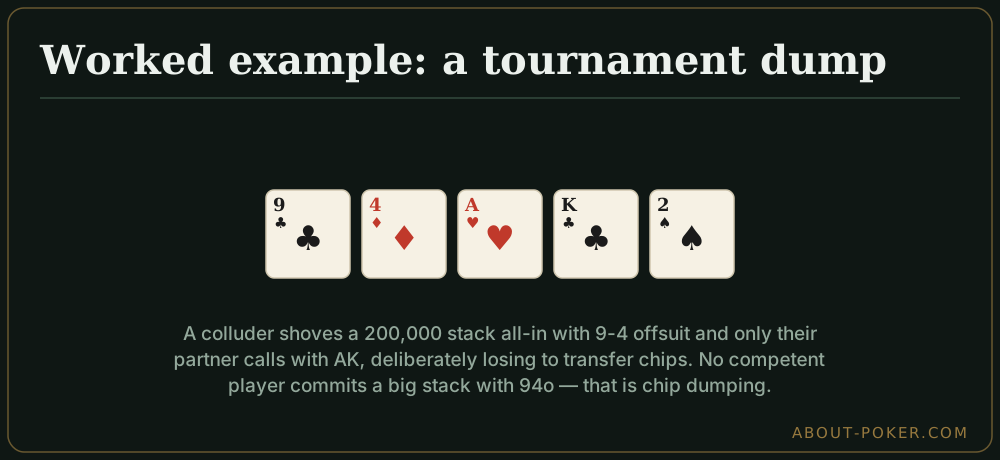
Imagine two colluding players deep in an online tournament. Player A holds a big stack of 200,000 chips; Player B, the intended beneficiary, has 60,000. They want to consolidate into one large stack to increase their combined chance of a top payout.
A limps, B raises, and A shoves all-in for 200,000 holding 9c 4d — a hand no competent player commits a big stack with. B “calls” with Ah Kc. The board misses everyone and A’s nine-high loses. Just like that, 200,000 chips move from A to B, who now sits on 260,000. On the surface it reads as a reckless bluff gone wrong. In reality it was a planned transfer, and the honest players at the table just lost equity to a stack that was inflated by cheating rather than by winning.
How sites detect and punish it
Modern poker operators run automated integrity systems that watch for exactly these patterns: repeated large transfers between the same pair of accounts, all-ins with dreadful holdings, folding clear winners, and unusual bet sizing that only appears between two specific players. They also cross-reference off-table data — shared IP addresses, devices, payment methods, and login times — to link colluding accounts.
Flagged hands go to a security team for review. When chip dumping is confirmed, sites typically confiscate the transferred chips, void any related winnings, freeze and refund affected players where possible, and permanently ban every account involved. In regulated markets they can also report the activity to gaming authorities. The takeaway for honest players is reassuring: the behavior leaves a heavy statistical fingerprint and is one of the more reliably caught forms of cheating.
How chip dumping differs from angle shooting
It is worth separating chip dumping from angle shooting. Angle shooting bends the rules to gain an unfair edge while technically staying inside them — think ambiguous chip declarations or fake folds. Chip dumping is not a gray area at all. It is outright collusion and fraud, with no rule-technicality defense. One is unsporting; the other is flatly cheating.
Keep going
Chip dumping is the kind of term most honest players only need to recognize, not use — knowing what it looks like helps you understand why sites scrutinize odd all-ins and lopsided transfers. If you ever see the same two players moving chips one direction on nonsense hands, that is what you are watching. For a related but distinct form of misconduct, read about angle shooting, and browse the full poker glossary for more of the game’s vocabulary.
Frequently asked
What is chip dumping in poker?
Chip dumping is deliberately losing chips to another player, usually by making obviously bad bets or folding winners, to transfer value between accounts. It is a form of collusion and is banned on every legitimate poker site and in card rooms.
Is chip dumping cheating?
Yes. Chip dumping is a serious integrity violation because it lets players collude to move money, boost a partner's stack in a tournament, or launder funds. Sites confiscate the chips, void winnings, and permanently ban the accounts involved.
Why would someone dump chips?
Common reasons include transferring money to a partner while dodging withdrawal limits, laundering funds, boosting a teammate's stack in a tournament, or paying off a debt off the books. All of these are prohibited and detectable.
How do poker sites detect chip dumping?
Sites use software that flags suspicious patterns — repeated large transfers between the same accounts, all-ins with terrible hands, folding the nuts, or shared IP addresses and payment methods. Flagged hands are reviewed by security teams.