What Is Cold Four-Bet in Poker?
A cold four-bet is 4-betting with no prior money in the pot, over a raise and a 3-bet. Learn what a cold 4-bet is, ranges, and when to make one.
On this page · 6 sections
A cold four-bet is making the fourth bet of a preflop raising war when you have not yet voluntarily put money in the pot. The sequence runs: one player opens (the first bet), a second player 3-bets (the third bet), and then you — fresh from behind, with no prior chips in — make the 4-bet. The word cold signals that you are entering the fight cold, having neither raised nor called earlier in the hand.
That “cold” part is what makes the play so powerful. A normal 4-bet comes from the original raiser, whose range is already wide from opening. A cold 4-bet comes from a player who woke up with a hand after seeing an open and a 3-bet — a much rarer, much stronger event.
Why the Cold Four-Bet Is So Strong
Think about what has to happen for you to cold 4-bet. Two players ahead of you have already shown strength — one opened, one re-raised — and you are choosing to raise over both of them with money you have not committed. You are not “defending” a previous investment; you are voluntarily building a huge pot from scratch against two ranges that are already above average.
Because of this, a cold 4-bet range is extremely tight and polarized. It is dominated by premiums — typically QQ+ and AK — with only a sprinkling of bluffs. Opponents know this too, which is exactly why the play generates so many folds: your line screams “monster.” A cold 4-bet is a much stronger statement than a light 3-bet, which can be far wider.
A Worked Example
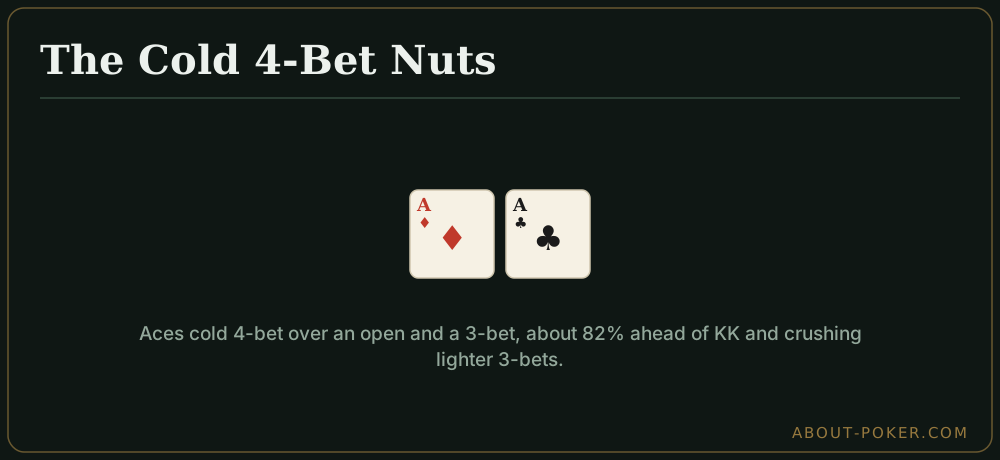
You are on the button in a $2/$5 game with A♦A♣. The cutoff opens to $15 and the hijack 3-bets to $50. The action folds to you. You have put in nothing yet — this is a cold spot.
You cold 4-bet to $130. Against a typical 3-betting range, aces are a huge favorite: AA beats KK about 82% of the time and dominates AK, QQ, and lighter 3-bet bluffs even more. When the cutoff folds and the hijack 4-bet-shoves with KK, you snap-call as a big favorite. The cold 4-bet built the biggest possible pot in the one spot where you most want the money in — and its rarity got you paid.
Cold 4-Bet Value vs. Bluff
Like any polarized action, a strong cold 4-bet strategy is not only premiums — it needs a few bluffs so observant opponents cannot simply fold everything but aces and kings.
- Value combos: QQ, KK, AA, and AK make up the core. These want the money in and are happy to get 5-bet shoved on.
- Bluff combos: the best are blocker hands like A5s or A4s. The ace blocks the opponent’s AA and AK, cutting down their value range, and the suited wheel ace keeps a little playability if called.
Keep the bluffs sparse. Because a cold 4-bet folds out so much, you do not need many bluffs to stay balanced — a rough ratio of two value combos to one bluff is a sane starting point at typical stack depths.
Common Mistakes
- Cold 4-betting too wide. This is not the spot for hero aggression. Against two shown-strong ranges, a loose cold 4-bet gets you stacked by the value hands that call.
- Never having bluffs. If you only cold 4-bet AA and KK, good players fold everything and you never get paid on your bluffs — or your value. A few blocker bluffs keep you honest.
- Bluffing without blockers. Cold 4-betting 76s as a bluff is far worse than A5s: it blocks none of their premiums and folds out worse.
- Ignoring stack depth. Short-stacked, cold 4-betting usually means you are committed. Deep-stacked, you have more room to bluff and to fold to a 5-bet.
How Position and Opponents Change It
Position matters because a cold 4-bet from the blinds is even stronger and tougher to balance than one on the button, where you keep a positional edge postflop if called. In the blinds, lean value-heavy.
Opponents matter most of all. Against a tight 3-bettor, their re-raise range is already premiums, so cold 4-bet bluffs rarely fold out enough to profit — go value-only. Against a light 3-bettor who re-raises air, a cold 4-bet bluff picks up a rich, folding-heavy pot, and you can add a few more blocker bluffs.
Quick Checklist Before You Cold 4-Bet
- Am I entering cold, with no prior money in the pot? That is what defines the play.
- Is my hand a genuine premium (QQ+, AK) — or a deliberate blocker bluff (A5s)?
- Does the 3-bettor’s range fold enough to my raise for a bluff to profit?
- Am I prepared for a 5-bet shove, and is my stack depth right for the play?
The cold 4-bet is one of poker’s loudest actions. Reserve it for genuine monsters and a handful of well-chosen blocker bluffs, respect how much strength it represents, and you will pick off aggressive 3-bettors while getting maximum value from your very best hands.
Frequently asked
What is a cold four-bet in poker?
A cold four-bet is making the fourth bet preflop when you have not yet put money in the pot voluntarily. Someone opens, someone else 3-bets, and you 4-bet cold from behind with no prior investment. The word cold means you enter the raising war fresh, without having raised or called earlier in the sequence.
Is a cold four-bet strong?
A cold four-bet is one of the strongest signals in poker. Because you are raising over both an open and a 3-bet with no prior money committed, your range is heavily weighted toward premium hands like QQ+ and AK, plus a small number of bluffs. Most opponents give it enormous respect and fold everything but the top of their range.
What hands make a good cold 4-bet bluff?
Good cold 4-bet bluffs are hands with blockers that reduce the opponent's value combos and that can still make a hand if called, such as A5s or AXs. The ace blocks their AA and AK, and the suited wheel ace retains playability. You bluff sparingly because a cold 4-bet folds out most of their range.